The Journal
The ZATCA Invoice Gap Saudi Retailers Fill With Headcount
Saudi retailers are absorbing ZATCA Phase 2 invoice exceptions as a staffing cost rather than automating them. Here is what that compliance gap actually costs at scale.
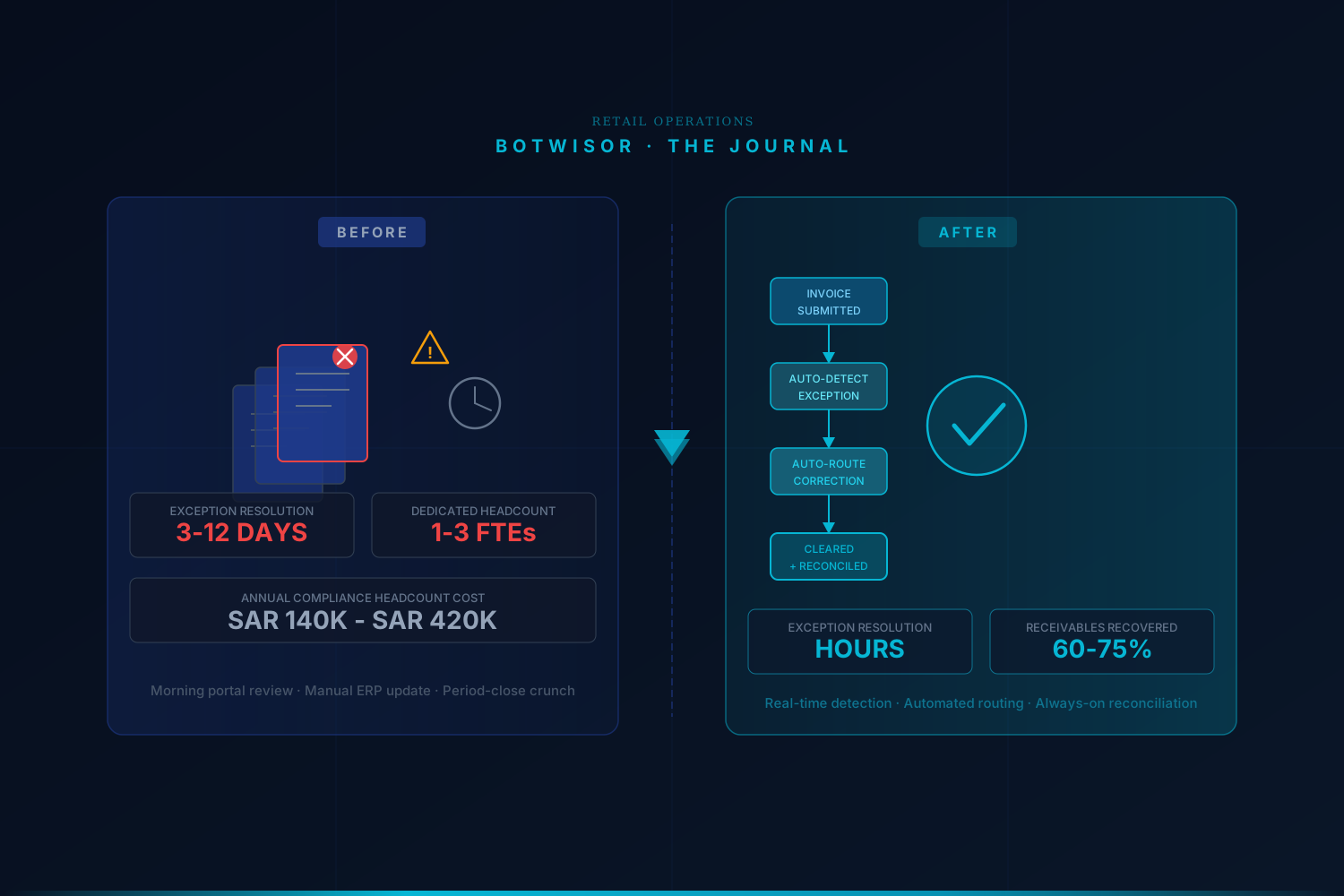
Saudi retailers processing thousands of B2B invoices each month are absorbing ZATCA Phase 2 compliance the same way they handle most manual processes: by assigning staff to it. Each exception queue gets a dedicated reviewer. The compliance cost scales with invoice volume, grows with the business, and cannot be cut without creating audit risk.
What Does ZATCA Phase 2 Require of Saudi Retailers?
Saudi Arabia's ZATCA (Zakat, Tax and Customs Authority) has rolled out Phase 2 of its e-invoicing mandate in waves since 2022, reaching large enterprises first and extending to mid-market businesses through 2024 and 2025. The requirement goes beyond issuing digital invoices. Every tax invoice must be cleared through ZATCA's FATOORAH portal, in real time or near-real time, before it reaches the buyer.
A cleared invoice is a legal document. A buyer cannot book an uncleared or rejected invoice in their accounts payable system, and cannot claim input VAT on it. This is not a procedural nicety: it is built into Saudi tax law.
For a retailer with a wholesale division, franchise partners, or a corporate sales channel, this means tens of thousands of invoices per month entering a clearance queue, each capable of being rejected for reasons ranging from a mismatched tax registration number to an incorrect VAT calculation. Every rejection triggers a correction cycle. The correction cycle requires a person.
Where Does the Exception Gap Show Up?
In most Saudi retail finance operations without ZATCA automation, the exception gap appears in three regular patterns.
The daily portal review. A finance officer opens the FATOORAH portal each morning to check for overnight rejections. Depending on invoice volume, this takes between 45 minutes and three hours, every working day. Rejected invoices are logged in a shared spreadsheet or email thread, then assigned for correction.
The cross-system correction loop. Rejections almost always point to a mismatch between what the billing or ERP system generated and what ZATCA expects. The correction requires identifying the error in the source system, updating the record, regenerating the invoice, and resubmitting it to FATOORAH. If the ERP is not directly integrated with the portal, each step is a manual operation. If integration exists but was not designed to handle exceptions, the resubmission is still a human task.
The period-close reconciliation. At month end and quarter end, finance teams reconcile what was submitted, accepted, rejected, and corrected. For a retailer generating 10,000 invoices per month, this reconciliation takes several days before the books can close, consuming the final week of the reporting period in high-volume months.
None of these tasks require expertise that is hard to find. All of them require consistent, uninterrupted attention. Saudi retail finance teams solve this by permanently allocating one or more employees to the function.
What Does the Manual Exception Cost Look Like?
A Saudi retailer with annual B2B revenue between SAR 60 million and SAR 180 million typically processes between 4,000 and 20,000 invoices per month, depending on average transaction size and the mix of corporate and wholesale customers.
At a 2 to 5 percent rejection rate, common in the first two years after ZATCA onboarding, the team handles between 80 and 1,000 exception events monthly. Each exception requires 20 to 45 minutes to diagnose, correct, and resubmit. At the lower end, one accounts receivable clerk handles little else. At the upper end, two to three finance team members are dedicated to the function.
The fully loaded cost of that headcount, including salary, employment contributions, and management overhead, runs between SAR 140,000 and SAR 420,000 per year. That cost exists entirely because the exception queue exists. It generates zero revenue. It does not improve vendor relationships or reduce cost of goods. It is the price of a compliance process that has not been automated.
| Manual ZATCA Compliance | Automated ZATCA Compliance | |
|---|---|---|
| Exception detection | Daily morning portal review | Real-time flag on every submission |
| Correction workflow | Manual ERP update, staff resubmits | Automated routing to correction queue |
| Period-close reconciliation | Multi-day crunch, manual matching | Continuous, auto-reconciled |
| Dedicated headcount | 1 to 3 FTEs | Redeployed to higher-value work |
| Audit trail | Spreadsheet logs, portal exports | System-generated, always current |
| Exceptions missed | Proportional to staff availability | Near-zero, full exception capture |
| Cash collection delay per exception | 3 to 12 working days | Hours to 1 working day |
How Does the Headcount Trap Work?
The instinct when an exception queue grows is to hire someone to clear it. Saudi retail finance teams have been doing this since Phase 2 launched. The problem is that invoice volume grows with revenue, and the exception queue grows with invoice volume. The headcount required to manage exceptions scales directly with the business.
This creates a structural cost that cannot be reduced without accepting compliance risk. Cutting staff to clear the exception queue means slower resolution, more outstanding rejections, and higher audit exposure. Keeping the staff means the compliance cost is permanent and proportional to business scale.
The second problem is availability. Manual exception resolution cannot run overnight, over weekends, or through public holidays. Corporate buyers who receive ZATCA-rejected invoices on a Thursday will not have them resolved until the following week. Finance teams that cannot operate continuously arrive at the start of each week with a backlog of unresolved exceptions from the preceding days.
The combination of scaling cost and availability gaps creates a compliance posture that becomes more expensive and more fragile as the business grows.
What Is the Cash Collection Knock-On?
The receivables impact of unresolved ZATCA exceptions is often larger than the headcount cost, but it is harder to see directly on a P&L.
When a rejection is not resolved within 24 to 48 hours, the buyer's accounts payable team cannot process payment. Saudi corporate buyers are increasingly rigorous about ZATCA status. Procurement departments at large Saudi companies routinely delay payment, or return invoices outright, when clearance status is unclear. Finance teams at those buyers have no incentive to process an invoice that may expose them to a VAT compliance issue.
For a retailer with SAR 12 million in monthly B2B receivables and an average exception resolution time of five working days, the receivables tied up in unresolved exceptions at any point can reach SAR 1.5 million to SAR 2 million. This is earned revenue that cannot be collected until the compliance queue clears. Finance teams that automate exception handling consistently report this figure drops by 60 to 75 percent, because the correction cycle collapses from days to hours.
That receivables improvement is not a cost saving: it is cash recovery. For a retailer carrying SAR 1.5 million in stuck receivables at an average finance cost of 6 to 8 percent per year, the carrying cost of those exceptions runs SAR 90,000 to SAR 120,000 annually, on top of the headcount dedicated to resolving them.
What Changes When Exception Handling Is Automated?
Automation does not remove the need for human judgement in ZATCA compliance. It removes the need for humans to perform detection, routing, and resubmission tasks that currently consume most of the compliance team's time.
In a retailer that has automated ZATCA exception management, the workflow changes in three specific ways. Rejections are detected immediately rather than the following morning. Correction routing happens through a predefined workflow rather than a person deciding what to do with each error. Resubmission to FATOORAH is triggered automatically once the correction is confirmed, rather than waiting for staff capacity.
The finance team still reviews correction categories, monitors exception patterns, and escalates anything the system cannot resolve. But the daily portal review disappears. The period-close reconciliation shrinks from days to hours. The staff previously dedicated to exception clearing redeploys to accounts receivable follow-up, reporting analysis, or commercial finance work.
The result is a compliance function that operates continuously, catches every exception on the day it occurs, and resolves most of them without a person being assigned to the task.
The Vision 2030 Context
ZATCA's e-invoicing programme is expanding in scope and matching capability as Saudi Arabia builds out its digital tax infrastructure. The Phase 2 rollout that reached large enterprises first will extend further, and ZATCA's ability to cross-reference invoice data with other tax and customs records will grow over time.
Retailers that automate ZATCA compliance now build integration infrastructure that absorbs future requirements without fresh hiring rounds. Retailers still managing exceptions manually when the next wave of requirements arrives will face a wider compliance gap at a higher compliance volume, with a staffing model that was already at capacity.
The question is not whether the current exception process is acceptable. The question is what it costs to maintain it, and what that cost buys.
Book a free automation audit to see exactly what ZATCA compliance is costing your finance team, and where automation closes the gap.