
The Journal
The Days Saudi Retailers Lose Between Vendor Contract and First Sale
Saudi retailers typically wait 4 to 8 weeks between signing a new vendor contract and generating the first sale from that vendor's products. The delay costs real revenue and burns seasonal windows that never come back.
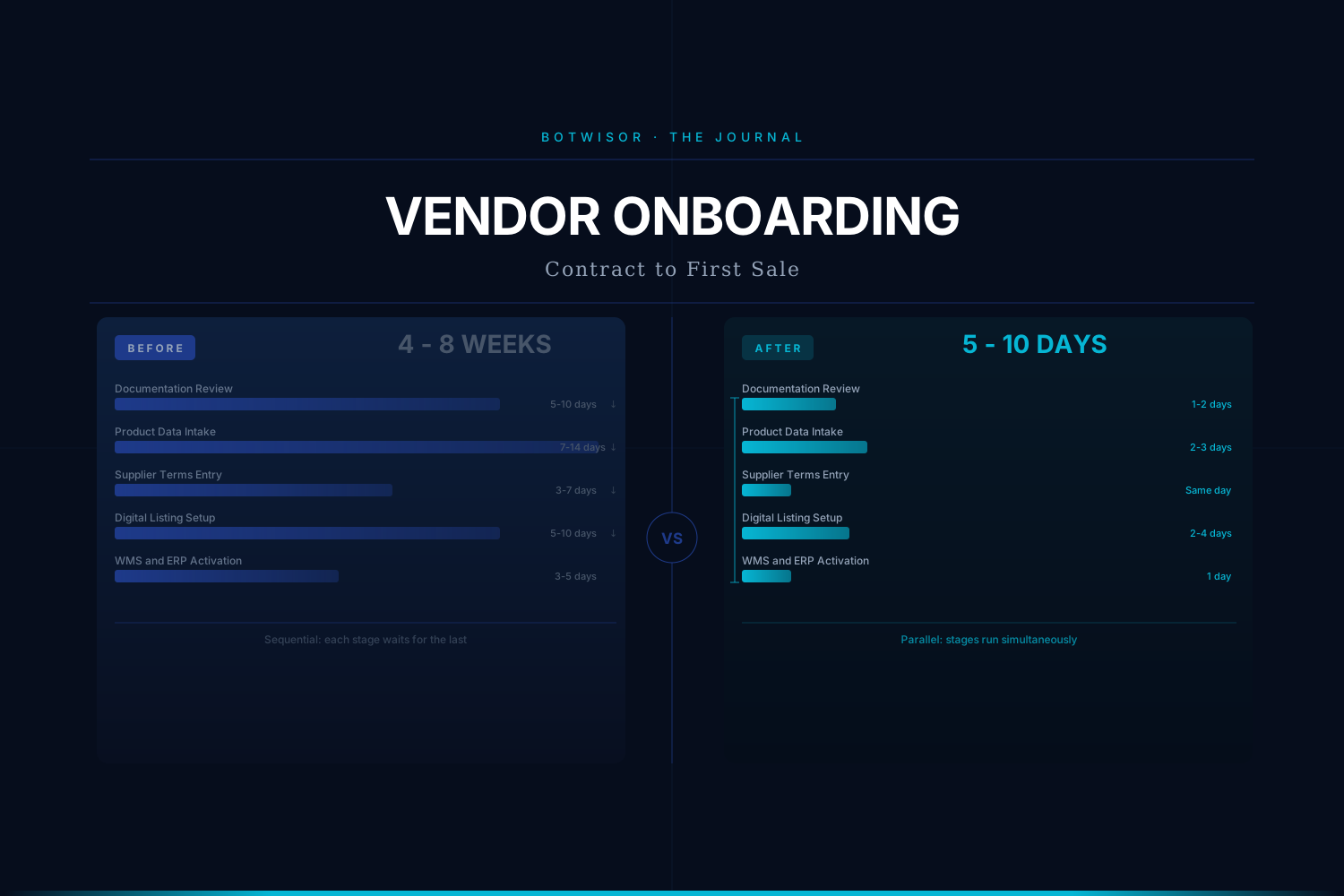
Saudi retailers typically lose 4 to 8 weeks between signing a new vendor agreement and generating the first sale from that vendor's products. The gap is not a negotiation problem or a logistics problem. It is an operations problem: manual document handling, email-routed approvals, and disconnected systems that extend the launch window one slow handoff at a time.
Why Does New Vendor Onboarding Take So Long?
Every new vendor relationship requires a predictable sequence of steps before a product can be sold. The sequence itself is not complex. What makes it slow is that each step, in most Saudi retail operations, is handled manually and in isolation from every other step.
Vendor documentation arrives by email: commercial registration certificate, trade registration, IBAN details, product liability declarations, and insurance certificates. Someone in procurement reviews and files them. That review has no system-enforced SLA. It advances when a person has capacity, which means it waits in the inbox when that person is occupied elsewhere.
Product data follows a separate track. The vendor submits a price list and SKU catalogue, typically in a spreadsheet that does not match the retailer's master product template. A category manager translates it, assigns taxonomy codes, adds margin tiers, and routes it for commercial review. Missing fields, inconsistent unit-of-measure notation, and Arabic versus English description mismatches add days or send the file back to the vendor for corrections.
Supplier terms go through a parallel but disconnected channel. Payment period, co-op marketing allocation, promotional commitment, and return policy are agreed commercially, then entered into the ERP or buying system by a finance or commercial analyst, sometimes days after the commercial conversation concludes.
Warehouse and digital system activation comes last. The WMS needs the vendor's products registered before receiving a first shipment. The ERP needs the vendor as a confirmed supplier record. If the brand will sell through a digital storefront, product listings require photography approval, Arabic and English copy, and category placement. None of this runs in parallel with the document review or data intake; each track waits for the prior one to close.
What Does the Manual Timeline Look Like?
A mid-sized Saudi retailer bringing on a new consumer brand moves through a recognisable sequence. The commercial team closes terms in week one. Then the delays compound.
Documentation sits in a shared email inbox until someone schedules a review meeting. Product data arrives in an incompatible format and returns to the vendor for corrections. The corrected version arrives five to seven days later, sometimes with additional fields missing. Finance enters supplier terms into the ERP and discovers that the agreed payment period conflicts with the system template, requiring an override and a second approval. The category team uploads product descriptions for digital listing and finds that the vendor's image files are below the platform's resolution requirement. The vendor delivers replacement files ten days later.
By the time the first shipment is received and confirmed in the WMS, six to eight weeks have passed since contract signature. The products are live. The vendor relationship survived. But between four and six weeks in which those products could have been generating revenue were spent in the onboarding queue.
| Stage | Manual Process | Typical Duration |
|---|---|---|
| Documentation review | Email receipt, manual checklist, filing | 5 to 10 days |
| Product data intake | Spreadsheet translation, category review, corrections | 7 to 14 days |
| Supplier terms entry | Finance team ERP entry, approval routing | 3 to 7 days |
| Digital listing setup | Photography check, copy upload, category approval | 5 to 10 days |
| WMS and ERP activation | IT or system admin task, sequential to above | 3 to 5 days |
| Total (sequential) | End to end, stages waiting on each other | 4 to 8 weeks |
What Does the Launch Lag Actually Cost?
The direct cost is measured in sales days. A new vendor expected to contribute SAR 120,000 per month in product sales loses the equivalent of SAR 30,000 to 60,000 in revenue for every two to four weeks the onboarding extends beyond the minimum feasible timeline. For a retailer managing 12 to 20 new vendor relationships per year, the aggregate launch lag represents a recurring revenue gap that never appears on a single report, because it is impossible to track sales that never started.
The seasonal cost compounds the direct revenue loss. Saudi retail concentrates heavily around Ramadan, the two Eids, and the National Day period. Roughly 40 to 50 percent of annual revenue in categories including fashion, home goods, and electronics lands in these windows. A vendor contract signed in January with the intention of capturing Ramadan placement often misses the campaign window entirely if the onboarding runs on an unmanaged manual timeline.
Category managers know this. They compensate by signing vendor contracts three to four months before seasonal peaks, which extends the commercial cycle without solving the operational bottleneck. The symptom is managed; the cause is not addressed.
Vendor relationships carry a cost too. A supplier who signs a retailer agreement and waits eight weeks for activation is simultaneously evaluating competing retail partners. In a Saudi market where international and regional brands have more retail options than they did five years ago, onboarding friction influences the quality of co-op and promotional support a vendor commits to a given retailer. The retailer that activates a vendor in ten days occupies a better position in that vendor's commercial planning than the one that takes eight weeks.
Why Vision 2030 Retail Growth Makes This Urgent
Saudi Arabia's retail sector is expanding across formats and categories under Vision 2030. New entertainment retail destinations, urban development projects in Riyadh and Jeddah, and a sustained rise in e-commerce penetration have increased the pace at which retailers are forming new vendor relationships, entering new categories, and expanding SKU range.
In this environment, onboarding velocity becomes a direct competitive variable. A retailer that can activate a new vendor in seven to ten days can build a wider assortment and respond to category trends faster than one operating on a six-week cycle. On digital channels, including Noon, Amazon.sa, and branded storefronts, assortment breadth directly influences search placement, discovery, and customer acquisition cost. The retailer with the fresher, wider, more complete catalogue captures organic visibility that the slower onboarding competitor cedes.
The growth in cross-border brand entry into Saudi Arabia has also increased the volume of new vendor relationships that retailers manage simultaneously. The bottleneck is increasingly on the retailer's operational side, not the vendor's willingness to enter the market.
What Changes When Vendor Onboarding Is Automated?
When vendor onboarding runs through an automated pipeline, the sequential handoffs that extend the timeline become parallel tracks with enforced SLAs.
Documentation is submitted through a structured intake form that validates completeness at submission, not at review. Missing fields are flagged immediately, before the review clock starts. The reviewer receives a complete file rather than an email chain with attachments to chase.
Product data intake uses a standardised mapping layer that translates the vendor's SKU catalogue into the retailer's master product format automatically, flagging exceptions for human attention rather than routing the entire file back for manual correction. The category manager reviews a clean exception list in hours, not a raw spreadsheet over several days.
Supplier terms entered by the commercial team flow directly into the ERP via an integration, triggering a finance approval queue rather than a separate data-entry task. Digital listing setup begins as soon as product data is clean, running in parallel with WMS registration rather than after it completes.
| Stage | Automated Pipeline | Typical Duration |
|---|---|---|
| Documentation review | Structured intake, auto-validation at submission | 1 to 2 days |
| Product data intake | Template mapping, automated exception flagging | 2 to 3 days |
| Supplier terms entry | Commercial-to-ERP integration, triggered approval | Same day |
| Digital listing setup | Runs in parallel with WMS registration | 2 to 4 days |
| WMS and ERP activation | Triggered on approval confirmation | 1 day |
| Total (parallel) | Stages overlapping, no sequential waits | 5 to 10 days |
The approvals, the reviews, and the human judgements remain. What changes is that the time between those judgements compresses from days to hours, and the process does not stall because a single person is managing a backlog or out of office.
Retailers running automated onboarding bring new vendors live in 5 to 10 days against a 6-week manual baseline. That difference, across 12 to 20 new vendor relationships per year, represents several hundred additional selling days that the manual baseline leaves permanently unused.
The question is not whether the current timeline is acceptable. For most operations, it has simply never been measured against its real cost.
Book a free automation audit to see where your vendor onboarding pipeline is adding weeks it does not need to add.