
The Journal
What Saudi Developers Lose When Subcontract Claims Go Unverified
Unverified subcontract claims are a hidden margin drain for Saudi developers. Here is what the gap between claimed and owed actually costs.
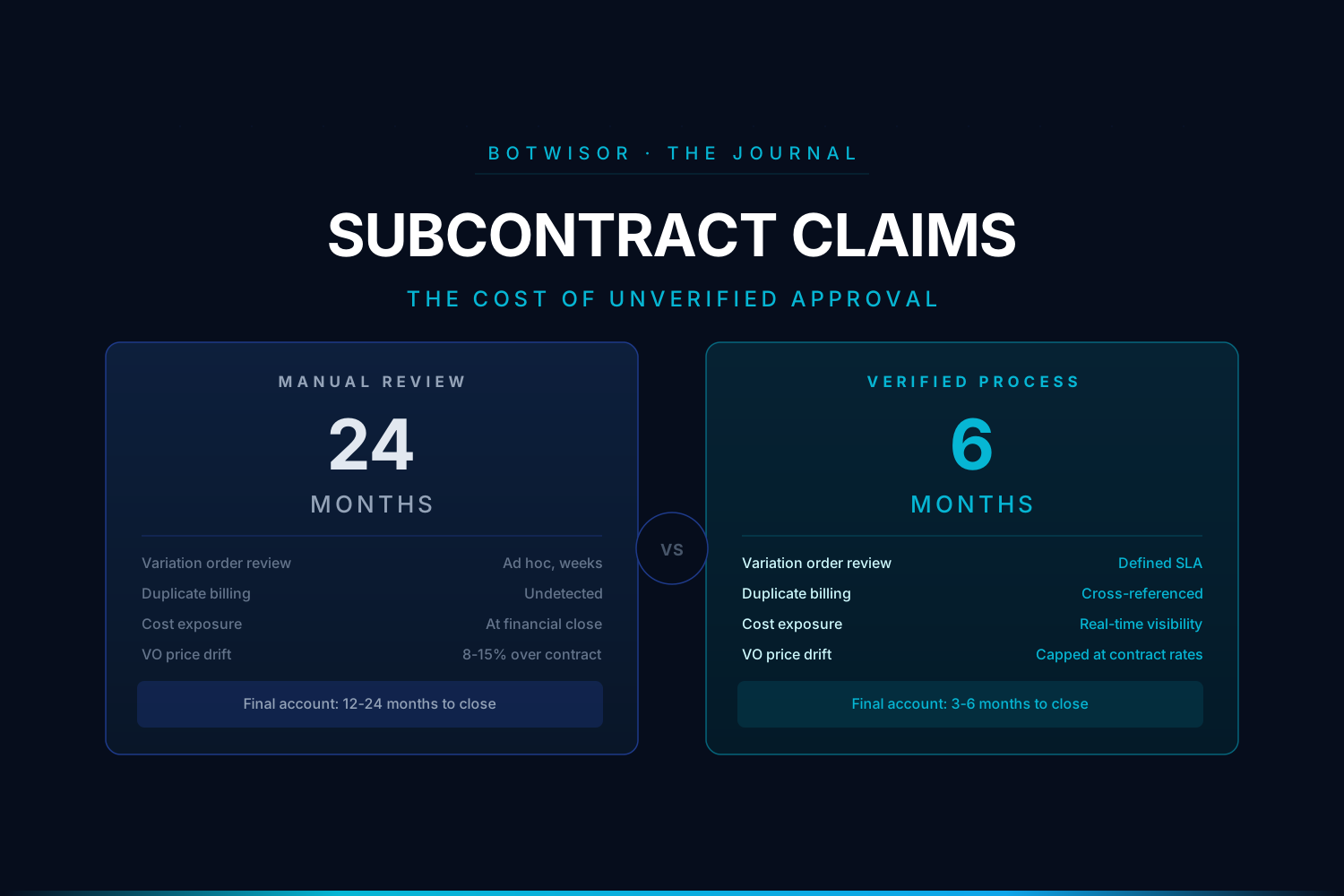
On a typical Saudi construction project, subcontractor payment claims arrive in waves: monthly progress applications, variation orders, prolongation notices, and retention release demands. Each one requires verification. Most Saudi developers lack the operational infrastructure to review these claims systematically, and the gap between what is claimed and what is owed quietly compounds into losses that only surface at final account.
Why Claim Verification Breaks Down at Scale
Saudi construction has entered an era of scale that its operational processes have not kept pace with. Giga-projects such as NEOM, The Red Sea Project, and Diriyah Gate involve hundreds of subcontract packages running simultaneously, each with its own contract terms, milestone schedule, and variation regime.
A main contractor or developer coordinating fifty active subcontracts receives hundreds of payment applications per month. Each application may contain several line items for varied or additional work. Verifying a single variation order properly (confirming scope, checking rates, and validating time impact) typically takes between two and six hours of a commercial manager's time when records are clean. When records live across email inboxes and shared drives, the process gets compressed or skipped entirely.
The outcome is not that developers refuse to pay. It is that developers pay without knowing whether what they are paying is correct.
What Unverified Claims Actually Cost
The financial exposure from unverified subcontract claims concentrates in four areas.
Variation order inflation. Subcontractors submit variations in good faith, but pricing does not always align with original contract rates. On complex builds, variation pricing can drift well above benchmark costs when there is no systematic review. Across a large Saudi residential or mixed-use project, this drift typically adds between 8 and 15 percent to subcontract out-turn costs.
Prolongation claims. When a subcontractor argues that delays outside their control entitle them to additional standing time, the resulting claims can be substantial. Without contemporaneous records and a structured review process, developers have limited ability to dispute these claims effectively. Settlements often run higher than they should.
Duplicate and overlap billing. On projects using multiple subcontractors with overlapping scopes (a situation common in fit-out and MEP works), the same item of work is sometimes claimed by two separate subcontractors. Manual reconciliation across dozens of applications rarely catches every overlap.
Retention disputes at completion. Retention funds (typically 5 to 10 percent of subcontract value, held back until defects are resolved) become contested when there is no clear audit trail for what was withheld and why. Disputes at practical completion can hold up final accounts for twelve to eighteen months, tying up capital needed for the next project phase.
Before and After: Manual vs. Structured Claim Review
| Aspect | Manual Review | Structured Review |
|---|---|---|
| Variation order processing | Ad hoc, email-based, weeks to resolve | Standardised submission format, defined review SLA |
| Supporting document audit | Partial review when time allows | Systematic check against contract rates and scope |
| Prolongation assessment | Reactive, often settled under pressure | Based on contemporaneous programme records |
| Duplicate billing detection | Depends on team members noticing | Cross-referenced against payment register |
| Retention tracking | Spreadsheet per subcontract, often outdated | Centralised ledger tied to defect closure dates |
| Final account resolution | 12 to 24 months typical | 3 to 6 months with clean records |
| Cost exposure visibility | Discovered at financial close | Visible throughout construction |
The Vision 2030 Pressure Point
Saudi Arabia's construction pipeline is unlike anything the Kingdom has managed before. Giga-projects alone represent hundreds of billions of riyals in active construction, and delivery timelines are fixed. When a project within NEOM or The Red Sea Project sets an opening date, the main contractor and their entire supply chain must hit it.
This delivery pressure creates a specific commercial risk for developers who have not modernised their claim management. Teams stretched thin across multiple fronts are less likely to review claims thoroughly. The instinct under sustained pressure is to pay and move on, particularly when the relationship with a critical subcontractor feels fragile. That instinct is rational in the moment. The cost shows up at final account.
RERA oversight of developer project finances and SAMA-regulated lending conditions mean Saudi property firms face increasing scrutiny over cost reporting accuracy. Unverified payments that later become disputed create audit trails that are difficult to explain to lenders or investors. For developers listed on the Saudi Exchange, project cost overruns affect quarterly disclosure obligations in ways that are hard to attribute and harder to reverse.
Where the Recovery Happens
When Saudi developers implement structured claim verification, the most immediate change is not in what they pay. It is in what they know before authorising payment. A commercial team that can compare every application against original contract rates, approved variation records, and programme data can distinguish legitimate entitlements from inflated claims before money leaves.
The second change is negotiating position. A developer with documented evidence showing exactly what work was done, when it was done, and what rate applies occupies a fundamentally stronger position than one relying on email chains and memory to contest a disputed item. Most subcontractors do not want protracted disputes either. A well-documented review process typically produces faster settlement, not slower.
The third change is retention management. When withheld retention is recorded clearly, with specific defect closure dates documented, disputes at practical completion become tractable. Final accounts that previously dragged for eighteen months tend to close in three to six.
The Accumulated Cost of Not Reviewing
Saudi developers managing subcontract claims manually are absorbing several categories of untracked loss:
- Variation order overpayment, where the absence of systematic rate review allows pricing to drift from contract terms across dozens of packages simultaneously.
- Prolongation settlements accepted without a counter-analysis, approved because building one under time pressure is not feasible for a stretched commercial team.
- Capital tied up in disputed retentions while subsequent project phases need funding and the bank relationship requires demonstrable cash conversion.
- Investor and lender confidence eroded when final accounts land materially above original budget with no documented explanation tied to approved scope changes.
None of these losses appear in a single visible line item. They accumulate across payment applications, subcontracts, and months of commercial pressure. By the time they surface in a final account reconciliation, the project is complete and the leverage to recover anything meaningful is gone.
The developers who manage this well are not necessarily the largest or the best-funded. They are the ones who built a review process before the applications started arriving.
If your commercial team is processing subcontract claims against compressed timelines and limited review capacity, the first step is understanding where your largest exposure sits. → Book a free automation audit to map your current claim workflow against your subcontract portfolio and identify where verification gaps are costing you most.