
The Journal
Every Unresolved Customer Query Is Costing Saudi Retailers a Second Sale
Saudi retail service queues responding in 24 to 48 hours are losing the second sale. The cost is real, measurable, and hiding in repeat-purchase metrics.
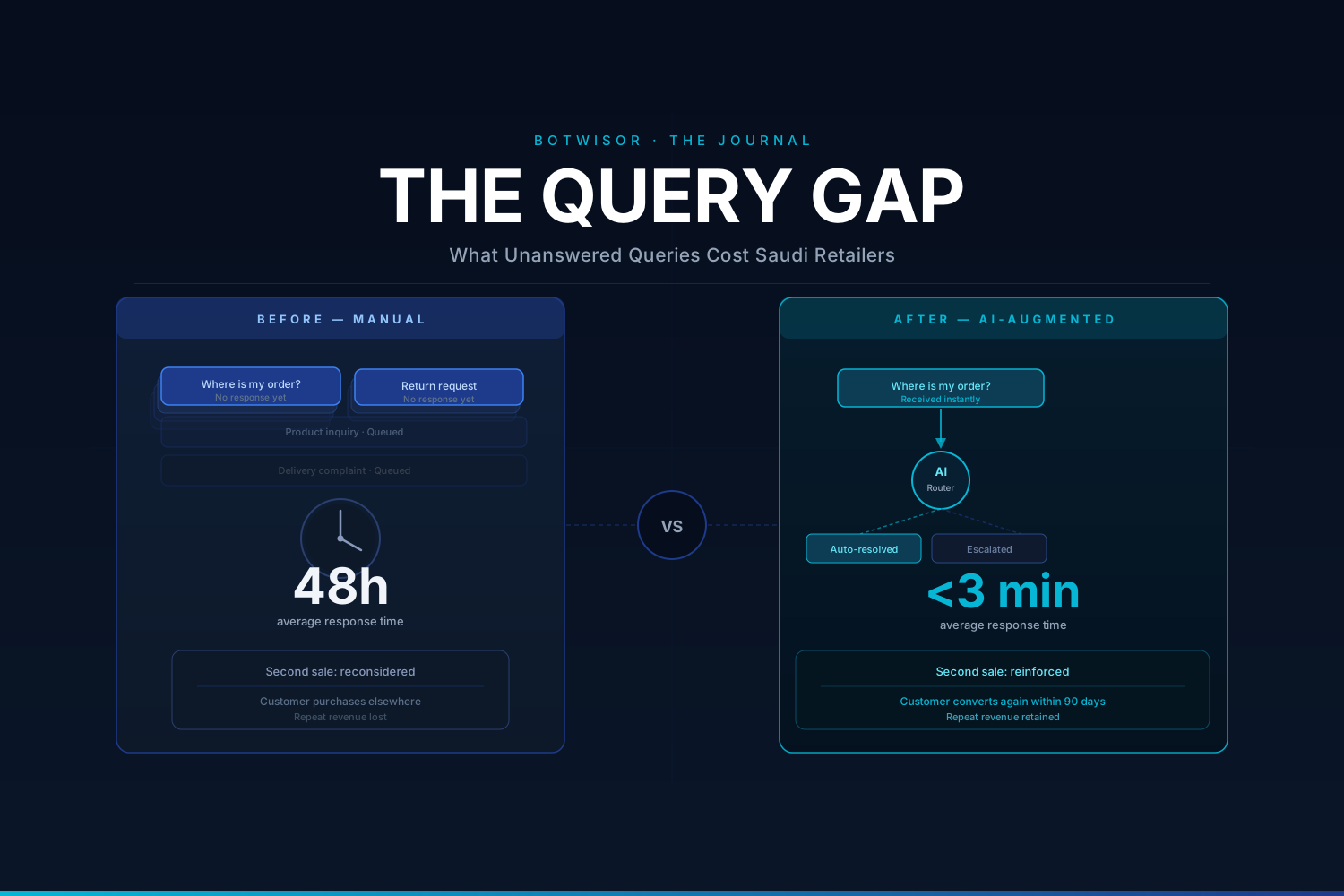
Saudi retailers relying on manual customer service queues typically deliver first responses within 24 to 48 hours. By that window, a meaningful share of buyers has moved to a competitor, requested a refund, or deferred the follow-on purchase they were primed to make. The cost does not appear on the service-desk report. It surfaces in repeat-purchase rates and churn metrics six weeks later.
Why the Second Sale Is the One That Matters
The economics of Saudi retail depend heavily on repeat buyers. Customer acquisition cost has risen as performance-marketing budgets compete across a narrowing set of high-intent placements. The customer who completes a second purchase within 90 days of the first is two to three times more likely to buy a third time than a first-time buyer is to buy a second time.
This means the post-purchase period is not just a service window. It is a revenue window. Every interaction a customer has with the brand after paying, whether a delivery inquiry, a product question, or a return request, is an opportunity to reinforce or erode the probability of that second purchase.
A query that sits in a queue for 36 hours does not just leave the customer waiting. It leaves them reconsidering.
The Queue: What Happens Before a Customer Reaches an Answer
In a typical mid-sized Saudi retail operation doing SAR 30M to SAR 100M annually, customer inquiries arrive across at least four channels: WhatsApp Business, Instagram DM, a website chat widget, and email. These channels are usually monitored by separate staff or, in smaller operations, a single person dividing attention between them.
When a message arrives, it enters one of several queues. During business hours, response time depends on agent availability and queue depth. Outside business hours, including the post-9pm window when a significant share of Saudi online shopping occurs, messages wait until the next working day. During Ramadan, when shopping volume spikes and working hours shift, queues extend further.
For a routine "where is my order?" inquiry, the resolution sequence typically runs:
- Agent opens the inquiry.
- Agent searches the order management system for the order.
- Agent copies the tracking number and opens the logistics portal.
- Agent reads the delivery status.
- Agent pastes a response.
This sequence takes three to five minutes per ticket under normal conditions. For a retailer handling 150 to 250 inquiries per day, common at the SAR 40M to SAR 80M scale, that is eight to twenty staff hours daily on queries that carry no revenue upside and exist solely because the customer was not updated proactively.
The customer does not see any of this. They only know how long they waited.
Why a Delayed Answer Rarely Stays Just an Answer
A 36-hour response gap has downstream effects that extend well past the individual inquiry.
The original purchase doubt compounds. A buyer who waited a full day to learn that their delivery is delayed has spent that day without confidence in the brand. The second purchase they were going to make, a replenishment, a complementary product, a gift, is now a conscious decision rather than a habitual one. Conscious decisions require more persuasion, more incentive, and more friction to convert.
Negative reviews arrive before resolutions do. Saudi consumers are active on Google Maps, platform review sections, and social media. A query that goes unanswered for 48 hours frequently results in a public complaint before the private channel resolves. That public record shapes the next buyer's conversion decision, creating acquisition cost consequences from a service failure that began as a manageable inquiry.
Refund rates rise with ambiguity. When customers cannot get a delivery status update, many default to requesting a refund. Retailers then spend time and return-processing fees on orders that were in transit and on schedule. The margin loss is real; its root cause does not appear as "slow customer service" anywhere in the reporting stack.
Agent quality deteriorates under volume. Teams handling 200 tickets per day without automated triage develop fatigue. Escalations are missed. Tone degrades. First-contact resolution rates fall because agents rush. The cost of these second and third contacts is rarely tracked at the ticket level, but it inflates total service cost per customer significantly.
What Changes After AI-Augmented Query Management
AI-augmented customer service does not replace agents. It removes agents from queries that do not require them. Order status checks, return eligibility questions, store hours, promotional terms, and size availability represent a large share of inbound volume for most retailers, and they resolve against structured data that a well-configured integration can serve instantly.
When this tier of queries resolves automatically:
- Response time for the majority of inbound volume drops from hours to under two minutes.
- Agent capacity concentrates on complaints, exchange negotiations, and high-value relationship management.
- Proactive updates, including delivery notifications and delay alerts, pre-empt a meaningful share of inbound volume entirely, because customers who receive proactive status updates do not need to ask.
Retailers who have implemented this structure report that inbound contact volume falls. Not because customers have fewer needs, but because those needs are met before they require active inquiry. The refund-request rate for in-transit orders drops. The complaint-to-public-review escalation rate drops. Second-purchase rates move measurably within 60 to 90 days of deployment.
Before and After: Key Metrics That Shift
| Metric | Before (Manual Queue) | After (AI-Augmented) |
|---|---|---|
| Average first response time | 24 to 48 hours | Under 3 minutes for automated query types |
| Routine query auto-resolution rate | Near zero | 55 to 70% of total inbound volume |
| Refund requests from "order status unknown" | Common, difficult to attribute | Reduced by proactive status delivery |
| Agent hours on non-escalated queries | 8 to 20 hours per day | Under 2 hours per day |
| First-contact resolution rate | 30 to 50% (varies with agent) | 70 to 85% (escalated-only queue) |
| Second-purchase rate (90-day trailing) | Benchmark | Measurable improvement within 60 to 90 days |
The last row is the one that changes P&L. All others are operational indicators pointing toward it.
Where Saudi Operations Add Specific Friction
Saudi retail customer service carries operational characteristics that compound manual queue depth in ways that differ from other markets.
Language routing. Saudi customers contact retailers in Modern Standard Arabic, colloquial regional Arabic, and English, often within the same conversation. Manual teams switch language and register per ticket. Automated classification handles this instantly and routes to the appropriate response template or agent profile without delay.
Prayer time gaps. Customer contact volume does not pause during prayer breaks; agent availability does. This creates five reliable gaps per day during which queries queue without acknowledgment. An AI-augmented first-response layer handles acknowledgment and routine resolution regardless of agent availability.
Seasonal concentration. Saudi retail experiences sharp volume concentration around Ramadan, Eid Al-Fitr, Eid Al-Adha, National Day, and White Friday. Manual teams cannot scale linearly with volume spikes, and service quality degrades precisely during the periods that matter most for customer relationship formation. AI-augmented handling scales without headcount.
WhatsApp as a primary channel. Saudi consumers prefer WhatsApp for retail contact at rates above most markets. WhatsApp Business API integrations that automate triage, status delivery, and first-response are operational requirements for any retailer managing volume, yet a significant share of Saudi retailers still handle WhatsApp through a shared device or a staff member checking messages manually between other tasks.
What This Is Not an Argument For
The case above is not an argument for removing human judgment from customer service. Complex complaints, goodwill decisions, trust-sensitive exchanges, and high-value account relationships require skilled agents operating with context and empathy. The argument is for removing human handling from queries that do not need it.
This distinction matters because retailers who deploy AI-augmented CX without this framing tend to either under-automate, where AI handles the FAQ widget with no backend integration and solves almost nothing, or over-automate, where a rigid system frustrates customers with genuinely complex problems and increases escalations. Getting the tier structure right is the work.
The Cost That Does Not Look Like Cost
The difficulty with this category of loss is that it is diffuse. It does not appear on any single report. Repeat-purchase rate decline is attributed to marketing performance or product fit. Refund rate increases are attributed to logistics. Agent hours on routine queries appear as headcount. None of these reports point back to the response-time gap that caused them.
The retailers making measurable progress on retention and repeat-purchase economics are the ones who decided to treat first-response time as a revenue variable rather than an operational nuance, and who built the automation layer that closes the gap.
If your service team is spending the majority of its hours on queries that could resolve automatically, the second sale is the price you are paying for that structure.
→ Book a free automation audit to see where query-to-resolution gaps are affecting your repeat-purchase metrics.