The Journal
Unresolved Complaints Are Costing Saudi Banks on Two Fronts
Saudi banks relying on manual complaint intake face SAMA regulatory exposure and customer attrition in parallel. Both costs accumulate quietly until the backlog becomes undeniable.
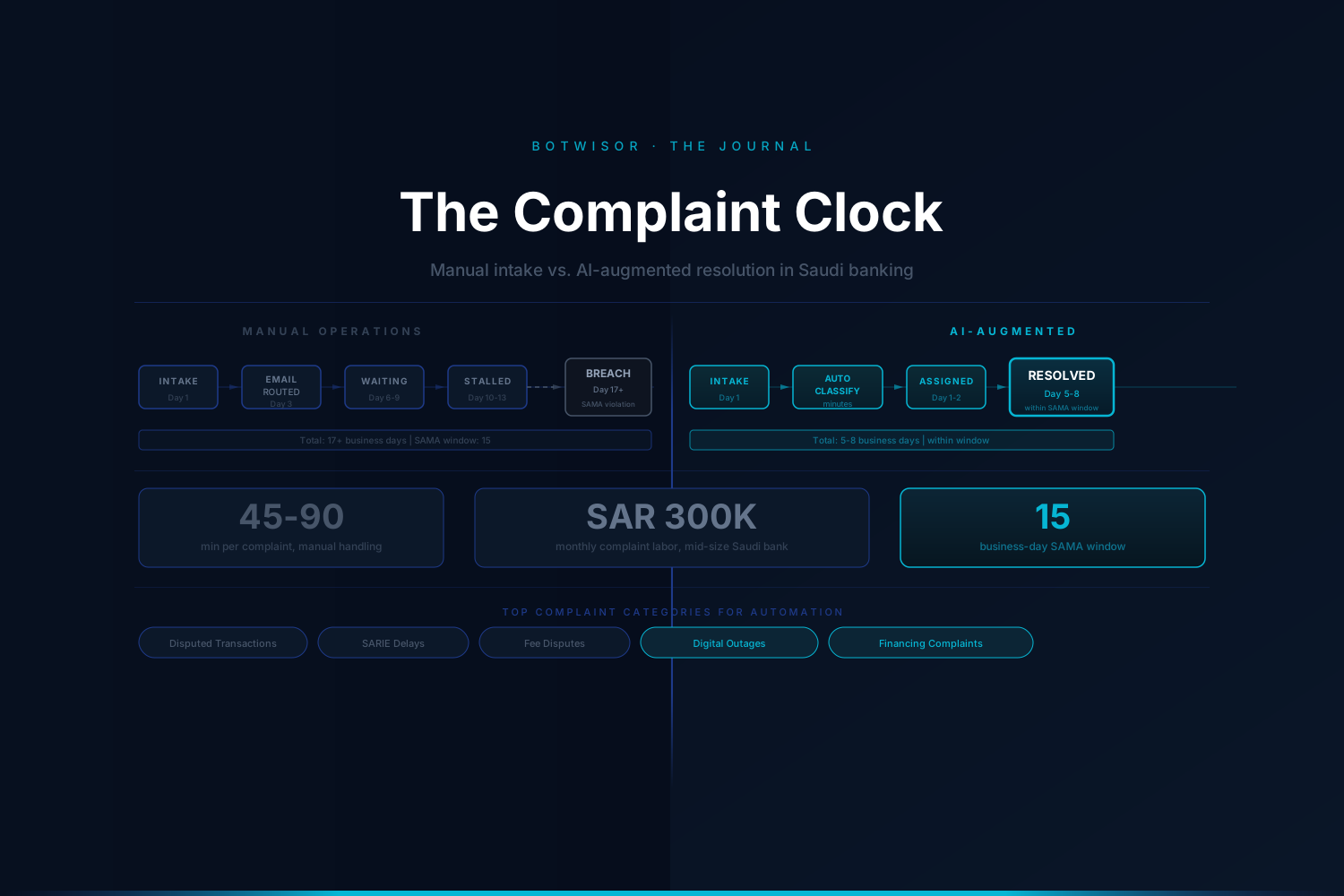
Saudi banks running manual complaint workflows are absorbing a dual liability they rarely quantify in the same analysis. SAMA's complaint-handling framework sets a 15-business-day resolution window for retail complaints; missing it creates regulatory exposure. At the same time, every complaint that stalls past the customer's patience threshold is a customer measuring whether to move their current account, mortgage, or investment mandate to a competitor.
What SAMA's Complaint Framework Requires
The Saudi Central Bank requires banks to acknowledge customer complaints formally, assign an owner, and resolve or escalate within defined timeframes. For standard retail complaints, the benchmark is 15 business days. Payment disputes and urgent cases carry shorter windows. Banks must maintain a complete record of every complaint: date of receipt, category, communication timeline, assigned handler, and resolution outcome.
These requirements are supervisory commitments, not guidelines. SAMA conducts periodic reviews, and findings appear in communications that circulate across the financial sector. A bank that misses resolution windows repeatedly, or cannot produce a clean complaint log at audit time, faces formal non-compliance findings. For banks operating under Saudi Arabia's Financial Sector Development Program, which targets a globally competitive banking sector by 2030, chronic complaint delays create a visible contradiction with the customer-centricity the program demands.
Beyond the regulatory dimension, there is a commercial one. SAMA's published supervisory indicators are read by institutional counterparties, rating analysts, and the increasingly informed retail customer comparing digital banking options. A consistent pattern of complaint mishandling is not invisible to the market; it accumulates into a reputational signal.
Where Manual Handling Breaks Down
A typical manual complaint workflow at a Saudi bank moves through several handoff points. A customer contacts the bank by phone, branch, or app. An agent logs the complaint in a CRM field or a shared spreadsheet, then routes it by email to the relevant department: card services, retail operations, mortgage, or wherever the complaint originates. Someone in that department reviews it, may request additional documentation, and sends a response back. The agent updates the customer.
Each handoff introduces latency. A complaint touching two departments can spend three to four days waiting in inboxes before substantive work begins. A complaint requiring documentation from the customer can stall further while the follow-up request sits in an agent's pending queue. No one has a real-time view of how many open complaints are within five days of breaching the SAMA window. Escalations happen reactively, after the deadline has already passed.
The failure is structural, not individual. Agents are not careless; the process lacks the routing logic, SLA counters, and automatic escalation triggers that would surface a complaint before it becomes a compliance event. A bank with 50 complaint-handling staff and no workflow orchestration layer is running 50 parallel judgment calls about prioritization every day, with no systematic guarantee that any specific case gets the right attention at the right time.
The Two Fronts: What Banks Actually Lose
The following table maps the gap between manual complaint operations and an AI-augmented alternative across both cost categories:
| Dimension | Manual Operations | AI-Augmented Operations |
|---|---|---|
| SAMA compliance | No live SLA counter; breaches discovered after the fact; audit trail assembled manually from emails and CRM notes | Automated SLA tracking from intake; at-risk complaints flagged at day 10; SAMA-format log exportable on demand |
| Acknowledgment speed | Customers may wait 24 to 48 hours for confirmation that their complaint was received | Automated acknowledgment sent within minutes of intake, regardless of channel |
| Routing | Manual email routing adds 1 to 3 days per handoff | Rules-based routing delivers complaint to correct team immediately; no email required |
| Escalation | Escalations happen when a supervisor notices an aging complaint; no systematic trigger | Automatic escalation at day 10; compliance team alerted at day 13; breach rate near zero |
| Customer retention | Stalled complaints drive substantially higher attrition; no early signal before the customer exits | Faster resolution reduces attrition probability; closed-loop notification confirms case closure to customer |
| Operational cost | Each manually chased complaint consumes 45 to 90 minutes of combined agent and supervisor time | Routing, acknowledgment, and status updates handled automatically; human effort reserved for complex disputes |
| Audit readiness | SAMA audit preparation requires days of manual assembly across email threads, CRM fields, and offline records | Structured log with all required fields; exportable in minutes |
The operational cost figure warrants attention on its own terms. A mid-sized Saudi bank processing 4,000 complaints per month at 60 minutes average handling time is committing roughly 4,000 staff-hours per month to complaint administration, before accounting for the additional cost of cases that breach the SAMA window and require remediation. At a blended labor cost of SAR 75 per hour, that is SAR 300,000 per month in complaint-handling labor alone.
On the retention side, customer experience research across financial services markets consistently shows that unresolved complaints drive churn at two to four times the rate of resolved ones. The customer who files a complaint and receives a slow, poorly communicated resolution is more likely to leave than the customer who never complained at all. The complaint is the final diagnostic the bank has before that customer makes a decision; a slow response confirms their concern rather than addressing it.
What AI-Augmented Operations Look Like
The structural difference that AI-augmented complaint handling delivers is not faster agents. It is a different process architecture: one where routing, acknowledgment, SLA tracking, and escalation are handled by the system rather than by individual judgment calls at each step.
When a complaint arrives by any channel, it is classified automatically by category: payment dispute, unauthorized transaction, service unavailability, product fee, or financing complaint. An SLA counter starts immediately. The complaint routes to the correct team without email. The customer receives a formal acknowledgment within minutes.
At a defined threshold, typically day 10 of a 15-day window, the system surfaces the complaint to a supervisor automatically. At day 13, the compliance team receives an alert. If additional documentation is needed from the customer, the system sends a structured request with a response deadline and tracks whether it arrives. Complex cases involving multiple departments are tracked across all of them simultaneously; no complaint can fall between two teams undetected.
Resolution data feeds into a structured record with a standard field set: root cause, resolution type, any compensation offered, customer confirmation. That record satisfies SAMA's audit requirements without manual assembly.
For clear-cut categories, a misdirected transfer that needs reversal or a fee charged against a stated tariff, parts of the resolution workflow can be partially automated. A human approves the action; the system executes it and closes the case. The agent's involvement shifts to judgment on edge cases rather than administrative orchestration of standard ones.
Five Complaint Categories Worth Prioritizing
Not every complaint type benefits equally from automation. These five generate the highest volume at Saudi banks and carry the most regulatory scrutiny under SAMA's framework:
- Disputed or unauthorized transactions. High volume, clear resolution path, and among the most time-sensitive cases under payment protection guidelines. Automated classification and routing compress investigation time significantly.
- SARIE and instant payment delays. Saudi Arabia's instant payment network handles high transaction volumes; when payments fail or are delayed, customers expect rapid acknowledgment. Automated status checks and proactive updates reduce the volume of follow-up inquiries the bank must handle manually.
- Fee and tariff disputes. Customers disputing charges that contradict stated product terms follow a defined resolution path: verify the applicable tariff, confirm whether the charge applied correctly, reverse if warranted. Automation handles the verification step; a human approves the outcome.
- Digital channel outages and access failures. When mobile banking or ATM access fails, complaint volume spikes sharply. Automated acknowledgment and status updates prevent a service incident from generating a secondary surge of complaint-handling workload.
- Financing and mortgage servicing complaints. These carry longer resolution windows but benefit significantly from automated intake and early classification. A complaint sitting unclassified for its first five days has already consumed a third of the SAMA window without substantive progress.
The FSDP Dimension
Saudi Arabia's Financial Sector Development Program envisions a banking sector that is operationally efficient, customer-centric, and globally competitive by 2030. SAMA's complaint framework is one enforcement mechanism within that vision; it is not a standalone compliance obligation but part of a broader institutional expectation about how Saudi banks treat their customers.
Banks that shorten resolution time are not simply avoiding fines. They are generating structured feedback on their most frequent service failures, feedback that is rarely captured in usable form when complaints route through email and CRM free-text fields. That data, analyzed across complaint categories and product lines, reveals where operations are producing friction: which stages of the financing application generate the most disputes, which fee structures customers find opaque, which branch locations or agent teams have the highest complaint rates.
Over time, this feedback reduces future complaint volume by addressing root causes rather than resolving individual cases in isolation. The institution improves the processes that generate complaints, not just the process for handling them.
The banks best positioned for Saudi Arabia's 2030 competitive landscape are not necessarily those with the fewest complaints; complaint volume scales with customer base and product complexity. They are the ones that resolve complaints fastest, demonstrate SAMA alignment by design rather than by scramble, and convert complaint data into measurable operational improvement that compounds over time.