
The Journal
What Saudi Banks Spend When Trade Finance Runs on Paper
Saudi banks running trade finance manually pay in delayed approvals, compliance risk, and lost corporate clients. Here is what the paper trail actually costs.
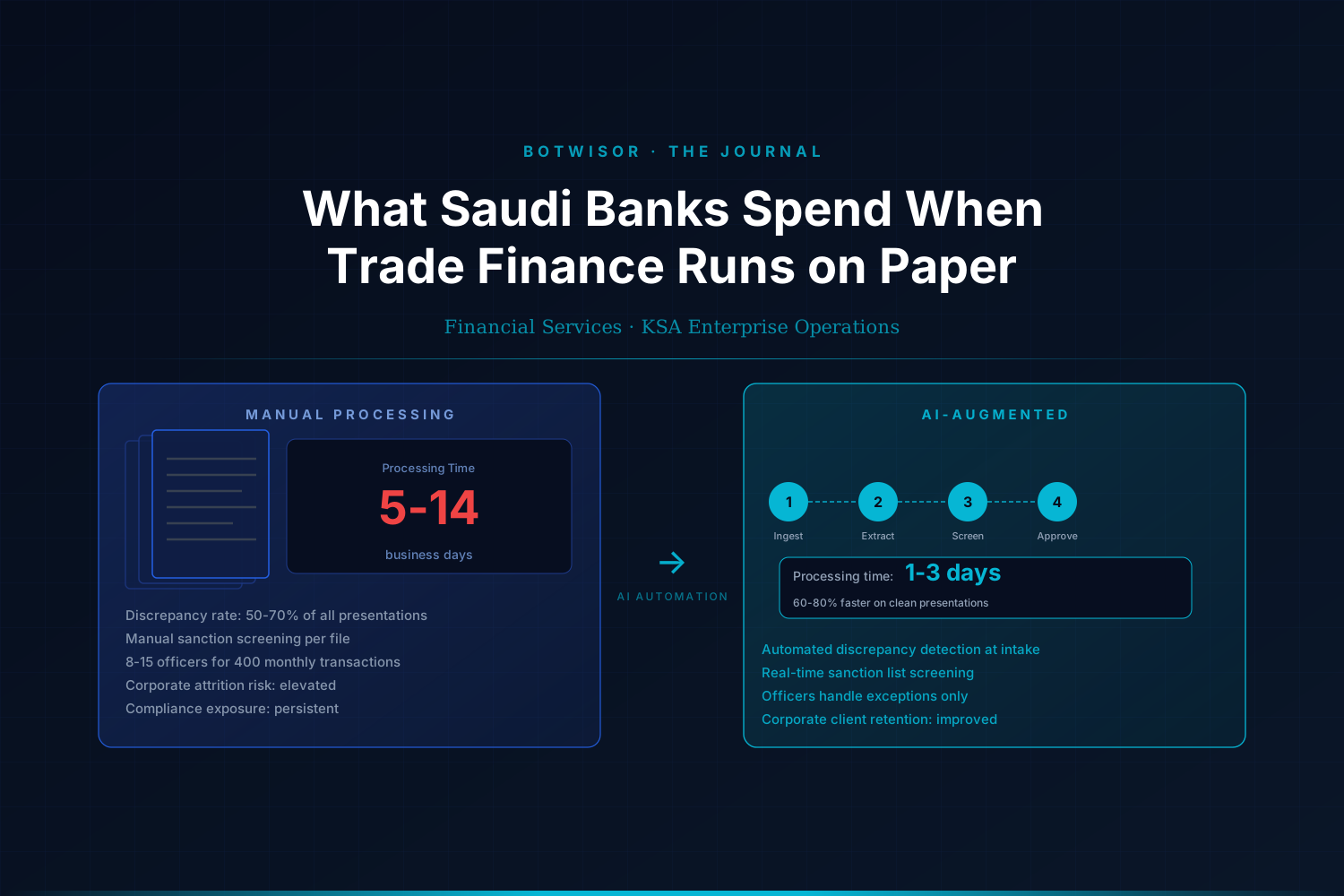
Saudi banks processing trade finance documents the traditional way (paper, email, and manual data entry) lose on three fronts simultaneously: slower turnaround times than regional peers, higher operational cost per transaction, and corporate clients who notice both. This article compares the manual workflow with an AI-augmented equivalent and explains why the gap is widening.
What Trade Finance Actually Involves for a Saudi Bank
Trade finance covers the instruments that sit between a Saudi buyer and a foreign supplier whenever goods cross a border: letters of credit (LCs), guarantees, documentary collections, and standby instruments. A manufacturing company in Jeddah importing steel from Korea, a food distributor in Riyadh sourcing from European markets, or a construction firm procuring materials for NEOM-related projects all route this paperwork through their bank.
The documents involved -- commercial invoices, bills of lading, certificates of origin, inspection reports, and packing lists -- arrive in varying formats, frequently in multiple languages, and must be verified against the terms of an underlying credit agreement before the bank can proceed. In a manual process, a trade finance officer handles this sequentially: receive, log, verify, query, approve, communicate.
Where Manual Processing Breaks Down
A standard LC processing cycle in manual operations looks like this:
| Stage | Manual workflow | Typical timeline |
|---|---|---|
| Document intake | Email and physical courier | 1 to 2 days |
| Data entry into core banking | Manual keying per field | 2 to 4 hours per dossier |
| Compliance and sanction screening | Manual cross-check | 1 to 3 days |
| Discrepancy identification | Officer review, line by line | Hours to a full day |
| Client notification | Phone or email | Same day if no issues |
| Internal approval routing | Email chain, manager sign-off | 1 to 3 days |
| Settlement or rejection communication | Manual letter or email | 1 day |
| Total end-to-end | 5 to 14 business days |
For a Saudi corporate client with a tight shipping window, a 10-day processing cycle is not a minor inconvenience. It affects their supplier relationships, their inventory planning, and ultimately their willingness to route future transactions through the same bank.
What the Delay Costs the Bank
The visible cost is staff time. A mid-sized Saudi commercial bank processing 200 to 400 trade finance transactions per month might dedicate 8 to 15 officers to the function, each spending the majority of their working week on document review and data entry. The less visible costs are harder to locate on a P&L but equally real.
Discrepancy rates in manual LC processing typically run between 50% and 70% of all presentations -- an industry benchmark driven by inconsistent document preparation on the exporter side. Each discrepancy triggers a cycle of notifications, waiver requests, and reprocessing. In a manual environment, every discrepancy adds 2 to 5 days to the cycle and requires an officer to draft the notification, log the client response, and recheck the amended documents.
Compliance exposure is the other silent cost. Sanction screening against OFAC, the UN Security Council list, and SAMA guidance is not optional. When it runs as a manual cross-check, officers compare parties against lists that update on rolling cycles. A missed update during a high-volume period can result in a compliance failure whose remediation cost exceeds any operational savings from keeping the process manual.
Corporate client attrition is the most strategically damaging outcome. Larger Saudi corporates with active treasury teams routinely benchmark their banks on trade finance speed. A 7-day processing time compares unfavorably against regional peers who have automated document checking and can close a clean LC in 24 to 48 hours. Once a corporate treasurer begins routing trade flows to a faster bank, the impact extends well beyond trade finance fees into FX, credit, and the broader relationship.
What Changes With AI-Augmented Processing
The intervention is not replacing trade finance officers. It is removing the steps that do not require judgment.
Intelligent document processing extracts structured data from commercial invoices, bills of lading, and certificates of origin -- regardless of format -- in seconds. Fields that an officer would key individually are populated automatically into the core banking system, with flagged exceptions forwarded for human review.
Automated discrepancy detection compares extracted document data against the LC terms without a line-by-line read. Discrepancies are identified and categorized before the officer opens the dossier, so review becomes decision-making rather than discovery.
Sanction and compliance screening runs against up-to-date lists at intake, with continuous data updates, removing the lag and the human error rate that accompany manual cross-checks.
The result is a meaningfully different processing timeline:
| Stage | AI-augmented workflow | Typical timeline |
|---|---|---|
| Document intake | Digital ingestion, any format | Minutes |
| Data extraction | Automated parsing | Minutes |
| Compliance screening | Automated at intake | Minutes |
| Discrepancy identification | Automated comparison against LC terms | Minutes to 1 hour |
| Officer review | Judgment on flagged exceptions only | 1 to 3 hours |
| Approval routing | Workflow-driven, tracked | Hours |
| Total end-to-end | 1 to 3 business days |
Saudi banks that have moved to AI-augmented trade finance document processing report processing time reductions of 60% to 80% on clean presentations and significant reductions in discrepancy-driven rework cycles.
Why the Timing Is Significant for Saudi Banks
SAMA's digital banking framework and broader open banking guidelines set expectations for bank operations that extend beyond consumer-facing products. Corporate clients, particularly those active in manufacturing, construction, and the industrial sectors that Vision 2030 is scaling, expect digital-grade responsiveness across all product lines, not just mobile applications.
Saudi Arabia's non-oil exports are growing as a direct result of Vision 2030 manufacturing and industrial diversification policy. More domestic producers trading internationally means more trade finance volume. A bank whose processing pipeline remains manual faces a growing workload against a static or shrinking capacity ceiling.
The supply chains behind Vision 2030 mega-project procurement -- NEOM, Red Sea, Diriyah Gate -- involve significant cross-border sourcing that runs through trade finance instruments. Banks positioned to process these transactions quickly and accurately capture a disproportionate share of a growing fee pool.
The Compounding Effect on Fees and Relationships
Trade finance is not a standalone product. A corporate banking relationship typically spans current accounts, payroll, FX, short-term credit, and trade finance. A bank that is slow on trade finance does not lose only the trade finance fee; it creates a reason for a treasury team to consolidate relationships with a faster competitor.
The fee on a single LC is not large relative to total relationship value. The combined revenue from a portfolio of 200 to 400 transactions annually, plus associated FX and credit cross-sell, represents a meaningful piece of any corporate banking relationship. Banks that consistently deliver fast, accurate trade finance processing retain the relationship; those that do not, eventually lose it.
What Manual Processing Signals to Corporate Clients
When a corporate treasurer waits 10 days for a clean LC to clear, the message received -- even if unintentional -- is that the bank's operations are not keeping pace with their business. Saudi corporates increasingly operate on timelines shaped by global supply chain logistics, where days matter. A bank that processes at paper speed is not a natural partner for that kind of operation.
The gap between manual and AI-augmented trade finance is no longer subtle. Regional GCC banks have been investing in trade finance automation for several years. Saudi banks that have not yet made the transition are visible to any corporate treasury team comparing processing times across their banking relationships.
The Practical Starting Point
The most common obstacle is not technology availability. It is the assumption that trade finance complexity makes automation difficult. Structured document types -- commercial invoices, bills of lading, certificates of origin -- are among the better candidates for intelligent document processing precisely because their formats, while varied, are constrained. The edge cases that genuinely require officer judgment are exactly where officer time should be concentrated.
The practical first step is a processing audit: map current end-to-end cycle times, discrepancy rates, and officer hours per transaction type. The performance gap becomes visible quickly, and the business case (reduced staffing cost, lower discrepancy rework, improved corporate retention) typically closes within the first year of deployment.
→ Book a free automation audit to see where your trade finance pipeline is leaving time and margin on the table.