
The Journal
How Slow Tenant Onboarding Costs Saudi Landlords More Than They Track
Saudi commercial landlords lose up to SAR 660K per year to manual tenant onboarding delays. Here is where the cost builds and what AI-augmented ops delivers.
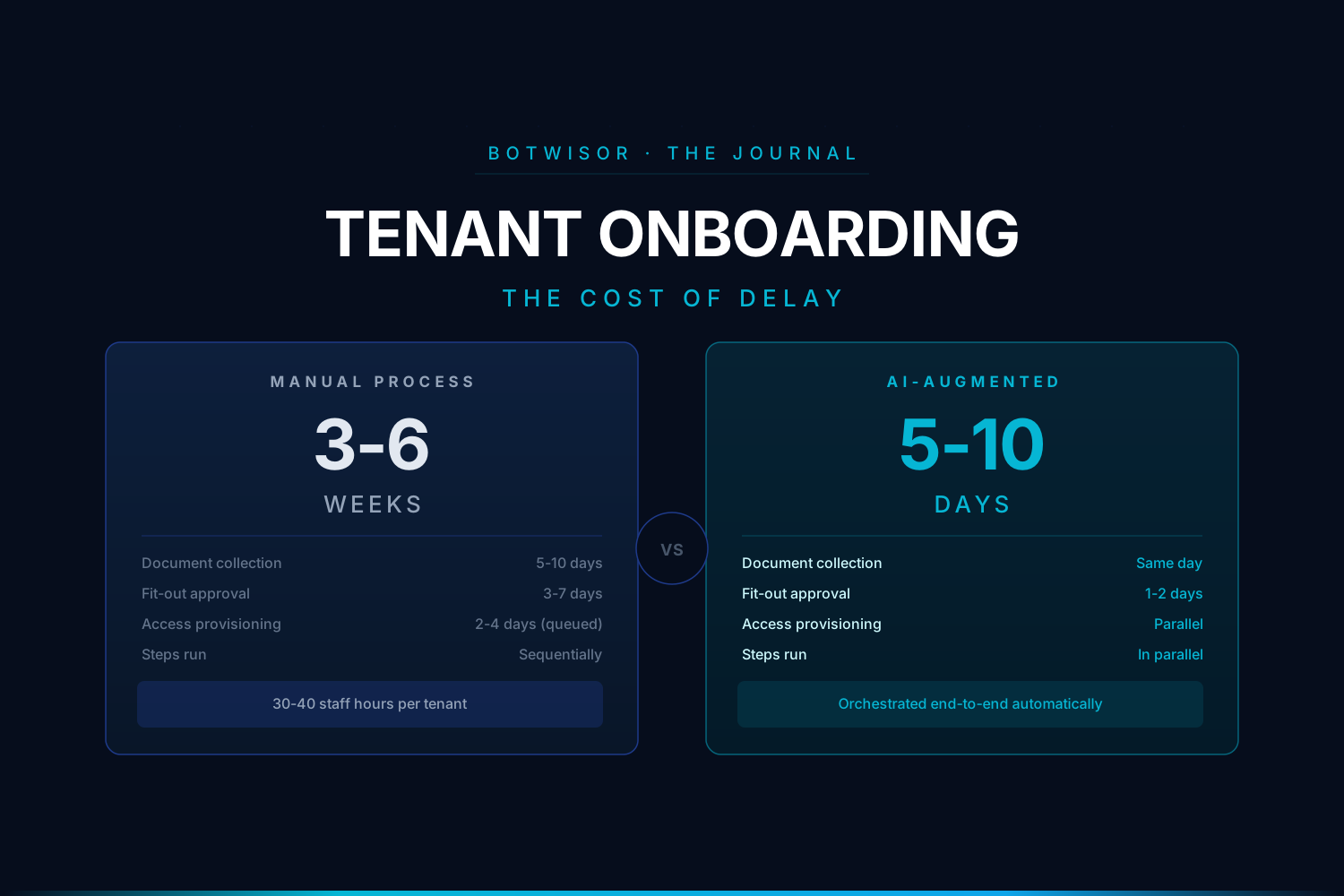
Saudi commercial landlords focus on signed contracts, but the revenue sitting between a lease signature and a tenant's first operating day often goes unmeasured. Manual onboarding processes that take three to six weeks extend rent-free periods, drain staff hours, and set a tone of friction that follows the tenancy for years.
What Happens Between Signature and Move-In?
The signed lease is not the revenue event. The revenue event is the day the tenant occupies and begins paying rent. Between those two dates sits a sequence that most Saudi commercial landlords manage through WhatsApp threads, shared email inboxes, and spreadsheets watched by a junior administrator.
A typical sequence at a Saudi commercial property runs as follows: the landlord team requests documents after the lease is countersigned (corporate registration, insurance certificate, fit-out contractor details). The tenant submits some and chases others over several days. An operations manager reviews the fit-out plan and returns it with comments. The facilities team schedules a base-condition handover inspection. The building management system team issues access credentials once an operations manager's request reaches them. A welcome letter and parking allocation arrive, sometimes a week after keys are collected.
In Riyadh's Grade A office corridors around King Abdullah Financial District or Jeddah's expanding retail strips, this process can take anywhere from two to six weeks depending on the tenant's complexity and the landlord's back-office capacity. Every day of that process is a day the lease has started on paper but the revenue clock has not.
What Does the Onboarding Delay Actually Cost?
The visible cost is the rent-free incentive period. If a landlord grants three months rent-free and manual onboarding consumes four weeks of it, the tenant's effective free period shrinks but their readiness to open does not accelerate. The incentive has been partially consumed by administrative friction rather than commercial goodwill.
The less visible costs accumulate:
- Internal staff hours. A property management team handling five concurrent new leases may spend 30 to 40 hours of coordinator and manager time per tenant across document chasing, fit-out approval follow-up, and access provisioning. At a burdened internal cost of SAR 80 to SAR 120 per hour, each tenancy absorbs SAR 2,400 to SAR 4,800 in internal cost before any external spend.
- Delayed fit-out commencement. When fit-out plan approval takes two weeks instead of four days, the tenant's contractor cannot begin. The tenant's opening date slips. In retail, a delayed opening costs the tenant revenue and introduces resentment early in a relationship that needs goodwill to sustain.
- Early-tenancy friction. Property management research consistently shows that the first 90 days of occupancy predict renewal likelihood. A tenant who spends those 90 days chasing access credentials and unresolved fit-out punch lists does not begin the relationship from a place of confidence in the landlord's operation.
- Portfolio compounding. A landlord managing 50 commercial units and turning over 20 leases per year absorbs this cost repeatedly. At a conservative estimate of SAR 3,000 in internal staff time and SAR 15,000 to SAR 30,000 in informal rent-free extensions granted to smooth over delayed onboarding, the annual portfolio drag reaches SAR 360,000 to SAR 660,000 before accounting for any tenant churn attributable to a poor first impression.
Before vs. After: Saudi Commercial Tenant Onboarding
| Stage | Manual Process | AI-Augmented Process |
|---|---|---|
| Document request and collection | Property manager emails a list; tenant responds over 5 to 10 days; missing items chased manually | Automated portal request within an hour of signing; reminders at 24h and 48h; checklist validates format automatically |
| Fit-out plan submission and approval | Tenant emails a PDF; manager reviews when available; comments returned 3 to 7 days later | Digital submission with automated spec checklist; priority routing to reviewer; comments returned same day |
| Access credential provisioning | Building team issues passes when an operations manager's request arrives; request waits 2 to 4 days | Credentials provisioned automatically on document clearance; tenant receives digital pass before handover |
| Welcome and orientation | Ad hoc call or meeting, often delayed until after move-in | Automated welcome sequence with building guide and service portal access sent before move-in day |
| Total onboarding duration | 3 to 6 weeks | 5 to 10 business days |
The compression is not achieved by skipping steps. Every document still gets verified. Every fit-out plan still receives human review. The difference is that no step sits waiting in an inbox while a coordinator is in another meeting.
Why Does Manual Friction Compound After Move-In?
Saudi commercial landlords rarely trace lease churn back to the onboarding experience because the link is indirect. A tenant who leaves at the end of year three does not write "your onboarding was slow" in the exit conversation. They say they found a better offer.
The connection between onboarding friction and renewal behavior is consistent in property management research. When the first weeks in a new space feel administratively burdensome, the tenant does not fully settle into the relationship. The landlord's team is perceived as reactive rather than professional. Minor service requests in month four travel through the same WhatsApp thread used to chase documents in month one.
In Riyadh's expanding professional-services market and Jeddah's growing retail and hospitality strip, tenants have more than one credible option. A landlord whose onboarding signals operational excellence from day one differentiates on something a competitor cannot neutralize with a lower quoted rent.
What Does AI-Augmented Onboarding Deliver for Saudi Landlords?
AI-augmented onboarding is not a tenant portal. Portals have existed for fifteen years and adoption in KSA remains inconsistent because the back office still depends on human coordination to move between process stages.
What AI adds is orchestration: the system knows where each new lease stands in the onboarding sequence, identifies which step is blocked and why, and escalates to the right person only when human judgment is genuinely needed.
In practice, AI-augmented onboarding handles:
- Document completeness validation, matching submitted files against the required checklist and flagging gaps without a coordinator reviewing routine items.
- Fit-out approval routing, directing each submission to the correct reviewer based on fit-out category, tracking the service-level commitment, and auto-escalating if review is not completed within 24 hours.
- Parallel processing, running access provisioning concurrently with final document verification rather than sequentially after every step closes.
- Tenant communication cadence, sending proactive status updates at each stage completion with expected timelines and named contacts for each phase.
- Exception logging, capturing every delay with its cause and duration for the portfolio manager's weekly review.
The result is not just a faster process. It is a measurable one, which most Saudi portfolio operators currently lack. When a landlord can see that fit-out approval consistently takes 11 days at one asset and 4 days at another, the gap becomes something actionable rather than something assumed.
How Does Saudi Arabia's Commercial Expansion Change the Stakes?
Saudi Arabia is adding significant commercial real estate supply under Vision 2030 programs. Riyadh's Northern Ring Road corridor, the King Abdullah Financial District expansion, and the Jeddah Central development zone are all increasing Grade A and Grade B commercial stock. Mixed-use zones across NEOM business districts are introducing new categories of commercial tenancy that will require landlords to compete on service quality, not only on location.
Against that backdrop, the landlords who retain occupancy and defend premium rents are those whose operations match their asset quality. A sleek Grade A tower whose tenant onboarding runs on WhatsApp and email creates a disconnect that sophisticated tenants in Riyadh's financial and professional-services sector quickly register.
The cost of manual onboarding is already running on every active portfolio. In an expanding market, it also creates competitive exposure: a tenant who experiences a smooth, professionally orchestrated move-in at a competitor's building has a reference point that a landlord running manual processes cannot easily address once the tenancy is underway.
The Starting Point: Knowing the Number
Most Saudi commercial landlords do not carry a number for what their onboarding process costs. The delay is absorbed into how things work and never appears as a line item in the portfolio operating account.
Establishing that number is the starting point: how long does your onboarding actually take, step by step, and what does each week of delay cost in extended rent-free periods or internal staff hours? For most mid-size portfolios managing 50 to 200 commercial units in Riyadh or Jeddah, that number typically lands between SAR 200,000 and SAR 700,000 annually.
Once it is visible, the question shifts from whether to invest in improving the process to what the cost of not improving it has already been.
If you manage commercial property in Saudi Arabia and want to put a number to your onboarding gap, book a free automation audit. The assessment covers your current process, the size of the recoverable delay cost, and what AI-augmented onboarding would realistically deliver for your portfolio.