
The Journal
The Tenancy Void Saudi Landlords Accept Without Measuring It
Saudi commercial and residential landlords absorb lost rent during every vacancy without tracking the cost. The void period between tenants is longer than it needs to be, and the gap is almost entirely operational.
Saudi commercial and residential landlords treat vacancy periods as an unavoidable feature of property ownership. A unit sits empty, some rent is lost, the market eventually fills it. The cost is rarely measured, and the process that extends the void rarely gets scrutinised. Most Saudi landlords are absorbing a preventable cost each cycle without calculating how much.
What Is the Tenancy Void?
The tenancy void is the period between one tenancy ending and the next beginning: the days or weeks a unit sits vacant while the re-leasing process runs. It covers the time needed to update listings, notify brokers, schedule and conduct viewings, screen applicants, prepare and execute the lease, and confirm payment before handover.
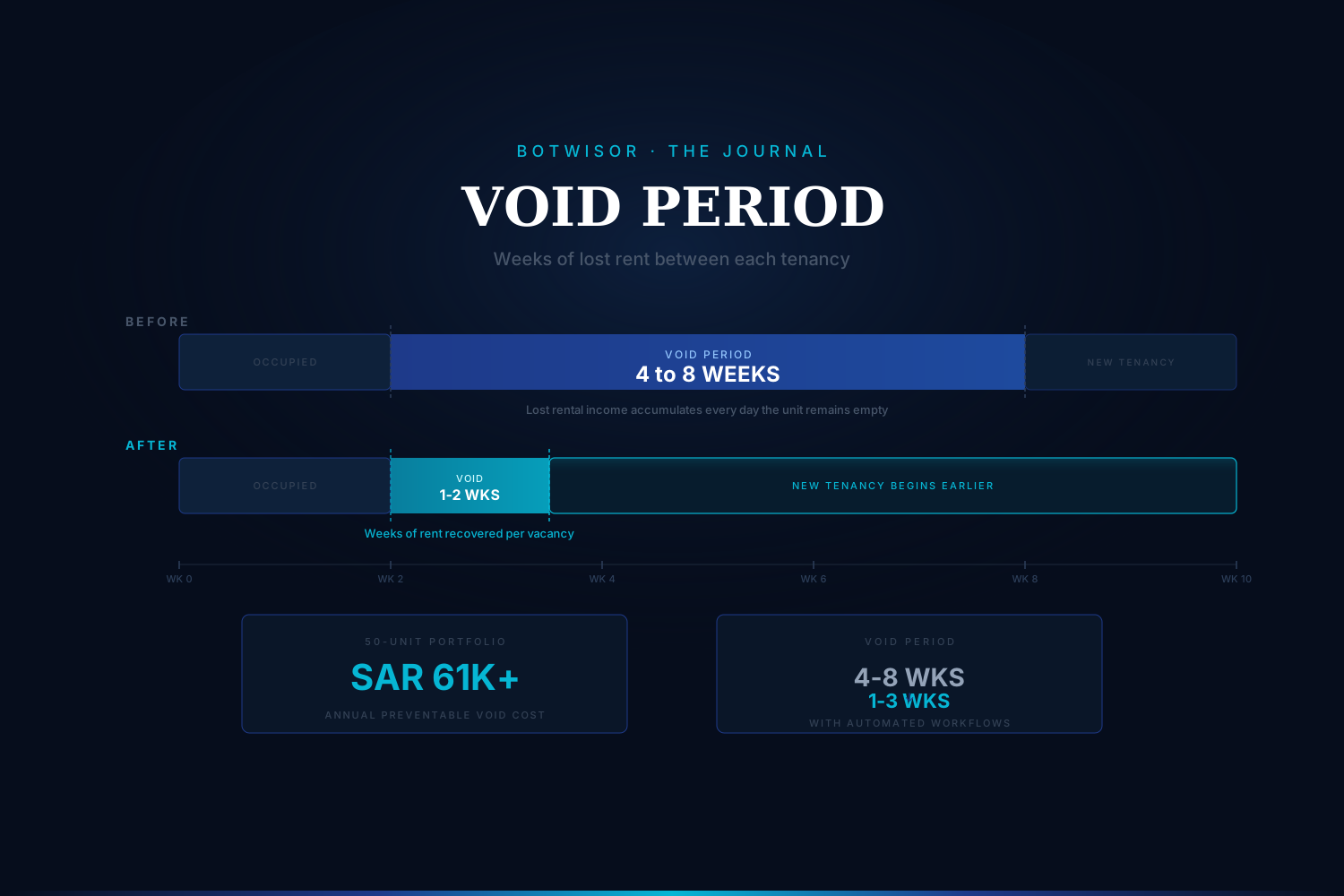
In a well-run operation with automated workflows, this process completes in one to two weeks. In a manual operation, which describes most Saudi property management today, the void commonly runs four to eight weeks. For a unit renting at SAR 8,000 per month, a six-week void costs SAR 12,000 in lost rental income. For a SAR 120,000 per year commercial unit, the same period costs SAR 13,846. Neither figure includes the staff time spent managing the process manually.
Where the Void Period Grows
The tenancy void extends at each handoff in the re-leasing process. Consider how a vacancy typically unfolds in a manually managed Saudi commercial property.
A tenant notifies the landlord or property manager that they will not renew. The leasing team is informed by phone or WhatsApp. The unit is added to an internal availability list. Someone updates listings on Aqar, Bayut, and Ejar separately, a process that takes several hours per unit and often lags a week or more behind the notification. Brokers are contacted individually via WhatsApp.
Viewing requests arrive across different channels: platform enquiries, broker calls, and direct WhatsApp messages. Scheduling is done by phone with no shared calendar. Applications are reviewed manually, with reference calls made individually. When an applicant is selected, the lease is prepared from a template, printed, signed in person, and scanned. The deposit and advance rent are confirmed by bank transfer screenshot.
From vacancy notification to new tenant commencement, the elapsed time is typically four to eight weeks. The process is not slow because landlords are inattentive. It is slow because every step waits for a person to notice and act, while that person is managing other units at the same time.
The Broker Network Effect
When a unit becomes available in a manually managed portfolio, broker notification adds its own delay. A leasing manager juggling multiple vacancies across a portfolio does not always send every broker a briefing on the day of vacancy. In practice, notifications go out when the leasing team has bandwidth, which may be three to five days after the vacancy is known internally.
In that window, competing units in the same submarket have already reached brokers actively matching clients. A broker with a client looking for SAR 80,000 commercial space in Al Olaya will work with the first landlord who provides a usable brief. A unit that arrives five days late to that broker's awareness may miss a client who has already signed with a competitor.
In high-demand submarkets in Riyadh and Jeddah, this delay is less consequential. In secondary locations or during softer leasing periods, the notification gap extends the void in a way that is rarely attributed to the process. The vacancy lingers, and the conclusion is that the market is slow, when the more accurate explanation is that the network received the brief too late.
What the Void Costs, in SAR
The cost calculation is direct but rarely made. Take a 50-unit commercial portfolio in Riyadh with an average annual rent of SAR 80,000 per unit and a 20% annual turnover rate, producing 10 vacancies per year. If the average void period runs six weeks instead of two, each vacancy carries four extra void weeks.
Four extra weeks on a SAR 80,000 per year unit equals SAR 6,154 per vacancy. Across 10 vacancies per year, that is SAR 61,540 in annual preventable void cost for a 50-unit portfolio. A 100-unit portfolio doubles that figure.
For residential property investors managing multiple units under Ejar, the same arithmetic applies at a smaller scale. An investor with five apartments renting at SAR 5,000 per month, experiencing two vacancies per year with four extra void weeks each, is absorbing SAR 23,077 in annual preventable void cost.
These figures use conservative assumptions and do not account for secondary costs: the management hours spent on manual coordination, the broker relationships strained by slow communication, or the reputational signal of a unit sitting empty on public portals for weeks longer than necessary.
Manual Re-Leasing Operations vs. Automated Vacancy Workflows
| Step | Manual Process | Automated Workflow |
|---|---|---|
| Listing update | Team updates each portal separately, one to three day lag | All portals updated simultaneously on vacancy trigger |
| Broker notification | WhatsApp messages sent individually to selected contacts | Structured unit brief distributed to full broker network automatically |
| Viewing coordination | Requests across channels, scheduled by phone | Unified booking system with automated confirmation and reminder |
| Applicant screening | Manual reference checks, no scoring framework | Application scored against defined criteria; shortlist generated automatically |
| Lease preparation | Template emailed, signed in person or scanned | Digital lease prepared from template, sent electronically, tracked to signature |
| Deposit and rent collection | Bank transfer with screenshot confirmation | Payment gateway with automatic reconciliation |
| Typical void period | 4 to 8 weeks | 1 to 3 weeks |
| Staff hours per vacancy | 8 to 15 hours spread across the void period | 2 to 4 hours for exception review |
The gap is not about effort. Manual leasing teams work hard. The problem is structure: human-speed coordination cannot scale with a portfolio that experiences steady turnover, and informal check-ins cannot catch delays accumulating across every stage of the process.
The Ejar and RERA Context
Vision 2030's formalisation of the Saudi rental market adds further considerations for landlords who manage vacancy cycles manually. The Real Estate General Authority (RERA) governs tenancy documentation and dispute resolution. Ejar is the national platform for tenancy contract registration. Both require documentation accuracy and timeliness that is easier to maintain within automated record-keeping than across a combination of WhatsApp screenshots and scanned PDFs.
When a tenancy ends and a new one begins, the handover documentation (unit condition reports, security deposit accounting, and Ejar contract registration for the new tenancy) must be accurate and timely. Manual processes create gaps: a unit re-let without a recorded vacancy, a deposit not formally returned and re-collected under the new contract, a condition report not completed before the new tenant enters. Each gap creates liability and the potential for a dispute at the next vacancy.
Saudi PDPL (Personal Data Protection Law) also applies to tenant data collected during screening. Landlords and property management companies collecting income documentation, national ID copies, and employment records are handling personal data. Managing this across WhatsApp conversations and email threads creates governance exposure that a structured screening workflow avoids.
What Changes When Void Management Is Automated
The primary benefit is time compression. Every step in the re-leasing process happens faster when it is not waiting for a person to notice and act. A unit becomes available, listings update that day, the broker network receives the brief that day, and viewing slots open on a shared calendar that day. Screening begins as soon as applications arrive.
The secondary benefit is the audit trail. Every step generates a record: when the vacancy was posted, who viewed the unit, which applications were received and how they scored, when the lease was signed, and when payments cleared. That record supports RERA compliance, PDPL obligations, and internal portfolio reporting without additional effort.
The tertiary benefit is visibility. A landlord or property manager with 20 or 200 units knows, in real time, which units are vacant, how long each has been vacant, and where each sits in the re-leasing workflow. A property management company operating units across Riyadh, Jeddah, and Al-Khobar cannot hold vacancy status accurately in a spreadsheet. Units fall off active monitoring, re-leasing timelines are underestimated, and the total annual void cost is never measured against what it could be. Automated portfolio visibility closes this gap: current status, elapsed time, and the accumulating SAR cost, visible for every unit.
What does not change: the landlord's relationships with brokers, their judgment on which applicant to approve, and their knowledge of local market conditions. Automation handles the coordination work so the decisions that require experience receive more attention, not less.
A free automation audit from BotWisor covers your current vacancy management workflow, re-leasing timeline, and the SAR cost your void period carries per unit per year. The review typically takes under an hour and surfaces the longest delay in the process within the first 15 minutes.