
The Journal
Supplier Deductions Saudi Retailers Accept Without Audit
Saudi retailers absorb supplier deductions without audit because manual AP teams cannot match them in time to dispute. Here is the cost and what changes.
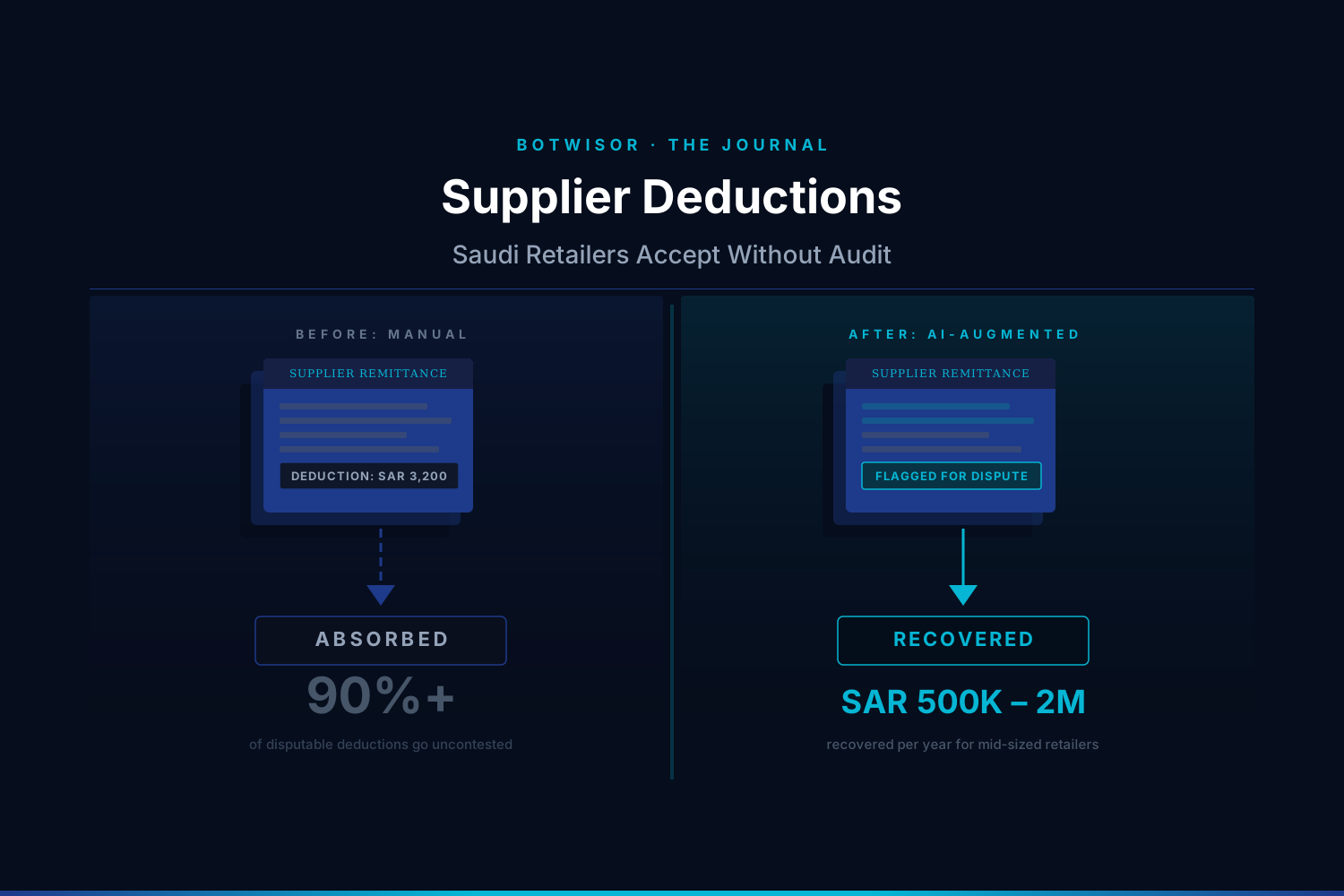
Saudi retailers operating on trading agreements receive supplier deductions from their payments whenever a fulfillment condition is breached. When those deductions are accurate, they belong. When they are wrong, and across large-format retail studies consistently show 15 to 30 percent are, the retailer absorbs the loss. Most go unchallenged: manual AP reconciliation cannot keep pace with the volume.
What Supplier Deductions Are
Trading agreements between Saudi retailers and their suppliers specify performance obligations on both sides. When a supplier ships short, delivers late, violates packaging specifications, or fails to execute promotional pricing correctly, the retailer's agreement entitles it to a financial claim against that supplier. Rather than issuing a separate invoice, the standard mechanism is a deduction: the supplier reduces the amount it pays the retailer, or the retailer reduces the amount it pays the supplier, depending on the payment direction.
The categories are consistent across grocery, fashion, consumer electronics, and home goods: on-time in-full (OTIF) penalties, co-op advertising bill-backs, promotional allowance charges, quality claims, and labeling or packaging violation fees. A Saudi retailer with 200 to 500 active supplier relationships processes deductions across all of these categories in every payment cycle.
The structural issue is not that deductions exist. Trading agreements create them for sound commercial reasons. The issue is what happens after they arrive.
The Scale of Uncontested Deductions in Saudi Retail
For most Saudi retailers, supplier deductions arrive embedded in remittance advice documents or payment notifications. The AP team records the net amount, the deduction is accepted, and the payment cycle closes.
Consider a Saudi hypermarket or specialty chain with SAR 250 million in annual supplier payments. If average deduction rates run at 2 percent of payment value, that is SAR 5 million in deductions processed each year. If 20 percent of those deductions are factually contestable, the recoverable amount is SAR 1 million per year. For a mid-sized retailer running on margins of 5 to 8 percent, that figure is not a rounding error.
The exposure compounds across retailer sizes. Larger operations with broader supplier networks and higher payment volumes face proportionally greater exposure. Smaller retailers with fewer suppliers but less AP resource face the same reconciliation bottleneck at a lower absolute scale.
What makes the problem persistent is that uncontested deductions do not appear as a distinct cost line in any financial statement. They appear as reduced income from supplier accounts, absorbed into the normal variation in trading revenue. Without a systematic matching process, operations leaders have no way to separate legitimate variation from margin that should have been recovered.
Why Manual AP Teams Cannot Keep Up
Three structural factors make manual deduction management ineffective at volume.
Speed against the dispute window. Trading agreements typically specify a window within which the retailer must raise a dispute, often 15 to 30 days from the deduction notice. When AP teams are processing hundreds of invoices per week across multiple supplier categories, dedicating the matching time required to contest individual deductions within that window is not realistic without dedicated resource. The window closes; the deduction stands.
Evidence scattered across systems. Contesting a deduction requires documentary evidence: the original purchase order, the goods receipt record, the delivery proof, and the trading agreement clause. Each exists in a different system. The ERP holds the purchase order. The warehouse management system holds the goods receipt. Email threads hold the trading agreement terms. Pulling them together for each contested deduction is a separate manual exercise for every dispute raised.
Volume discrimination. Faced with a backlog of deductions and limited time, AP managers make a practical judgment: contest deductions above a certain threshold and absorb smaller ones. The result is that small individual deductions, each individually minor, accumulate into a significant unchallenged total. A recurring SAR 2,000 deduction on a weekly payment cycle represents SAR 100,000 per year on a single supplier relationship if never contested.
The Supplier Relationship Concern
There is a second reason deductions go unchallenged: team reluctance to strain supplier relationships through frequent disputes.
This concern is real. Saudi retailers, particularly in categories where supplier concentration is high, manage relationships with major brands carefully. A pattern of aggressive dispute-raising can create friction that affects promotional support, exclusive allocations, and payment term negotiations.
The resolution is not to avoid disputes. It is to raise only well-evidenced ones. A contestation supported by a purchase order, delivery proof, and trading agreement reference is a factual matter, not a commercial challenge. Most supplier finance teams respond to well-documented claims more quickly and more favorably than to undocumented objections.
The operational effect of AI-augmented reconciliation on supplier relationships is typically positive rather than negative. When the retailer raises fewer disputes overall but the disputes it does raise are documented and accurate, supplier finance teams tend to engage constructively because they can verify the claim without additional back-and-forth.
Before and After: Manual vs AI-Augmented Deduction Reconciliation
| Dimension | Manual Reconciliation | AI-Augmented Reconciliation |
|---|---|---|
| Deduction detection | Reviewed when AP team has capacity | Every deduction flagged on receipt |
| Matching to source documents | Manual, hours per deduction | Automated cross-system matching in seconds |
| Dispute rate | 5–10% of contestable deductions raised | 60–80% of contestable deductions escalated |
| Evidence packaging | Compiled manually for each dispute | Structured evidence package generated automatically |
| AP team focus | Processing every deduction individually | Reviewing flagged exceptions and managing supplier dialogue |
| Typical annual recovery | Near zero for most operations | SAR 500K–SAR 2M for mid-sized retailers on SAR 200M–400M supplier spend |
The shift does not reduce AP team headcount in the short term. It changes what the team is asked to do. Instead of processing every deduction, the team reviews exceptions that have already been matched against source documents, scored for disputability based on the trading agreement terms, and queued with the supporting evidence.
The ZATCA Data Foundation in Saudi Retail
Saudi retailers are in a structurally stronger position to automate this process now than three years ago. ZATCA's Fatoorah e-invoicing mandate has progressively moved B2B invoice data into structured, machine-readable formats. Phase 2 integration requirements bring supplier invoices into a data standard that can be matched against purchase orders and goods receipt records programmatically, rather than through manual document review.
When a supplier deduction arrives as a structured data field in a ZATCA-compliant invoice rather than a footnote in a PDF remittance advice, matching it against the relevant purchase order is a data lookup, not a manual reading exercise. Saudi retailers who have aligned their ERP and supplier integration architecture with Phase 2 requirements are carrying reconciliation infrastructure that most have not yet activated for deduction management.
This is one of the clearer cases where Vision 2030's commitment to digital trade infrastructure creates an operational payback beyond regulatory compliance. The data foundation is already in place; the automation layer is the next step.
How to Know If This Problem Is Affecting You
The diagnostic is straightforward. Pull three months of supplier payment data and identify three figures: the share of inbound payments that included deductions, the average deduction value per transaction, and the current dispute rate your AP team is running. If the dispute rate is below 15 percent of deductions received, the operation is almost certainly absorbing recoverable margin.
For Saudi retailers in grocery, fashion, and home goods, where supplier count and payment frequency are highest, this exercise almost always surfaces a materially recoverable amount. The question is not whether the problem exists. It is whether the current AP process was ever designed to find it.
A useful reframe for finance directors: every deduction the AP team does not contest is a unilateral price reduction the retailer granted the supplier. Framed that way, the question is not whether to automate. It is why automation has not already started.
→ Book a free automation audit to assess your supplier deduction reconciliation process, identify what your current AP team is absorbing without audit, and size the recoverable amount.