The Journal
Saudi Retailers Are Forfeiting Supplier Co-Op Funds Every Quarter
Saudi retailers run supplier promotions and wait to be paid. Manual claim tracking lets co-op funds expire uncollected. Here is what changes and how much.
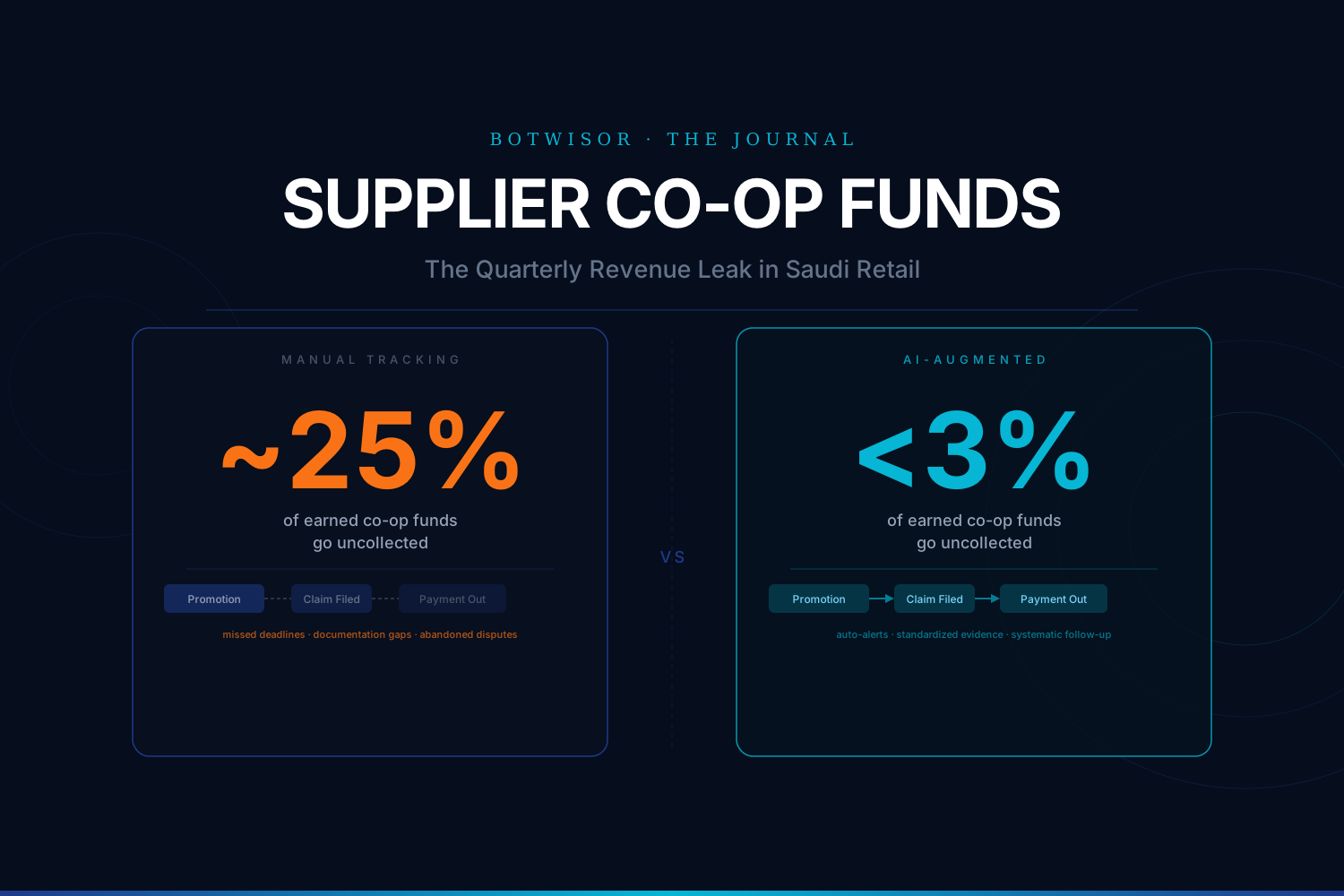
Saudi retailers run promotions for supplier brands, then wait to be paid for them. When claims are tracked manually, a meaningful share expire uncollected or are disputed and abandoned. This is not a minor accounts receivable nuisance: it is a recoverable revenue line that most retailers have never built a systematic process to capture.
What Are Supplier Co-Op Funds?
Consumer goods brands allocate a portion of their marketing budget to fund retail activations: featured shelf placements, promotional pricing campaigns, flyer inclusions, in-store displays, and digital storefront highlights. These funds go by different names across the industry, co-op advertising, trade promotion allowances, marketing development funds, but the commercial structure is consistent. The supplier commits funds to specific activations, and the retailer is entitled to claim those funds once the activation is completed and evidenced.
These arrangements are negotiated as part of annual trading terms. In Saudi Arabia, where mid-to-large grocery chains, home goods retailers, and specialty chains manage commercial relationships with hundreds of suppliers, co-op programs represent a material income line. For a Saudi retailer with SAR 300 to 500 million in annual gross revenue, commercial income from co-op programs typically runs between 2 and 5 percent of sales. That range translates to SAR 6 to 25 million per year in entitled funds.
The mechanics are straightforward: the retailer runs the activation, captures evidence that it ran per specifications, and submits a claim to the supplier's marketing budget. The supplier validates and pays. When the process is systematic, it is a routine receivable. When it runs on spreadsheets and institutional memory, it leaks.
How Saudi Retailers Manage Co-Op Claims Today
Most Saudi retailers track co-op obligations through a combination of account manager spreadsheets, email exchanges, and category buyer memory. Each account manager or category buyer maintains their own supplier relationships and, by extension, their own informal record of what promotions were committed, which have been activated, and which claims have been filed.
At month-end or quarter-end, account managers compile their activations, raise claims on the supplier relationships they have time and bandwidth to action, and submit via email or supplier portals. Claims approaching or past their submission window get deprioritized. Activations without clean photographic or POS evidence get skipped. Suppliers known to dispute aggressively receive fewer claims than the activation record would justify.
Finance teams, working from the receivables ledger, see submitted and collected amounts. They have no view of the gap between what the activation record entitles the retailer to claim and what was actually submitted. The commercial income receivable is systematically understated because no one has a consolidated view of outstanding entitlements.
Where Funds Get Lost Before They Are Collected
The revenue leak occurs at predictable failure points.
Claim window expiry. Most supplier co-op agreements specify a submission deadline, typically 30 to 90 days after the activation period ends. Retailers managing simultaneous campaigns across dozens of brands with a stretched account management team regularly miss these windows. Once the deadline passes, the entitlement is forfeited regardless of whether the activation was executed correctly.
Documentation gaps. Supplier finance teams reviewing claims require evidence: promotional pricing confirmation, shelf placement photographs, activation duration logs, planogram compliance records. When account managers are running multiple activations in parallel, systematic documentation at the standard required for a clean claim submission is not consistently maintained. Underdocumented claims get disputed or rejected outright.
Below-threshold abandonment. Account managers making practical time trade-offs focus on high-value claims and absorb smaller ones. A recurring quarterly activation with a SAR 4,000 co-op claim represents SAR 16,000 per year from a single supplier relationship. Across a hundred-supplier book of business, accumulated below-threshold abandonment is significant.
Dispute attrition. When a supplier disputes a claim, the resolution path through email and manual evidence compilation is long. A portion of legitimate claims get abandoned mid-dispute because the operational cost of resolution exceeds the recovery value, particularly for smaller amounts.
How Much Goes Uncollected Each Year?
Industry research across retail co-op programs consistently shows that 10 to 25 percent of earned co-op funds go uncollected annually in organizations without systematic claim management. The loss is concentrated in smaller activations, newer supplier relationships, and activations where documentary evidence was not captured at execution.
For a Saudi grocery or home goods retailer with SAR 400 million in annual revenue and a co-op income rate of 3 percent, the entitled co-op funds total approximately SAR 12 million per year. At a 15 percent uncollected rate, the retailer forfeits SAR 1.8 million annually. At 20 percent, the forfeiture reaches SAR 2.4 million. For an operation running on net margins of 4 to 6 percent of revenue, the accumulated impact of uncollected co-op funds affects total profitability in a way that does not appear as a distinct cost line on any report.
This is one of the more unusual P&L exposures in retail: a revenue item that disappears not because the entitlement did not exist, but because the process to collect it failed.
Before and After: Manual vs. AI-Augmented Co-Op Management
| Dimension | Manual Process | AI-Augmented Process |
|---|---|---|
| Pipeline visibility | Varies by account manager | Centralized view of all entitlements, deadlines, and claim status |
| Claim submission timing | Triggered by account manager availability | Automated alerts at configurable lead time before each deadline |
| Evidence capture | Ad hoc, inconsistent across teams | Standardized at activation close, linked to each entitlement record |
| Below-threshold claims | Routinely absorbed | Submitted systematically regardless of individual claim size |
| Dispute handling | Case-by-case email resolution | Structured evidence package generated automatically; dispute status tracked |
| Finance view | Submitted and collected amounts only | Accrued entitlements, pending claims, and collected income in one ledger |
| Annual uncollected rate | 10–25% of earned entitlement | Typically under 3% with systematic follow-through |
The process change is not about replacing account manager relationships with supplier brands. It is about removing the claim pipeline from dependence on individual account manager bandwidth and attention. When the infrastructure tracks entitlements, deadlines, and evidence automatically, account managers focus on the supplier relationships that matter rather than on documentation filing.
Finance acquires a real-time view of commercial income accruals, changing how the co-op receivable appears on the balance sheet: earned but uncollected entitlements are visible rather than hidden in the gap between submitted claims and the actual activation record.
What Saudi Retailers Have Not Used the ZATCA Data Foundation For
Saudi Arabia's Phase 2 e-invoicing requirements under the ZATCA Fatoorah program have moved business-to-business invoice and payment data into structured, machine-readable formats. For retailer-supplier commercial income relationships, this creates a data layer that substantially simplifies co-op claim automation.
When promotional pricing, activation periods, and supplier settlement records are exchanged through ZATCA-compliant data structures rather than PDF attachments and email threads, matching activation evidence to co-op entitlements becomes a data lookup rather than a manual document review. Saudi retailers that have aligned their ERP and supplier integration architecture with Phase 2 requirements have a technical foundation for systematic co-op management that most have not yet extended to commercial income claims.
Vision 2030's retail modernization priorities include investment in digital trade infrastructure precisely to enable this category of operational improvement. Saudi retailers activating co-op claim automation as part of their digital transformation programs are not layering on additional complexity: they are directing existing infrastructure toward a revenue line that has been leaking for years.
Signs the Problem Is Material for Your Operation
Four questions surface whether uncollected co-op funds are a significant exposure for your operation.
Does your finance team know, at any point in the quarter, what co-op entitlements have been earned but not yet claimed? If the consolidated figure is unavailable, the commercial income receivable is incomplete.
What is your claim submission rate against total activations completed? If your account management team cannot produce this number quickly, the tracking system does not support it.
How many co-op claims in the last quarter were submitted after the supplier's contractual deadline? Claims filed late are rejected or negotiated down; any positive number here reflects direct forfeiture.
What is your average time from activation close to claim submission? Manual operations typically run four to eight weeks from activation end to claim filing. Against supplier agreements with 30-day windows, this timing forfeits the entitlement by default.
If any of these questions surface a gap, the operation is forfeiting commercial income it has already earned. The question is not whether the problem exists. It is how long the current process has been running without a system designed to collect everything it is entitled to.
→ Book a free automation audit to assess your co-op claim pipeline, quantify the uncollected entitlement, and identify the integration points in your existing ERP and supplier data.