
The Journal
The Subcontractor Retention Audit Saudi Developers Defer Until Project Close
Saudi construction developers withhold 10% retention from every subcontractor payment across dozens of contracts. Most defer formal reconciliation until project close, when disputed figures and missed release milestones have already made the problem significantly more expensive to resolve.
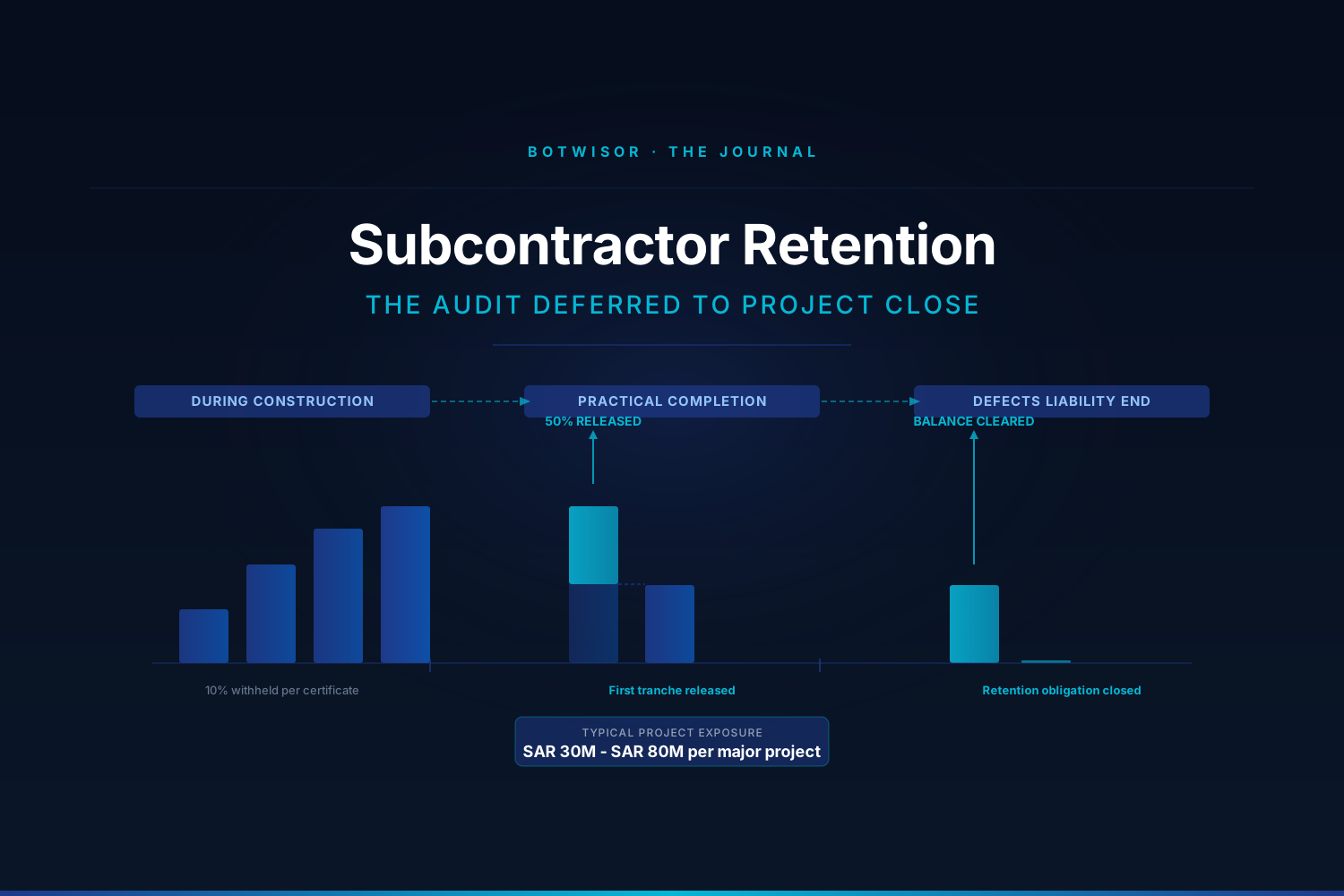
Saudi construction developers withhold 10% retention from every subcontractor payment as a contractual security buffer. Across a project with 40 or more active subcontracts, these liabilities accumulate to tens of millions of riyals. Most development teams defer formal reconciliation until the project closes. By then, errors in the ledger, missed release milestones, and subcontractors owed money for months have turned a manageable accounting process into a close-out dispute with real cost attached.
What Retention Is and Why Subcontractors Track It Closely
In Saudi construction contracts, retention is the percentage of each certified payment that the developer withholds until specific milestone conditions are met. The standard deduction is 10% of each payment certificate value, accumulating until the total reaches a cap of 5% of the overall contract sum.
The retention liability releases in two tranches. The first, typically half the accumulated balance, is due when the subcontractor achieves practical completion of its scope and any outstanding punch list items are formally resolved. The second tranche releases at the end of the defects liability period, usually 12 to 24 months after handover, once the developer certifies no remaining defects.
For a subcontractor delivering civil works on a Riyadh residential tower, the retained amount may reach SAR 900,000 to SAR 1.5 million before any release is triggered. That is real working capital withheld from a firm that has already performed the work. Across 50 subcontracts on a single project, the developer carries SAR 30 million to SAR 80 million in retention obligations at peak construction, each tied to its own milestones, its own contractual history, and its own defect conditions.
How the Liability Accumulates Across a Saudi Construction Project
The arithmetic looks manageable: each payment certificate is reduced by 10%, the deduction is logged, and a running total is maintained per subcontractor. The administrative reality across a live project is considerably more complex.
At any moment, some subcontractors are approaching practical completion and expecting their first release. Others are mid-scope and have not reached the retention ceiling. A few are in defect disputes, which puts their release on hold. Some contracts have been novated, meaning the original firm was replaced mid-project and the retention obligation transferred to the incoming party. Scope variations have altered contract values, which in turn affect the cap calculations and the amount of retention that should have been withheld on each historical certificate.
Managing this across disconnected spreadsheets, contract files scattered through email archives, and payment certificates issued by the quantity surveyor produces a situation where the retention balance in the finance ledger and the retention balance in the project management records diverge. Neither figure is reliable when a subcontractor calls to ask when their release is coming.
What the Close-Out Audit Actually Finds
Most developers do not run a structured retention reconciliation during construction. The task sits in a grey zone between the finance team, which owns the payment ledger, and the project management team, which manages contractual milestones. Neither party holds the full picture, and neither is formally accountable for producing one until the project approaches close.
When the close-out audit finally runs, the findings follow a recognisable pattern. Retention balances in the ledger do not match the payment certificate history. Subcontractors whose first release should have been triggered months earlier are still waiting because nobody formally connected the practical completion certificate to the retention release workflow. In some cases, retention was released in full before the defects liability period expired, removing the developer's contractual leverage to compel repairs. Several subcontractors have outstanding defect lists that were never linked to their retention balance.
The sequence that produces these outcomes is predictable. A subcontractor completes its scope and the project manager signs off practical completion. The project manager emails finance to note the subcontractor is eligible for a first retention release. Finance does not have the retention balance readily available because the ledger needs to be reconciled against the payment certificate history first. That reconciliation takes several days. The payment request then routes through approvals. By the time the transfer initiates, six to eight weeks have passed since the subcontractor finished work.
The subcontractor has been calling weekly. The project manager is fielding questions they cannot answer. Finance is waiting for approvals. The approval chain is waiting for a document that arrived by email three weeks ago.
The table below shows how each stage of the retention process compares between manual management and an automated workflow.
| Retention Stage | Manual Workflow | Automated Workflow |
|---|---|---|
| Retention calculation | Manual deduction entered on each payment certificate | Calculated automatically at certificate approval |
| Cumulative balance | Spreadsheet per subcontractor, reconciled by hand | Real-time balance updated on each approved certificate |
| First release trigger | Identified when subcontractor escalates | Triggered when practical completion is recorded in the system |
| Second release trigger | Depends on someone tracking DLP end dates | Calendar-linked to defects liability period, flagged at expiry |
| Defect linkage | Defect lists managed separately from retention | Outstanding defects block release within the same workflow |
| Ledger accuracy | Diverges from project records over months | Continuous reconciliation against payment certificate history |
| Time to answer a subcontractor query | 1 to 3 days of manual cross-referencing | Immediate: status visible in the contractor portal |
The Cost of Getting the Figures Wrong
The financial exposure runs in two directions, and both are common on Saudi construction projects.
Overpayment occurs when retention is released before the contractual conditions are satisfied: before the defects liability period ends, or before outstanding defects are signed off. The developer loses the leverage to compel the subcontractor to return for repairs. On a project that has partially demobilised, sourcing another contractor to complete outstanding work is expensive. On a SAR 60 million subcontract, an incorrect full retention release at the wrong milestone represents SAR 3 million in contractual leverage surrendered with no recourse.
Underpayment occurs when retention that is legitimately due is not released on schedule. The subcontractor withholds cooperation on remaining scope items, submits formal claims, or in the case of international firms on NEOM or Red Sea corridor projects, initiates formal dispute proceedings. Even where Saudi contract law does not impose interest on delayed retention, the commercial damage compounds through deteriorating relationships, reduced willingness to tender on future projects, and a market reputation for slow settlement.
Vision 2030's construction programme has significantly increased the number of simultaneous projects Saudi developers are running. A developer managing four active projects, each with 35 to 50 active subcontracts at different stages of completion, is tracking 140 to 200 individual retention balances with different release conditions. At that volume, spreadsheet management is not a minor inefficiency. It is a systematic audit risk that materialises at the moment project close demands a precise accounting.
What Changes When Retention Tracking Is Automated
When retention calculation, balance tracking, and release triggering operate through a connected workflow rather than a sequence of manual updates and email threads, three things change immediately.
The balance is always current. Each time a payment certificate is approved, the retention deduction records automatically against that subcontractor's running balance. Finance can pull the figure in seconds when a subcontractor calls, without reconstructing history from spreadsheets.
Release events are driven by milestone records, not by someone monitoring a calendar. When the project management system records practical completion for a subcontract scope, the first retention release calculates and routes for approval automatically. When the defects liability period expires and no outstanding defects are logged against that subcontractor, the second release follows the same route. The process does not depend on anyone remembering to act.
Disputes surface before they escalate. If a subcontractor has an outstanding defect item formally linked to their retention balance, the release is blocked and that block is visible to both the project team and the subcontractor. The subcontractor knows exactly what resolution is required. The project team knows exactly who is responsible for it. The follow-up calls stop because the information is accessible.
The reconciliation that would have occupied the finance team for two to three weeks at project close runs continuously as a background byproduct of the normal payment and milestone approval workflow.
Is This the Right Priority for Your Development Business?
For developers running a single project with a small subcontract base and a short timeline to close, manual retention management is workable, if uncomfortable. The risk profile changes significantly when any of the following apply.
You are running two or more active projects with overlapping construction and handover schedules. Your subcontract base exceeds 25 contracts on any single project. Subcontractors have raised retention queries that your finance team could not resolve quickly. You have completed a project close on a previous development and found that the retention ledger required significant reconstruction before final accounts could be settled.
If those conditions describe your current operations, the gap between your finance records and your actual contractual retention obligations is almost certainly larger than any internal report has surfaced.
A structured review of your retention balances against your payment certificate history and defects liability calendars typically reveals the size of that gap within a few days of analysis. Book a free automation audit and we will map your retention exposure across active projects in one session.