
The Journal
The Snagging Queue Holding Up Saudi Developer Cash Collection
Saudi property developers carry millions in deferred final installments while punch lists overrun. Here is what the delay costs and what a structured snagging workflow recovers.
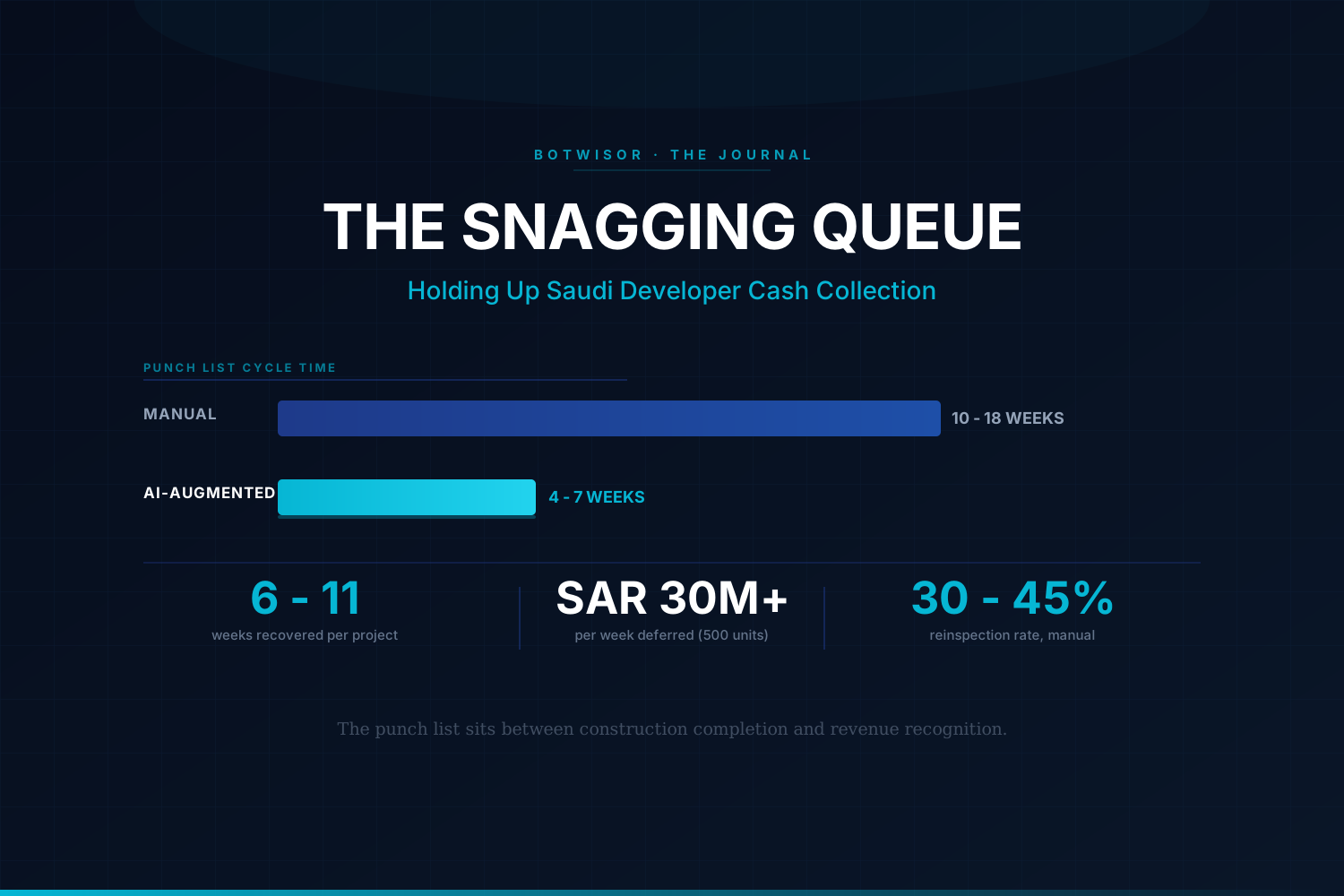
Saudi property developers often complete construction months before collecting final payment. The bottleneck is the punch list: a backlog of defects and sign-offs that must clear before formal handover, title deed transfer, and final installment collection. Developers managing that process on spreadsheets and WhatsApp groups routinely wait 8 to 16 additional weeks compared to projects using structured digital workflows.
What Is Snagging and Why Does It Gate Developer Revenue?
Snagging is the process of identifying, assigning, tracking, and closing defects in a completed unit or building before formal handover to the buyer or tenant. In KSA real estate, clearing the punch list is the prerequisite for:
- The final installment from off-plan buyers (typically 5 to 10 percent of purchase price, withheld until handover).
- Occupancy permits on projects requiring municipal approval.
- RERA registration of completed units.
- Service charge billing start dates on commercial assets.
For a developer handing over 500 units at a SAR 1.2 million average sale price, a 5 percent final installment represents SAR 30 million in deferred revenue for every week the punch list overruns. On larger mixed-use schemes along the Red Sea coastline or in Riyadh's expanding districts, that figure climbs into nine digits.
The Before State: How Saudi Developers Manage Punch Lists Today
Spreadsheets, WhatsApp, and Manual Scheduling
The standard workflow at most mid-size Saudi developers still runs like this: a site inspector walks the unit, photographs defects on a phone, uploads images to a shared folder, records the item in an Excel sheet, and sends a message to the relevant subcontractor on WhatsApp. The subcontractor acknowledges receipt, sometimes. Days later, the inspector returns to check the repair. If the repair is incomplete, the cycle restarts.
The problems accumulate quickly.
There is no single source of truth. Multiple sheets exist for different phases, floors, and buildings, and a defect closed in one version can remain open in another. Subcontractor acknowledgement is informal: no enforceable timestamp, no service-level agreement, no escalation trigger. Reinspection timing depends on the inspector's diary, and when that shifts, the reinspection slips.
Management has no live view of where the punch list stands. A project director typically learns about overruns at the weekly site meeting, not from a dashboard.
What the Timeline Gap Looks Like
A manual snagging cycle for a typical residential building in Riyadh runs 10 to 18 weeks from opening to full sign-off. Industry data from comparable construction markets using digitised snagging workflows shows 4 to 7 weeks as the achievable benchmark. The gap is not structural: the construction quality and the scope of work are the same. The gap is operational.
Every additional week has a direct cash impact. It also compounds in three other ways.
Buyer satisfaction. Defects that surface during the buyer's handover walkthrough generate complaints that are difficult to close after keys are exchanged. In a market where off-plan sales run heavily on referrals and personal networks, the handover experience shapes reputation.
Regulatory standing. RERA monitors developer delivery patterns, and a track record of extended handover periods creates compliance exposure that intensifies when delivery volumes are high.
Operational cost. When the punch list runs long, site staff, project managers, and inspector time continues to be allocated to a project that construction has already finished. The overhead continues without matching revenue.
Manual vs. AI-Augmented Snagging: A Cost Comparison
| Dimension | Manual punch list | AI-augmented snagging |
|---|---|---|
| Cycle time per residential block | 10 – 18 weeks | 4 – 7 weeks |
| Reinspection rate | 30 – 45% of items revisited multiple times | Below 15% with automated SLA and closure tracking |
| Management visibility | Weekly status meeting | Live dashboard with threshold-triggered alerts |
| Subcontractor accountability | WhatsApp message, verbal follow-up | Timestamped assignment, SLA breach logged automatically |
| Final installment collection | Blocked until full cycle completes | Released in parallel as defects close |
| Buyer complaint rate at handover | Elevated; open items surface during walkthrough | Lower; most defects resolved before walkthrough |
| Extended site overhead | Continues until list clears | Reduces proportionally to faster cycle completion |
The SAR exposure varies by project scale. A developer running three simultaneous Riyadh residential towers, each with 200 units at SAR 900K average, carries SAR 27 million in deferred final installments for every month the cycle overruns, before accounting for continued site management costs.
After AI-Augmented Snagging: The Operational Shift
AI-augmented snagging replaces the spreadsheet-and-WhatsApp model with a structured mobile workflow. Defects are logged with structured data (location by floor and unit, category, severity level, photograph), automatically routed to the responsible subcontractor with a defined SLA, and tracked to closure in real time.
The operational shift is concrete in three areas.
Inspector time reallocates from coordination to inspection. Instead of manually tracking which subcontractors have acknowledged assignments and scheduling reinspections from a diary, inspectors work from a prioritised queue. The system surfaces items approaching SLA breach before they become overruns. Reinspections are triggered automatically when a subcontractor marks a repair complete.
Management visibility changes from retrospective to live. A project director can see, per building and per floor, the percentage of items open, in progress, and closed. Escalation rules fire before a pattern becomes a missed deadline.
Handover documentation generates in parallel. Because the defect log is structured and tracked throughout the cycle, the paper trail for RERA registration and final payment is ready when the last item closes. There is no separate documentation assembly step after the list clears.
Where Vision 2030 Adds Pressure
Saudi developers operating within giga-project delivery programs face handover expectations that manual snagging cannot meet at scale. Projects like NEOM, the Red Sea Project, and Diriyah Gate involve phased delivery across dozens of contractor packages running simultaneously. A punch list managed through WhatsApp at that scope generates contractual exposure, not just operational friction.
Away from giga-projects, Vision 2030's home-ownership targets have accelerated off-plan sales volumes across mid-market residential developers. Higher unit volumes mean more concurrent handovers, more final installments at risk, and more RERA registrations pending on a clean defect record. The process that worked for 100 units per year does not hold at 400.
The Cash Position Behind the Operational Problem
Snagging looks like a construction management problem. It is a cash-flow problem. The punch list sits directly between completion and revenue recognition. Every week it overruns is a week the developer is carrying a delivered asset without being paid for it, while site overhead continues and the next project phase waits for capital.
Developers who have moved to structured snagging workflows describe the change in terms that go beyond speed. Site teams spend less time coordinating and more time closing. Management has a current position rather than a lagged estimate. Buyers arrive at handover to sign off units that are already finished, not to compile a new list of open items.
The barriers to making that shift are lower than most developers assume. The workflow runs on mobile devices already present on every site. The critical integration is the subcontractor communication chain, not a core IT system.
If your current punch list cycle is deferring final installments or extending site overhead past practical completion, the first step is understanding what the delay is costing in SAR terms. → Book a free automation audit to map your current snagging workflow, estimate the cash-flow gap, and see what a structured approach would look like at your project scale.