
The Journal
The SME Financing Wait Saudi Banks Are Losing Deals Over
Saudi banks take three to six weeks to process an SME financing application. By the time a credit committee convenes, many applicants have already moved on. The wait itself is the attrition event.
Saudi banks take three to six weeks to process a small and medium enterprise financing application. By the time a credit committee convenes, many applicants have already secured funding elsewhere, delayed a business decision they needed capital for now, or withdrawn their file entirely. The wait itself is the attrition event: not the approval or the rejection.
How Long Does SME Financing Actually Take in Saudi Arabia?
The manual SME credit cycle at most Saudi banks follows a recognizable sequence: a relationship manager (RM) collects documents, a credit analyst builds a financial memo, an underwriting team reviews it, a risk committee meets, and post-approval documentation follows. At each handoff, files queue. At each queue, days pass.
Industry analysis across GCC banking markets places the average decision-to-disbursement timeline for SME working capital facilities at 28 to 45 business days. For term financing above SAR 1M, committees often require additional documentation rounds, pushing timelines past 60 days.
For an SME owner in Jeddah whose seasonal inventory order cannot wait six weeks, this is not a financing gap. It is a closed door.
What Happens While the Bank Is Still Reviewing
The conventional view is that a thorough review protects credit quality. The less-examined view is that extended review systematically selects against the businesses most sensitive to timing: growth-stage companies, seasonal-sector operators, and companies pivoting quickly enough to need a capital decision before the market moves.
What happens in those three to six weeks?
The business owner calls a peer who introduces them to a leasing company. They negotiate an informal mudaraba advance with a supplier. They approach a fintech platform licensed by the Saudi Central Bank (SAMA) that promises a decision in 48 hours. None of these alternatives is cheaper than bank financing. Speed is the product they are actually selling.
By the time the bank's RM calls to say the committee has approved the facility, the need has been met somewhere else. The deal is already closed.
The relationship rarely survives this pattern. An SME that felt deprioritized during a growth decision will not bring its next facility, its payroll account, or its owners' personal banking back to the same institution.
Before and After: The Process Compared
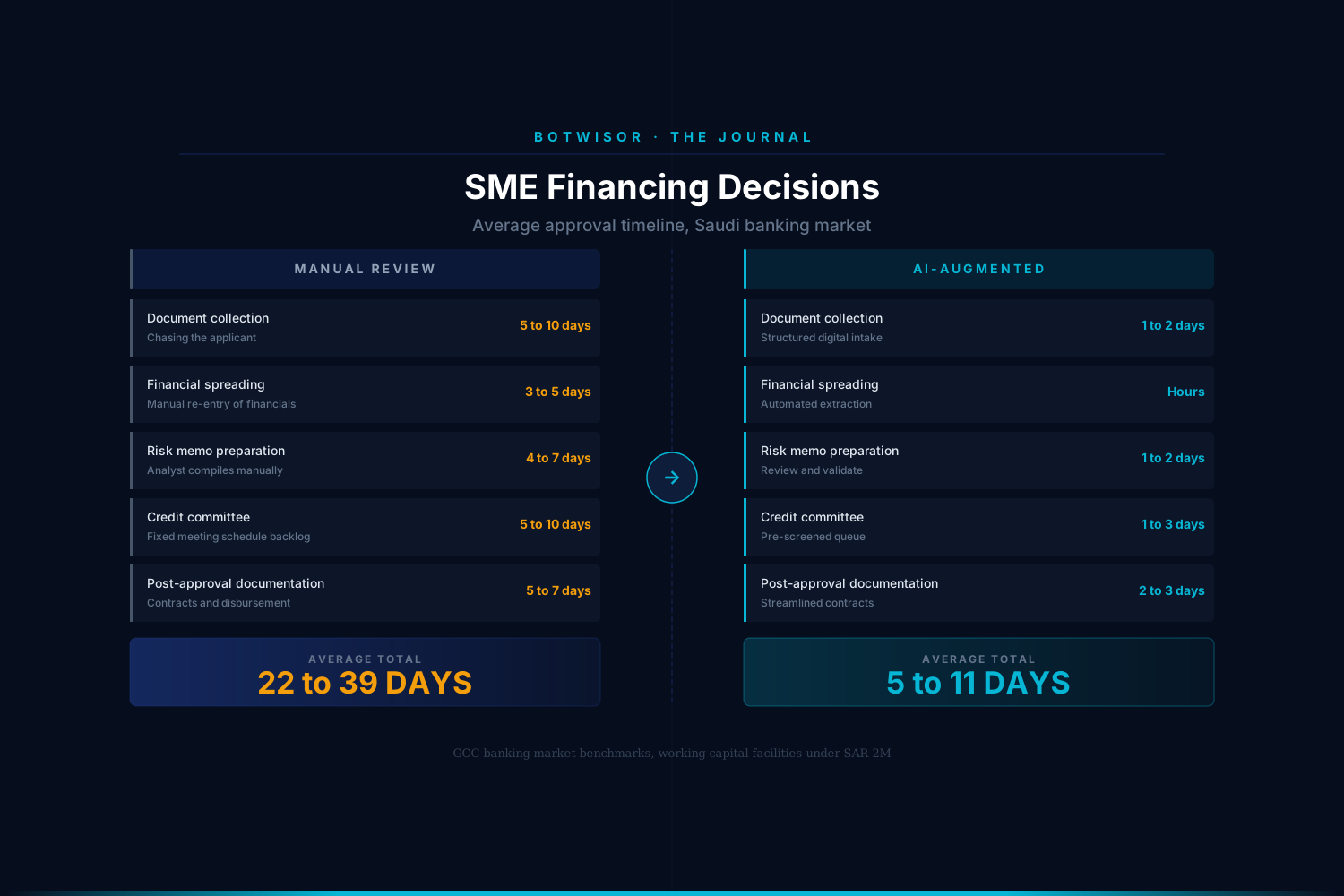
The gap between manual underwriting and AI-augmented credit review is not primarily about accuracy. Saudi bank credit memos are generally thorough. The gap is in speed, capacity, and what an analyst spends time doing.
| Stage | Manual process | AI-augmented process |
|---|---|---|
| Document collection | 5 to 10 business days (chasing the applicant) | 1 to 2 days (structured digital intake) |
| Financial spreading | 3 to 5 days (analyst manually re-enters financials) | Hours (automated extraction from GOSI, ZATCA, statements) |
| Risk memo preparation | 4 to 7 days | 1 to 2 days (analyst reviews, validates) |
| Credit committee scheduling | 5 to 10 days (meeting cadence backlog) | 1 to 3 days (pre-screened files queue faster) |
| Post-approval documentation | 5 to 7 days | 2 to 3 days |
| Total (working capital) | 22 to 39 days | 5 to 11 days |
The analyst does not disappear in this model. The committee does not disappear. The bank's credit policy does not change. What changes is where human judgment is applied: to exceptions and edge cases, not to re-entering data already available in the applicant's GOSI records, ZATCA filings, and banking statements.
The Vision 2030 Context: SME Targets and the Operational Gap
Vision 2030 targets raising SME contribution to Saudi GDP from 20% to 35% by 2030. Access to bank financing is a documented constraint on achieving that target. SAMA has published guidance encouraging banks to streamline SME credit processes. The National SME Authority (Monsha'at) has reported consistently that access to finance ranks among the top barriers to SME growth in the Kingdom.
The gap between policy intent and bank operations is not a risk-appetite problem. Most Saudi banks have adjusted their credit criteria favorably for SMEs over the past three years. The gap is operational: the review infrastructure has not kept pace with the application volumes a growing SME sector generates.
A bank that approves 60% of its SME applications but takes five weeks to do so is not well-positioned for growth. A bank that approves 55% but delivers a decision in a week has a different value proposition entirely.
What the Bank Loses Beyond the Individual Deal
A single withdrawn SME application has a limited direct cost. The compounding effect across a portfolio is different.
Consider a Saudi bank with 4,000 active SME relationships and an annual pipeline of 3,500 new financing requests. If 30% of those pipeline applications withdraw before a decision because of the timeline, that is approximately 1,050 deals per year that never reached a yes or no. At an average facility size of SAR 1.2M, that is SAR 1.26 billion in financing volume that passed through the bank's RM network but never converted.
The fee income and net interest margin on that volume, even at conservative levels, represents a material gap. More difficult to quantify is the relationship attrition: the business owners who moved on, built banking relationships elsewhere, and will not be bringing their next request back.
What Faster Decisions Actually Look Like
Banks that have modernized SME underwriting describe a different kind of RM workday. Relationship managers spend more time in front of clients because they are not chasing document completeness or rebuilding financial models from bank statements. Credit analysts focus on the 20% of applications that genuinely require judgment, rather than spreading all of them. Committees receive pre-filtered files with pre-built risk summaries, so their time goes to decisions rather than to information gathering.
Disbursement timelines that once ran to 45 days compress to under two weeks. Banks operating modernized SME platforms across the GCC have reported consistent seven-day turnaround for standard working capital facilities.
Credit quality does not degrade in this model. In several documented cases, automated document completeness checks and financial spreading have surfaced discrepancies that manual reviewers missed, improving portfolio quality rather than reducing it.
What does not change: the credit committee's authority, the bank's risk appetite, the RM's role as the client-facing point of contact. The automation sits in the back-office steps between application and committee, not in the committee itself.
The Cost of Waiting to Modernize
Saudi banking is competitive. The SAMA-licensed fintech ecosystem that did not exist five years ago is now originating SAR-denominated SME financing at scale. The competitive argument for modernizing SME underwriting was once theoretical. It is now empirical.
Banks that continue to review SME files the way they reviewed them in 2020 are not standing still. They are falling behind a customer segment that has learned it has options, and that measures its banking relationship partly by how long it was asked to wait.
The financing wait is the product. And right now, the product is losing deals it was already in position to win.