
The Journal
When Saudi Commercial Landlords Bill Service Charges Without Verified Cost Allocation
Saudi commercial landlords face mounting tenant disputes over service charges billed without a verified cost breakdown. The gap costs more than the invoice itself.
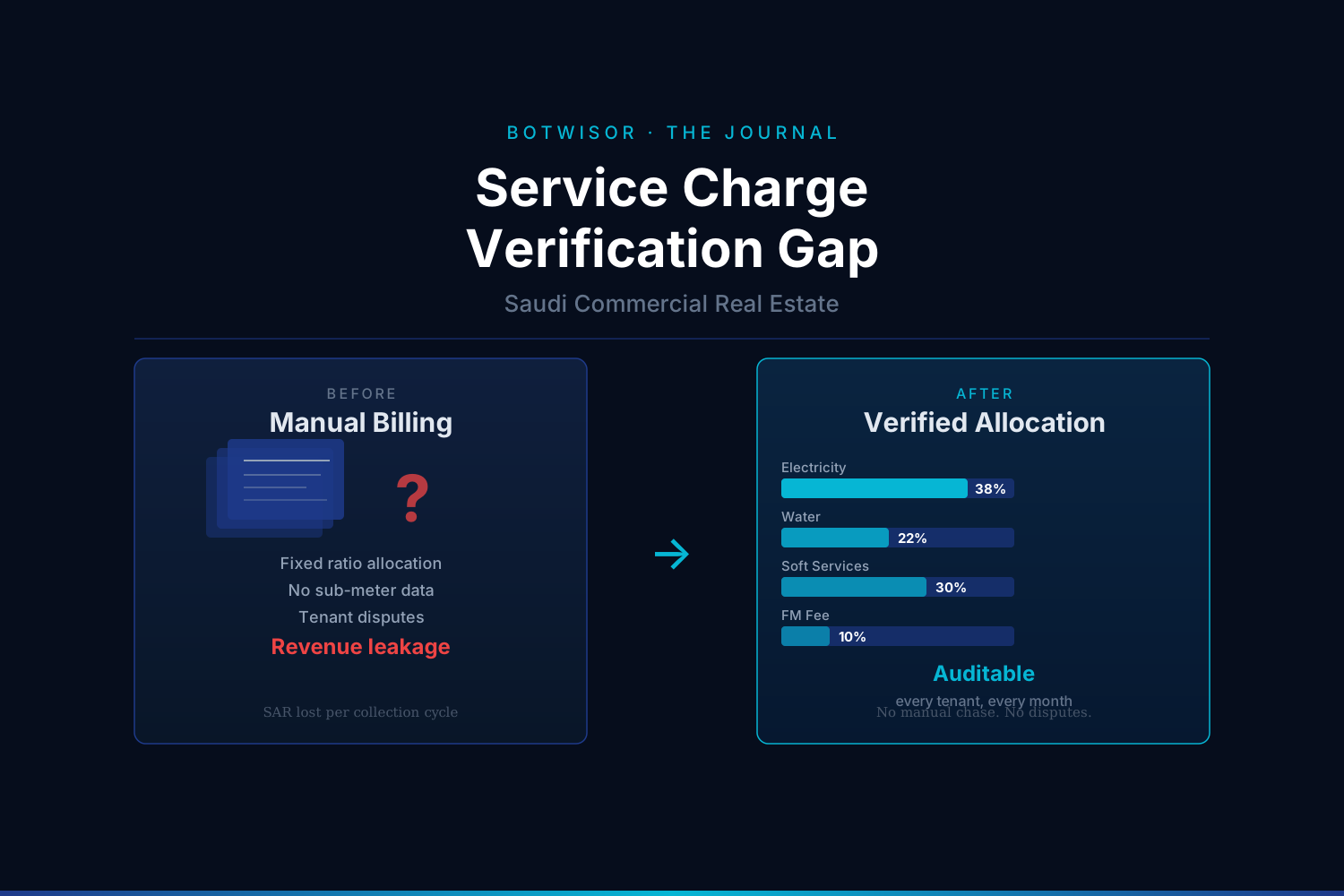
When a Saudi commercial tenant receives a service charge invoice with no supporting breakdown, one of three things happens: they pay it quietly, dispute it on principle, or use the confusion as leverage at renewal time. All three outcomes cost the landlord something. The question is how much they are willing to let that figure compound each year.
What Is a Service Charge in Saudi Commercial Property?
A service charge is a periodic payment from commercial tenants covering their proportional share of building operating costs: utilities, cleaning, security, landscaping, facility management fees, and in some buildings, insurance and administrative overhead. In Saudi Grade A offices and retail centers, service charges typically run SAR 80 to SAR 180 per square metre per year, on top of base rent.
The principle is straightforward. The execution is not.
A commercial building with 40 tenants, three utility accounts, four soft-service contracts, and a master FM agreement generates dozens of input invoices every month. Converting that stack into per-tenant charges requires the right data, the right allocation methodology, and a defensible audit trail. Most Saudi commercial landlords do not have all three.
How Saudi Landlords Typically Calculate Service Charges Today
The standard manual process runs something like this. The property team collects utility bills and service invoices in the week after month-end. A leasing or finance team member allocates costs using a fixed-percentage table built when the building first opened, usually weighted by leasable area. The totals are summed, a management fee is added, and invoices go out.
That process has four structural weaknesses:
- Allocation ratios do not update. Vacancy changes, tenant mix shifts, and anchor-tenant electricity loads vary seasonally. The fixed-percentage table ignores all of this.
- Utility sub-metering is inconsistently applied. Some tenants have dedicated electricity meters; others share a zone meter. When zone meters are not read at the correct cut-off, the allocation for that period is guesswork.
- Soft-service invoices arrive late or in bulk. Security and cleaning contracts often invoice quarterly. When a landlord tries to pass these through monthly, the apportionment involves estimates rather than actual costs.
- FM management fees are rarely shown line-by-line. The percentage markup a property manager charges for coordinating FM vendors is legitimate, but when it appears as a single undisclosed figure, tenants have no way to verify it.
| Cost category | Typical allocation method (manual) | Key weakness |
|---|---|---|
| Electricity | Fixed % by leasable area | Ignores sub-meter actuals and vacancy fluctuation |
| Water | Shared equally or by area | No mechanism to isolate high-consumption tenants |
| Cleaning and security | Monthly estimate from quarterly invoice | Actuals and estimates diverge over time |
| FM management fee | Percentage of total, often undisclosed | No line-level visibility for the tenant |
| Insurance | Annual premium split by area, billed monthly | Renewal timing creates mid-year billing gaps |
Where the Disputes Begin
When tenants receive a service charge invoice in the current Saudi market, their first instinct is to benchmark it. Corporate finance teams in Riyadh and Jeddah are more sophisticated than they were five years ago. They read commercial real estate market reports. They know what Grade B office service charges look like, and they know when a Grade A invoice does not match a Grade A building.
If a landlord cannot produce a cost schedule that ties the invoice total to verifiable input costs, the dispute starts with a simple question: where does this number come from?
That question has two expensive consequences. First, the collection cycle extends. A tenant who disputes a service charge will hold payment until they receive supporting documentation. In a building with several active disputes, this creates a receivables gap the landlord carries for weeks or months.
Second, and more costly, it poisons the renewal conversation. If a tenant has spent three years managing unexplained service charge invoices, the lease renewal becomes a negotiation about more than base rent. They will ask for a service charge cap. They will ask for audit rights. Some will walk.
Saudi commercial real estate is adding Grade A supply at pace, particularly in Riyadh's new business districts and along the development corridor toward NEOM. Tenants who have choices use them.
What the Gap Actually Costs
The direct cost of service charge disputes is measurable even without precise figures: extended collection cycles, fee concessions to settle disputes before they reach a formal channel, and time spent by property and finance staff responding to documentation requests that should not need to be answered manually.
The indirect cost is harder to quantify but larger. Service charge opacity is one of the most cited reasons Saudi commercial tenants request lease modifications or decline to renew. When a SAR 1.2M per year lease is lost in part because of a recurring SAR 60K service charge dispute, the service charge was never the real problem. Trust was.
A verified, documented service charge also has an upside: it justifies the amount. When a landlord can show that their SAR 140 per sqm service charge reflects a fully maintained building with responsive FM and accurate utility allocation, that figure becomes a selling point rather than a source of friction.
| Outcome | Manual billing (unverified) | Verified cost allocation |
|---|---|---|
| Tenant query response time | Days to weeks, manual document chase | Same-day, automated cost schedule |
| Collection cycle | Extended by active disputes | On-schedule, minimal exceptions |
| Renewal negotiation | Service charge becomes a sticking point | Charge is auditable, rarely contested |
| Occupancy risk | Tenant cites billing as reason to leave | Billing builds confidence, not friction |
What Verified Cost Allocation Looks Like
The alternative to manual allocation is not complicated in principle. It requires three changes to how cost data flows through the building management process.
First, utility data feeds into allocation automatically. Where sub-meters exist, their readings link directly to the cost calculation for each tenancy. Where zone meters are shared, the allocation rules are documented and applied consistently, not adjusted quarter by quarter.
Second, service invoices reconcile against contract commitments before allocation. A cleaning invoice that differs from the contracted rate triggers a review before it is passed through to tenants, not after they dispute it.
Third, the service charge statement is self-explaining. Each tenant's invoice shows the building total for each cost category, their allocation percentage, and the basis for that percentage. No supporting request needed.
This is not a theoretical standard. Saudi REITs and institutional landlords operating at scale already work this way. The gap sits in the mid-market: developers managing three to fifteen commercial properties who have not yet built the systems their tenants expect.
The Vision 2030 Context
Saudi commercial real estate is a priority sector under Vision 2030. The targets are substantial: higher private-sector employment, expanded office markets in secondary cities, and a retail real estate market aligned with domestic consumption growth. More tenants are entering long-term commercial leases, and their expectations are rising with the market.
REGA's disclosure requirements and the broader professionalization of Saudi property management are pushing the sector toward institutional standards. Landlords who can demonstrate verified, auditable service charge processes are better positioned to attract corporate tenants and institutional capital, and to retain them when the market tightens.
The Exit From Manual
The problem is not that Saudi commercial landlords are careless with service charges. It is that the manual process does not scale to the complexity of what a commercial building actually costs to run, and the gap between what the invoice says and what can be verified is where tenant trust erodes.
Automating cost allocation does not require replacing your property management platform. It requires connecting the data that already exists, applying consistent allocation logic, and generating statements that close the documentation gap before a tenant opens it.
If your current service charge process cannot produce a verified cost schedule in under an hour when a tenant asks for one, the process is costing you more than the time it takes to pull the data.
→ Book a free automation audit to identify where your service charge process is creating exposure and how to close it.