
The Journal
Saudi Bank Collections: From Manual to AI Recovery
Saudi consumer lenders lose significant recovery probability every month manual call queues delay contact. Here is what AI-orchestrated collections changes operationally.
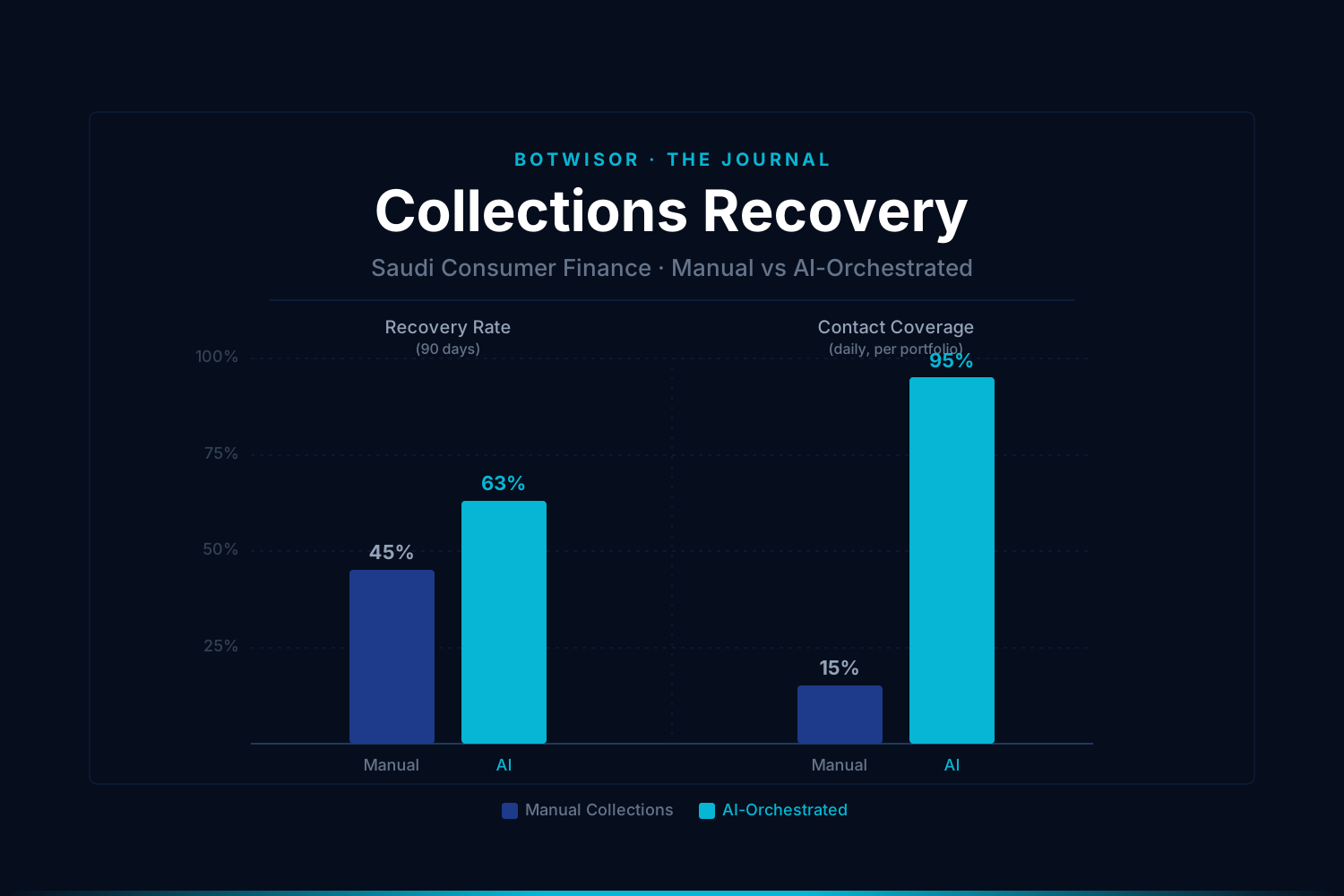
Saudi consumer lenders typically recover less than half of overdue balances within the first 90 days when collections run on agent call queues and manual portfolio tracking. AI-orchestrated collections change that outcome: case prioritization, automated Arabic-channel outreach, and real-time promise-to-pay monitoring compress resolution cycles by weeks and recover balances that manual follow-up lets lapse into deeper delinquency.
The Collections Challenge in Saudi Consumer Finance
Saudi consumer lending has expanded sharply over the past decade, with personal finance, auto loans, and point-of-sale credit proliferating across Riyadh, Jeddah, and the Eastern Province. Volume growth, however, brings proportional growth in overdue accounts. SAMA's regular supervisory publications show non-performing exposure in the consumer segment has grown alongside portfolio size.
Behind every non-performing loan figure is a collections operation. At most mid-sized and regional Saudi banks, that operation looks like this: a small team of agents, each managing hundreds of accounts, working through a list in whatever order it arrives, recording notes in a CRM or on spreadsheets, escalating edge cases to a supervisor by phone. Weekend delinquencies wait until Sunday. Ramadan and Eid holiday periods build a backlog that swallows the critical early-contact window.
The math is unforgiving. Industry benchmarks across consumer lending markets consistently show that recovery probability drops by roughly 15 to 20 percent for every 30-day aging bucket an account passes through. An account at day 1 of delinquency might carry a 75 percent recovery probability; at day 90, the same account can sit below 40 percent. Manual operations burn that probability window without realizing it.
Where Manual Collections Lose Recovery Probability
No Propensity Scoring
A manual collections queue treats accounts by age or balance size. A first-ever missed payment on a five-year account from a customer with a strong SIMAH history receives no different handling than a chronic late payer in the same bucket. Without a propensity-to-pay model, agents contact the wrong accounts first, miss the brief self-cure window for low-risk cases, and concentrate too little attention on accounts where firm engagement would have yielded a payment arrangement.
Limited Outreach Capacity and Channel Coverage
A collections agent managing 400 accounts can meaningfully contact 40 to 60 on a given day. The remaining 85 to 90 percent wait. That constraint is not a staffing problem; it is an architectural one. Automated outreach via WhatsApp, SMS, and in-app notifications can reach the full book simultaneously, in Arabic, at the optimal time of day for each customer segment. The agent team is then free for accounts that genuinely need human negotiation.
Channel coverage matters as much as volume. Most Saudi consumers prefer WhatsApp over phone calls for financial notifications. A collections function limited to agent phone calls is structurally disadvantaged against one that reaches customers on their preferred channel before accounts age further.
SAMA Communication Rules and Compliance Risk
SAMA's consumer finance regulations impose contact-window restrictions, frequency caps, and channel requirements on collections outreach. Manual agents under pressure to hit recovery targets sometimes call outside permitted hours or exceed permitted contact frequency, creating audit exposure during SAMA examinations. The problem is not intent: it is inconsistency, with each agent interpreting edge cases differently in practice.
Compliance risk in collections is not theoretical. SAMA's consumer protection supervisory framework continues to tighten, and examinations increasingly scrutinize collections conduct alongside lending practices.
Promise-to-Pay Monitoring That Breaks Down
When an agent agrees a payment arrangement with a customer, that commitment requires logging, monitoring, and follow-up if the payment does not arrive on time. In manual operations, broken arrangements often sit undetected until the account's next scheduled call cycle. The 24 to 48-hour window after a missed arrangement date is the highest-leverage moment for re-engagement. Automated monitoring catches it; manual review cycles frequently do not.
Before and After: A Saudi Consumer Finance Portfolio
The comparison below reflects operational patterns common across mid-sized KSA consumer lenders. Figures are indicative; actual outcomes depend on portfolio mix, delinquency bucket composition, and implementation quality.
| Dimension | Manual Collections | AI-Orchestrated Collections |
|---|---|---|
| Case prioritization | Age-sorted or balance-sorted queue | Propensity-to-pay scoring, dynamic re-ranking |
| Daily outreach capacity | 40-60 meaningful contacts per agent | Full-book automated outreach per day |
| Arabic channel coverage | Phone-call dominant | WhatsApp, SMS, in-app, Arabic-native messaging |
| Regulatory compliance | Agent-dependent, inconsistency risk | SAMA rules encoded as non-overridable guardrails |
| Promise-to-pay monitoring | Manual log, periodic review | Real-time monitoring, automated follow-up trigger |
| 90-day recovery rate (indicative) | 40-50% of early-stage cases | 58-68% of early-stage cases |
| Supervisory visibility | End-of-day reporting | Live dashboard per agent and per bucket |
The recovery rate improvement in the "after" column does not come from pushing agents harder. It comes from contacting the right accounts at the right time on the right channel and closing the monitoring gaps that let recoverable accounts slip past the window.
What AI Orchestration Actually Does
An AI-augmented collections operation does not eliminate agents. It restructures what agents do.
A typical deployment tiers the portfolio by propensity-to-pay and case complexity:
- Accounts with a high self-cure probability (first missed payment, strong SIMAH history, no prior delinquency) receive automated WhatsApp or SMS nudges in Arabic. Most resolve without agent involvement.
- Accounts that did not self-cure after automated outreach, or that carry a moderate recovery probability, receive escalated automated follow-up and queue for an agent call at the highest-probability contact window for that customer profile.
- Accounts in deeper delinquency, flagged for hardship indicators, or in active dispute route directly to senior agents or specialist negotiators, with full case history and prior outreach records surfaced automatically.
Agents spend their time on tier 3. That is the highest-value use of a trained collector: complex negotiation, hardship assessment, legal escalation decisions. The tier 1 and tier 2 activity that currently consumes 60 to 70 percent of agent hours runs automatically, at a fraction of the per-contact cost.
The PDPL Compliance Layer
Saudi Arabia's Personal Data Protection Law imposes specific obligations on how collections data is stored, used, and communicated to data subjects. Manual operations typically address PDPL compliance through policy documentation and periodic training. AI-augmented systems embed consent logic, data minimization constraints, and retention rules into the workflow itself, making compliance a design property rather than a behavioral one.
For banks undergoing PDPL readiness assessments, a collections function with demonstrable embedded compliance controls is a structurally stronger position than one relying on agent adherence to documented policies. The auditor reviews system configuration rather than call recordings and training logs.
The Compounding Cost of Waiting
Every month a collections operation remains manual, accounts continue to age through the delinquency buckets where recovery probability falls. A portfolio with SAR 50 million in early-stage delinquency that recovers at 45 percent leaves SAR 27.5 million unrecovered. Shifting that recovery rate by 15 percentage points through AI orchestration would recover an additional SAR 7.5 million from the same portfolio. Delayed by six months, six cohorts of early-stage accounts have already aged through their highest-yield recovery window.
Vision 2030's Financial Sector Development Program sets explicit digitization targets for SAMA-regulated institutions. The regulatory posture, supervisory expectations, and competitive landscape are all moving in the same direction. Lenders that restructure their collections function now preserve their current portfolio performance and build the operational foundation for the consumer credit growth projected through the rest of the decade.
Where to Start
The most useful first step is not a technology purchase: it is a precise audit of where the current collections workflow loses recovery probability. Which delinquency buckets have the widest gap between contact rate and account count? Which channels are reaching customers and which are missing them? What is the broken-promise-to-pay rate, and how quickly does a missed arrangement date trigger re-engagement?
That diagnostic is exactly what BotWisor's automation audit covers. → Book a free automation audit to map your current collections operation against what AI orchestration makes possible in your portfolio.