
The Journal
How Much Saudi Banks Pay for Each SAMA Report They Build by Hand
Saudi bank finance teams spend two weeks per quarter building SAMA reports manually. The cost in staff time and submission risk compounds with every cycle.
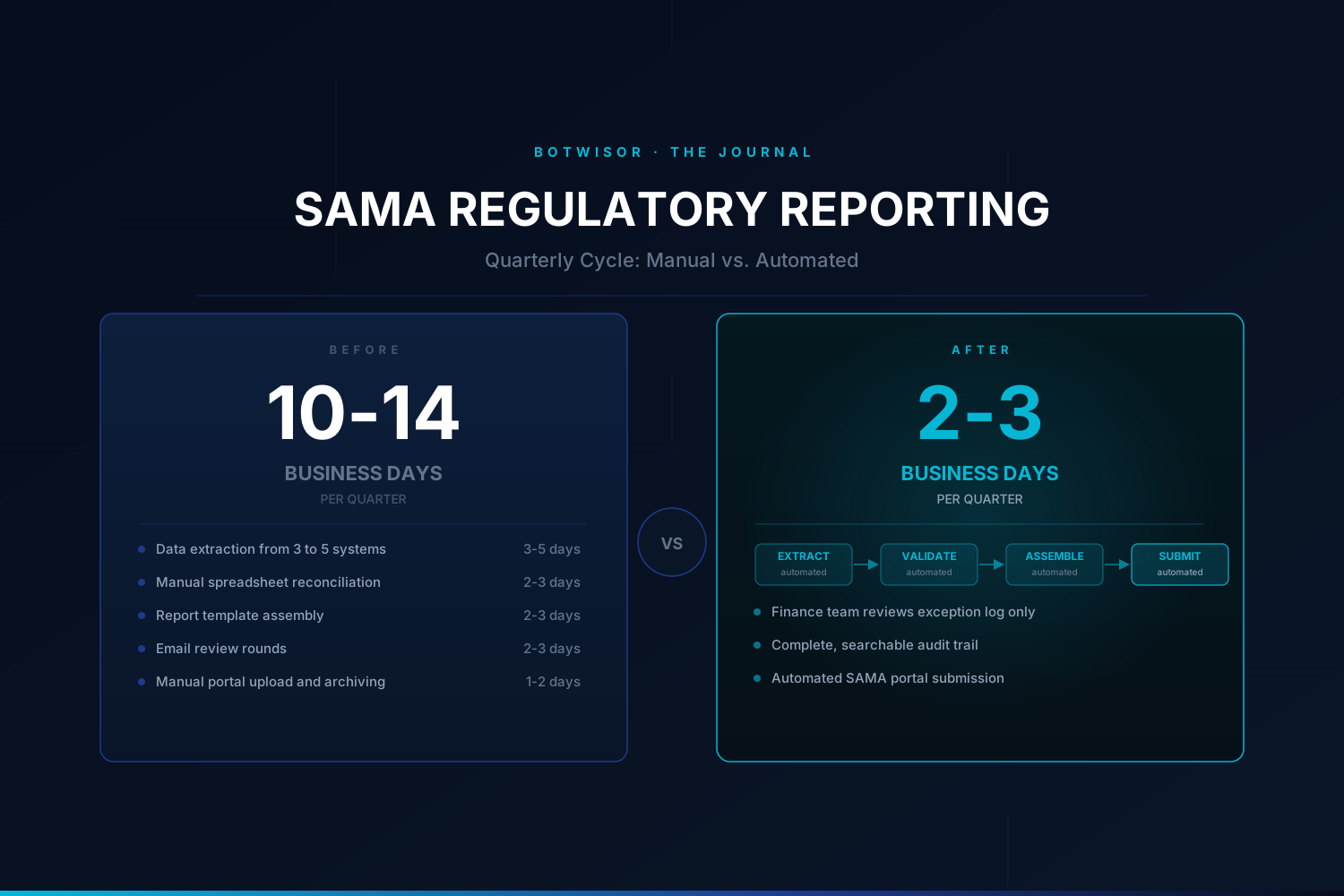
Most Saudi bank finance teams assemble SAMA regulatory filings the same way they have for years: export data from the core banking system, move it into spreadsheets, reconcile discrepancies by hand, build the required formats, and submit on deadline. The typical quarterly cycle takes between ten and fourteen business days. The cost, measured in staff hours and submission risk, accumulates every quarter and rarely appears in any management review.
Why SAMA Regulatory Reporting Takes Longer Than It Should
SAMA requires Saudi banks to file a range of periodic reports: monthly balance sheet and income data, quarterly capital adequacy and liquidity ratios, and annual submissions tied to ICAAP and other supervisory processes. For banks with multiple subsidiaries, Islamic finance windows, or regional branches, each filing cycle requires consolidating data from several source systems before reporting can begin.
The manual steps accumulate quickly. A standard quarterly cycle for a mid-size Saudi bank involves:
- Extracting raw figures from the core banking platform, plus loan management, treasury, and general ledger systems.
- Mapping each extract to the SAMA report template, which requires understanding the regulatory definitions that govern each line item.
- Reconciling the extracts against each other, because figures from three or four separate systems rarely align on the first pass.
- Constructing the formatted submission in the SAMA-specified structure.
- Running an internal review cycle across finance, risk, and compliance.
- Submitting the final version and archiving supporting documentation for examination purposes.
Finance teams that have run this process repeatedly develop informal workarounds to manage the workload. Those workarounds are built around the manual constraint, not around the underlying regulatory obligation.
What the Manual Cycle Actually Costs
The staff time is the most visible cost. A three-person finance team spending ten days per quarter on SAMA reporting commits roughly forty days per year to a single reporting obligation, before accounting for monthly submissions, ad hoc SAMA inquiries, and Basel-related filings running on a parallel track.
At a blended salary cost of SAR 15,000 per month per analyst, a three-person team represents SAR 540,000 per year in direct compensation. A conservative estimate placing thirty percent of that time against the manual reporting cycle puts the attributable cost above SAR 160,000 annually, for one regulatory reporting stream.
The less-visible costs compound on top of that.
Error-correction cycles are a routine part of the manual process. When a balance sheet figure does not reconcile against the prior period, teams must trace the discrepancy back to its source system, which often means coordinating with IT or the treasury operations desk. Each trace takes time that cannot be recovered before the deadline.
Version control is a persistent problem that few finance teams formally account for. When multiple reviewers work from a shared spreadsheet, the risk of someone editing an older version, or of the final submission not matching the internally approved draft, is significant. Most teams manage this through email chains and manual version labeling. Under a SAMA examination, an inability to produce a clean version history of the figures is an exposure that sits alongside the reporting risk itself.
The time pressure compounds across the year. A bank managing monthly SAMA monitoring reports alongside quarterly capital and liquidity submissions runs a near-continuous reporting cycle. The manual overhead does not pause between quarters; it restacks.
Before and After: What the Reporting Cycle Looks Like
The table below reflects realistic operating estimates for a mid-size Saudi bank running a manual reporting cycle alongside one that has automated the same process.
| Step | Manual Process | Automated Process |
|---|---|---|
| Data extraction | Analyst exports from 3 to 5 source systems, typically weekly | Automated connectors pull from source systems on a nightly or continuous basis |
| Reconciliation | Manual cross-checking across spreadsheets, with error traces to source | Rule-based validation flags exceptions at the line-item level automatically |
| Report assembly | Analyst populates SAMA templates and reformats figures to specification | Templates auto-populate from validated data, formatted to SAMA requirements |
| Internal review | Two or three rounds of email review, with version-control risk throughout | Single review of the exception log, with a complete and searchable audit trail |
| Submission | Manual upload to the SAMA portal, with offline record-keeping | Automated submission workflow, with confirmation archived to the regulatory record |
| Total cycle time | 10 to 14 business days per quarter | 2 to 3 business days per quarter |
The reduction in cycle time is not cosmetic. Eleven or twelve recovered working days per quarter is the difference between a finance team managing reporting logistics and a finance team contributing to analysis.
The SAMA Examination Factor Most Banks Have Not Priced In
SAMA's supervisory framework has strengthened significantly since 2020. The Financial Sector Development Programme, a core pillar of Vision 2030, includes explicit targets for improving the quality and timeliness of regulatory data across the banking sector. Banks that can demonstrate real-time access to their own regulatory data are better positioned during examination cycles than those that cannot.
A bank that responds to an ad hoc SAMA data request with a validated export in two hours signals a different level of operational maturity than one that asks for a deadline extension. That signal accumulates across examination cycles. It shapes the supervisory relationship over time and influences how examination teams calibrate their scrutiny.
For banks still running manual reporting cycles, the examination risk is specific and foreseeable. An examiner who arrives for a routine cycle and requests a breakdown of a balance sheet line item is not just testing the number. The examiner is testing the bank's ability to support that number on demand, with a documented trail. Banks that can produce that support in hours, through an automated reporting stack with complete data lineage, answer that question before it becomes a finding. Banks that need to reassemble figures from spreadsheets and email threads answer it differently.
Saudi banks evaluating investment-grade ratings or expansion into other Gulf markets also face this operational maturity question from credit analysts and international counterparties. The reporting infrastructure is increasingly part of the assessment.
The PDPL Angle That Sits Inside Every Manual Reporting Cycle
Manual regulatory reporting typically means regulatory data held in spreadsheets on individual analyst workstations, shared over email, and stored in personal folders. That data includes customer account figures, exposure breakdowns, and identifiers that fall under the scope of personal data protection requirements.
PDPL, which came into full effect for financial institutions in 2024, requires that personal data be handled in controlled, auditable environments with documented access governance. Spreadsheet-based workflows are difficult to audit at the data-handler level. Most banks running manual reporting cycles do not have a clear log of which analyst accessed which version of a regulatory file, when, and with what authorization.
This creates a compliance exposure that runs alongside the reporting risk. It is rarely discussed as part of the cost of manual SAMA reporting, but it belongs in the same calculation.
What Automation Changes for the Finance Team
Automated regulatory reporting is not a self-driving process. What it changes is where the finance team's attention goes.
In a manual environment, the finance team is primarily a data-assembly and reconciliation operation. The analytical judgment that experienced finance professionals are hired to apply gets crowded out by the logistics of pulling and matching data from disconnected systems.
In an automated environment, the system handles extraction, transformation, validation, and assembly. The finance team's role shifts to reviewing the exception log, applying judgment to flagged items, and signing off on the final submission. The analytical capacity is preserved. The deadline pressure is reduced. The audit trail is complete and searchable.
What automation cannot replace is the bank's regulatory obligation, the finance team's sign-off authority, or the relationship with the external auditor. Those responsibilities remain with the people who hold them. The automation removes the mechanical labor that currently crowds out judgment.
The Staffing Calculation Most Saudi Bank CFOs Have Not Run
Saudi banks have added reporting headcount to absorb growing regulatory requirements under the FSDP and wider Vision 2030 governance expectations. That headcount is now a fixed operating cost. The question is whether it is being applied to regulatory judgment or to regulatory logistics.
For banks still running manual reporting cycles, the answer is mostly logistics. The opportunity is not to cut the headcount but to redirect it. A team that spent forty days per year assembling SAMA reports can apply that same capacity to stress testing, scenario analysis, or the forward-looking capital planning that SAMA examiners increasingly expect to see in ICAAP submissions.
The first step is understanding the actual cost of the current reporting cycle, which most Saudi banks have not calculated at the line-item level. That calculation is where an assessment of the reporting process begins.
→ Book a free automation audit to map the cost of your current SAMA reporting cycle and identify where the process can be automated without disrupting the sign-off chain.