
The Journal
The Returns Backlog Draining Repeat Business for Saudi Retailers
Return cycles of 10 to 18 days are the norm in Saudi e-commerce. The real cost of slow processing is not the refund amount: it is the repeat customer you lose while the backlog builds.
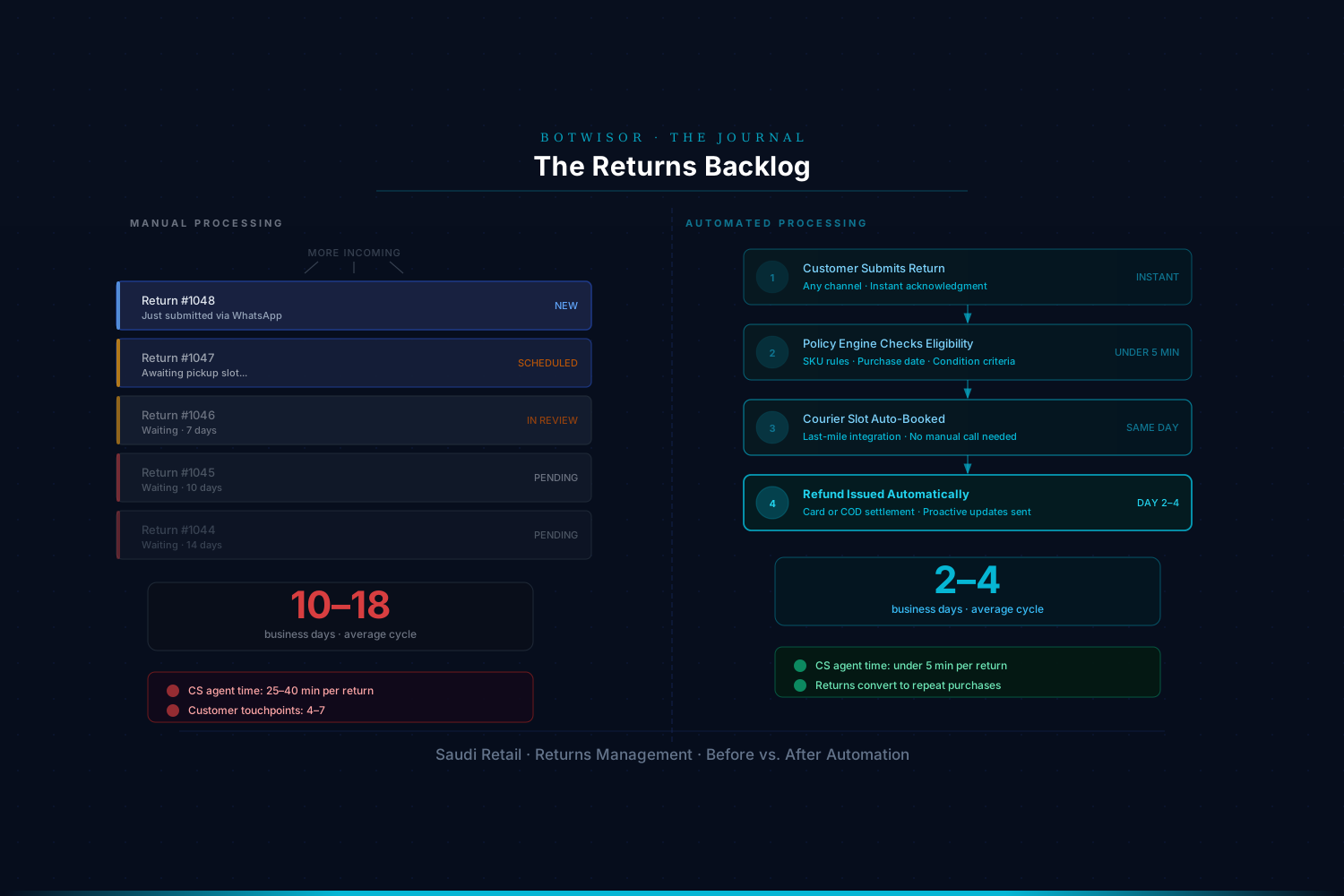
Saudi retailers who resolve returns cleanly keep the customer. Those who leave shoppers waiting 10 to 18 business days for a refund confirmation typically do not. The difference is almost entirely operational, and it compounds: every day the backlog builds is a day the repeat-purchase rate for that cohort is being quietly suppressed.
Why Returns Have Become a Competitive Variable in KSA
Saudi e-commerce has grown faster than most market infrastructure anticipated. Payment rails matured quickly. Last-mile delivery networks expanded across major cities and secondary markets. But post-purchase operations, particularly returns, lagged behind. Most retailers built their ops for a market where returns were rare; in modern KSA e-commerce, especially in fashion and electronics, returns are routine.
Fashion return rates in Gulf e-commerce markets typically run between 15 and 25 percent of order volume. For some sub-categories, the figure is higher. Returns are not the structural problem. The time and friction involved in processing them is.
Three realities compound the challenge specifically in the Saudi market:
Address granularity. A meaningful share of Saudi delivery addresses lack the street-level precision common in more mapped markets. Pickup scheduling for a return requires a human confirmation loop, adding 24 to 48 hours before a courier can even be dispatched.
WhatsApp as the primary returns channel. Saudi shoppers initiate returns predominantly through WhatsApp. This routes every request into a manual queue managed by CS agents already handling inquiries, complaints, and exchange requests simultaneously.
Cash-on-delivery volumes. Where COD is involved, the refund requires an additional step: a bank transfer initiated manually, which extends the settlement window further and creates a separate reconciliation task.
These are structural constraints. Hiring more CS agents absorbs cost without eliminating the lag.
How Manual Returns Actually Work in Saudi Retail
A typical manual returns journey in Saudi e-commerce proceeds like this:
- Customer messages the WhatsApp support line, attaches photos, states the reason.
- A CS agent reviews the message, checks the order number manually against the order management system, confirms eligibility. This step alone takes 4 to 24 hours depending on queue depth.
- Approval is sent. The customer is asked to drop off at the nearest store or to wait for a pickup slot.
- Pickup scheduling proceeds manually, often including a phone call to confirm address and availability. Average lag: 2 to 3 business days.
- The item returns to the warehouse and is inspected on arrival.
- If the item clears inspection, the refund is initiated. For card payments: 5 to 7 business days to the customer's account. For COD: a manual bank transfer, queued separately.
Total elapsed time from request to refund received: 10 to 18 business days in a typical manual setup.
During those 10 to 18 days, the customer is in a holding pattern. They have spent money, received something they do not want, and are waiting for a resolution. Whether they return to buy again depends almost entirely on how cleanly and quickly that resolution arrives.
What the Numbers Show: Manual vs. Automated
| Stage | Manual Processing | AI-Augmented Processing |
|---|---|---|
| Initial eligibility check | 4–24 hours (agent review) | Under 5 minutes (policy engine) |
| Pickup scheduling | 2–3 business days (manual) | Same day or next day (automated slot) |
| Warehouse inspection trigger | On physical arrival | Triggered by courier scan event |
| Refund initiation | 1–3 days post-inspection | Same day as inspection confirmation |
| Total cycle time | 10–18 business days | 2–4 business days |
| CS agent time per return | 25–40 minutes | Under 5 minutes (exceptions only) |
| Customer touchpoints required | 4–7 (confirmations, calls) | 1–2 (submit plus status updates) |
These figures are directional. The specific numbers vary by retailer volume, category, and existing tech stack. But the structural advantage of automation is consistent across operator profiles.
What a Slow Return Actually Costs
The true cost of a slow return is not the refund amount. It is what the customer would have bought next.
A fashion retailer where customers average 3 to 4 purchases per year at SAR 350 to SAR 500 per basket loses SAR 1,050 to SAR 2,000 in forward revenue for every customer the returns experience causes to churn. That figure does not include the cost of eventually reacquiring that customer through paid channels, which typically runs at a significant premium over retention spending.
Research across e-commerce markets consistently shows that shoppers who rate their returns experience as smooth are significantly more likely to place a follow-on order within 30 days. In Saudi Arabia, where the e-commerce market is growing rapidly and competitive options are expanding under Vision 2030's Digital Economy pillar, the returns experience has become a measurable retention variable rather than a back-office operational footnote.
An automation investment of SAR 15 to SAR 25 per return, built into a broader operations program, is not a cost center. It is a retention mechanism that pays forward in repeat-purchase frequency.
What AI-Augmented Returns Look Like
The operational difference in an automated returns workflow is visible at every stage:
Eligibility determination. The customer submits through whatever channel the retailer operates, whether app, website, or WhatsApp chatbot. A policy engine evaluates the request against purchase date, SKU rules, and condition criteria. Clear cases are approved in under five minutes with no agent involvement.
Logistics coordination. Approved returns automatically trigger a courier booking. The customer receives a pickup slot confirmation directly, without a manual scheduling call. Integration with last-mile providers eliminates the address confirmation bottleneck that currently adds days to the process.
Warehouse-side processing. When the return arrives, a scan event triggers the inspection workflow automatically. For high-velocity SKUs, the system flags condition outliers against pre-set quality thresholds, routing exceptions to agents while processing clean returns without human touch.
Refund initiation. Qualifying returns trigger refunds automatically upon inspection confirmation. Both card and COD settlements are handled via payment provider integration. Customers receive proactive status notifications at each stage, without needing to follow up.
Exception handling. Disputed conditions, potential fraud signals, and policy edge cases are escalated to agents with full context already loaded. The agent's job is judgment on complex cases, not data entry on straightforward ones.
The net experience communicated to the customer: your time is respected, the resolution is in motion, and this retailer can be trusted for the next purchase.
Who Should Prioritize Returns Automation First?
Returns automation generates the highest near-term return on investment in three retailer profiles:
High-volume fashion and apparel. Return rates are structurally elevated, and the cost of a poor returns experience in a category with strong competitive substitutes is particularly high. CS agent time consumed by returns also competes directly with pre-purchase support capacity.
Electronics and high-value goods operators. Return windows are legally mandated under Saudi consumer protection regulations. Automation ensures consistent compliance and reduces regulatory escalation risk and credit card chargebacks, which carry their own cost and relationship implications.
Omnichannel operators with both physical stores and online presence. Enabling in-store returns for online purchases, while reconciling inventory across both channels manually, creates compounding errors and delayed reporting. Returns automation resolves the reconciliation gap alongside the customer-experience gap.
If your operation processes more than 200 returns per week and your average cycle runs longer than 7 days, the operational and retention case for automation is already clear.
How to Move From Backlog to Retention Asset
The retailers who compete effectively in Saudi e-commerce over the next five years are not necessarily those with the lowest price point or the widest catalog. They are the ones who make it easy to buy again. A smooth return is one of the clearest operational signals a retailer can send: this transaction will be honored, no matter how it ends.
Manual returns processing is not a minor inefficiency. It is a structural leak in the repeat-purchase pipeline. Every day the backlog builds is another day the cohort of affected customers is moving toward a different default retailer.
The path from backlog to retention asset does not require a full technology overhaul. It starts with a clear-eyed mapping of the current returns journey: where customers wait, where agents intervene unnecessarily, and where the refund clock runs slow. That mapping typically takes less than two hours with the right operational review, and it defines precisely what automation needs to fix.
If you want to understand where your returns process loses customers and what an AI-augmented workflow would change for your operation, the first step is a detailed review of your current cycle time.
Book a free automation audit