
The Journal
Saudi Banks Carry a Returned-Cheque Cost That No One Has Measured
Returned cheques at Saudi banks trigger a manual chain across operations, compliance, and legal. The aggregate cost never lands on a single P&L line.
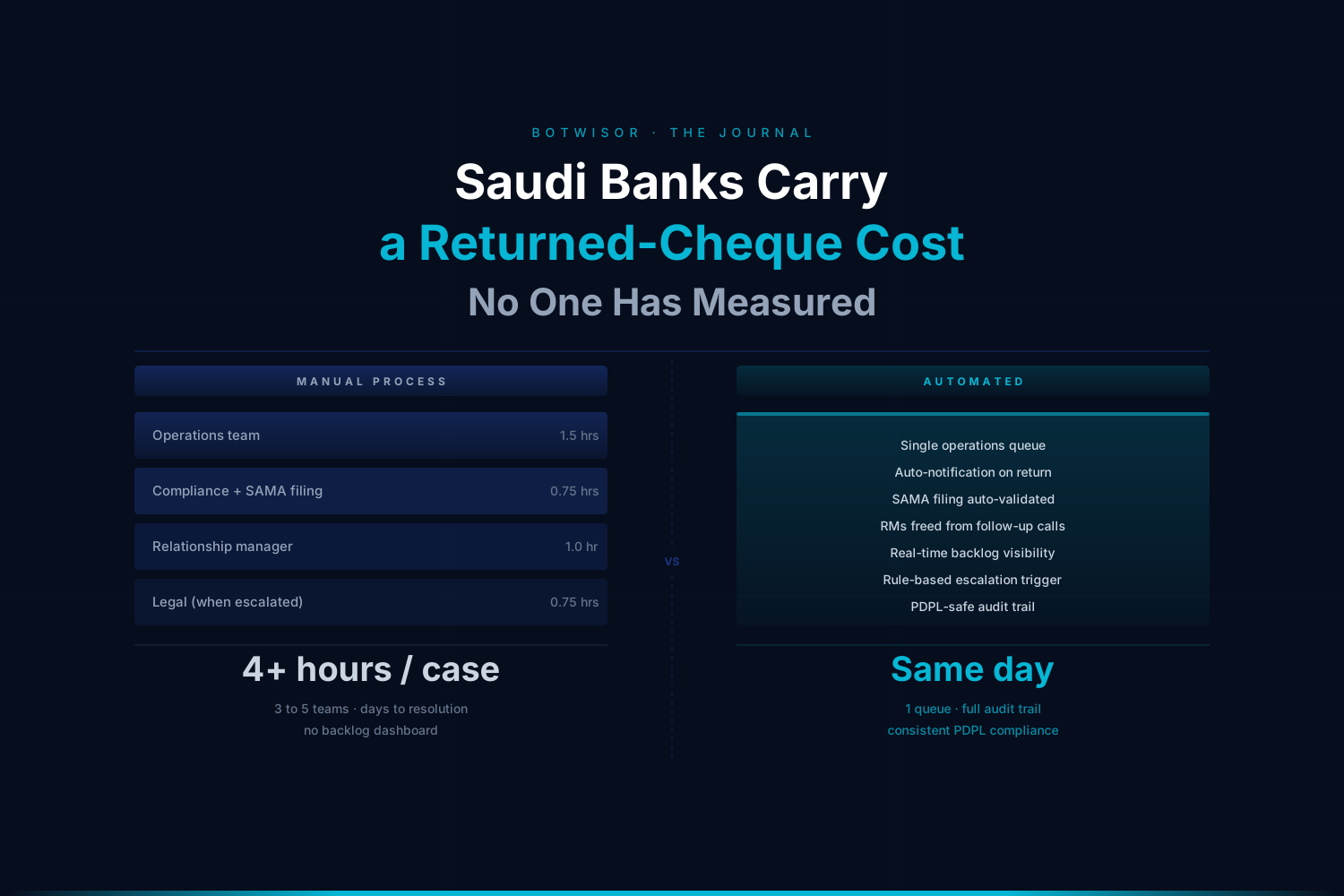
Saudi banks process returned cheques daily, yet the total operational cost of that workflow sits in no single budget line. Each bounce creates a case that moves through operations, compliance, relationship management, and sometimes legal, with each team logging time to a general cost centre rather than to the specific process. The real cost is invisible until someone adds it up.
Why Saudi Banks Still Process Significant Cheque Volumes
Electronic payment infrastructure in the Kingdom has advanced considerably. SARIE processes trillions of riyals in daily interbank value, and consumer platforms such as mada have shifted retail spending toward digital channels. Yet in business-to-business transactions, particularly across construction, real estate development, wholesale distribution, and retail supply chains, post-dated cheques remain a common instrument.
The reasons are practical. A post-dated cheque serves as a deferred payment commitment backed by legal enforceability under Saudi commercial law. A contractor building a residential tower in Riyadh may issue a series of post-dated cheques to a subcontractor timed to project milestones, providing a form of payment guarantee that an informal promise cannot replicate.
SAMA's Financial Sector Development Program, a core pillar of Vision 2030, targets a significant reduction in paper-based and cash transactions across the Saudi economy. Progress at the consumer level is visible. In B2B trade, the shift moves more slowly, and the returned-cheque workflow remains a standard operational reality for commercial and corporate banking teams across the Kingdom.
How the Manual Workflow Runs Today
When a cheque is returned unpaid, a multi-team process begins:
- The operations team notifies the depositing client by phone or email that the cheque was returned and explains the reason: insufficient funds, account closed, signature mismatch, or a technical defect in the instrument.
- A case is created internally, typically requiring manual data entry into the core banking system and separately into a tracking spreadsheet or helpdesk ticket.
- If the cheque amount or the issuer's payment history triggers SAMA reporting thresholds, the compliance team prepares and submits the required regulatory notification.
- The relationship manager for the depositing client receives an alert, contacts the client directly, and may need to coordinate with the relationship manager for the cheque issuer at the same institution or another bank.
- If the client pursues collection, the legal team advises on re-presentation procedures or drafts a formal demand letter.
- A final outcome is recorded: re-present, return to the client for external legal action, or write off.
Across these six steps, three to five teams touch every case. The elapsed time from initial return to case closure runs from several business days to several weeks depending on complexity and the current workload across teams.
What This Looks Like at Scale
The aggregate cost is a function of volume and case complexity. A mid-size Saudi commercial bank serving corporate and SME clients might handle 150 to 300 returned-cheque cases in a busy month. At an average of four combined staff hours per case and a fully loaded cost of SAR 120 per hour, the monthly operational cost for this single process sits between SAR 72,000 and SAR 144,000.
That figure excludes the relationship cost. When a client learns about a returned cheque from their own systems before the bank calls, the relationship manager absorbs the resulting friction: the client call, the internal escalation, the follow-up correspondence. That time is logged to RM overhead, not to the returned-cheque process. The true cost is consistently higher than any individual team estimates.
Before and After: What Automation Changes
| Dimension | Manual Desk | Automated Process |
|---|---|---|
| Client notification | 1 to 2 business days | Same day, triggered automatically on return |
| Case creation | Manual entry across 2 to 3 systems | Single automated record, consistent fields |
| Teams involved per case | 3 to 5 handoffs | Operations queue only; exception routing as needed |
| SAMA filing accuracy | Variable; human error risk | Consistent; auto-validated against filing template |
| Backlog visibility | No dashboard; email threads | Real-time queue with aging indicators |
| RM time per standard case | 30 to 90 minutes | Near zero |
| Legal escalation trigger | Manual judgment, often delayed | Rule-based; consistent; same-day for qualifying cases |
The operational gain is not primarily about speed. It is about consistency: every case follows the same path, every SAMA filing meets the same standard, and the operations manager can see at any moment how many cases are open, at what stage, and how long each has been waiting.
Why the Cost Stays Off the Radar
Four structural factors keep returned-cheque handling invisible as a managed cost:
No single process owner. The workflow spans multiple teams. Each team sees its portion and optimises for its own throughput. No team carries an incentive to surface the aggregate cost because doing so implies ownership of a scope they do not currently hold.
RM absorption. Relationship managers treat client communication around returned cheques as client service activity, which it is, but it also represents an operations cost that gets classified as RM overhead. The blending makes the true per-case cost impossible to extract from standard cost reporting.
Compliance framing. SAMA filings appear to be routine regulatory obligations rather than process cost drivers. The time required to gather data for each filing is never itemised or attributed to the returned-cheque workflow.
No dashboard. Without visibility into the open backlog, its age distribution, and the responsible team for each case, senior operations leaders have no prompt to act. What is not visible does not create pressure to change.
The Vision 2030 Dimension
SAMA's Financial Sector Development Program has set an explicit goal: positioning Saudi Arabia as a leading international financial hub with modern, efficient banking operations. Two of its core objectives connect directly to returned-cheque processing.
The first is end-to-end digitisation of banking operations: reducing manual entry, eliminating paper handoffs, and building consistent audit trails across core workflows. Returned-cheque handling, as it currently runs at most Saudi banks, is a textbook example of the fragmented manual workflow that this program targets.
The second is data governance under the Personal Data Protection Law (PDPL). When sensitive client data, including account numbers, cheque amounts, and return reasons, moves through email chains, spreadsheets, and multiple manual entry points, the risk of mishandling rises. An automated, centralised process substantially reduces that exposure. As PDPL enforcement develops, this consideration reaches board level at Saudi financial institutions.
Banks that address returned-cheque operations now are not fixing one workflow in isolation. They are establishing a process design pattern that applies across the full portfolio of exception-handling workflows: trade document discrepancies, loan drawdown disputes, payment reversal requests. Each follows the same basic shape of multi-team, manual handling at an unquantified cost.
The First Step Is a Cost Measurement
The most common obstacle to improving this process is not budget or technology. It is the absence of a baseline figure. Operations leaders who have never seen the aggregate returned-cheque cost in a single number have no reference point for evaluating a process improvement investment.
BotWisor runs this diagnostic as part of a free automation audit for Saudi financial institutions. The output is a structured cost map of current exception-handling workflows, ranked by the operational value that automation creates. The audit typically surfaces two or three processes where a well-scoped automation project delivers a measurable return within the first operating quarter.
→ Request a free automation audit for your bank's operations