
The Journal
What Saudi Retailers Lose When Loyalty Runs on Spreadsheets
Manual loyalty programs cost Saudi retailers more than they save: top spenders go unrewarded, churn rises undetected, and generic discounts train shoppers to wait for sales rather than buy at full price.
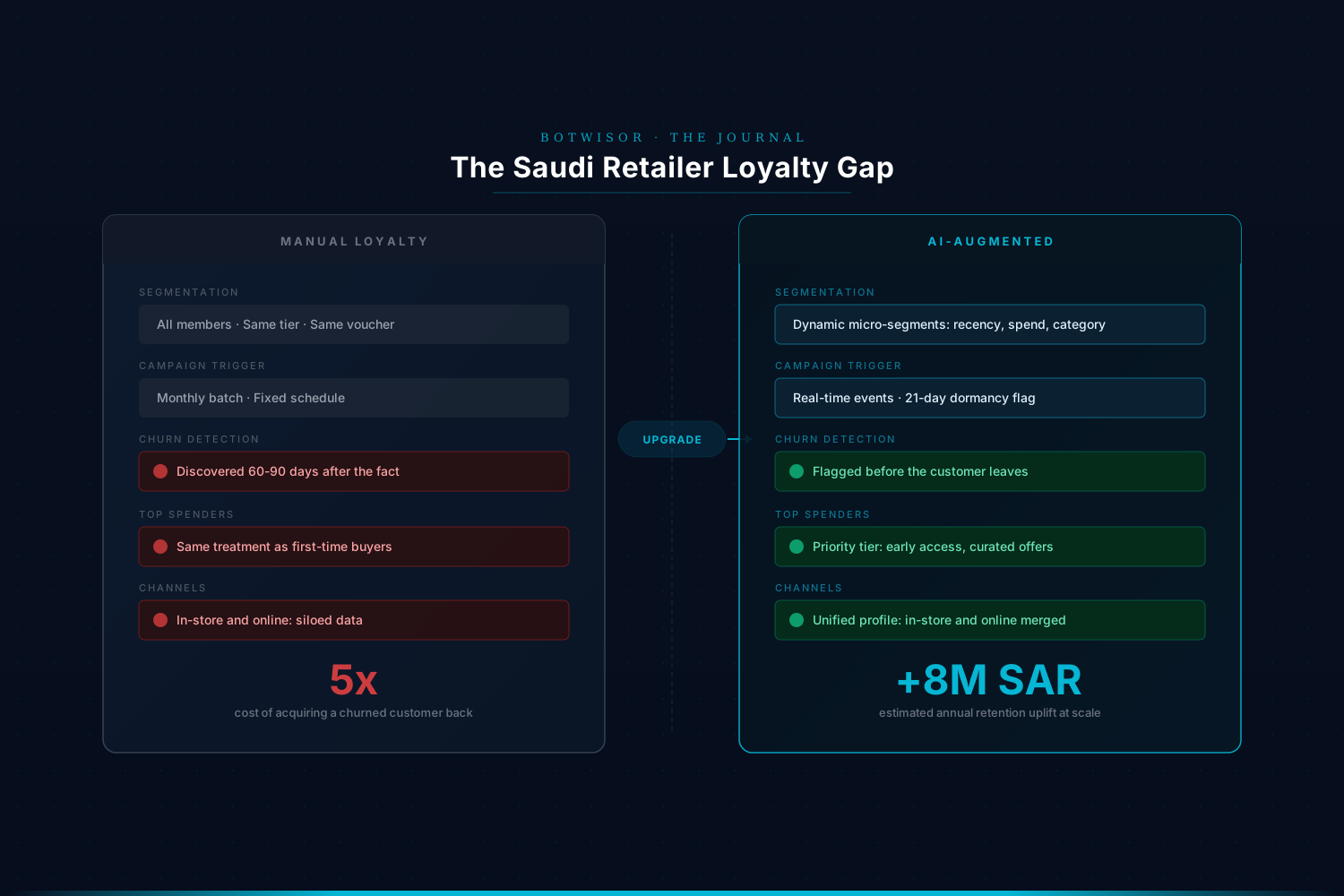
Most Saudi retail loyalty programs share the same quiet problem: they exist, but they do not work. Points accumulate, shoppers forget to use them, and the only customers redeeming rewards are bargain hunters who would have purchased anyway. Meanwhile, the retailer's highest-value spenders receive the same generic voucher as every occasional buyer and gradually drift to competitors who recognize them. The gap between having a loyalty program and having an effective one costs more than most operators realize.
The Loyalty Program Gap Saudi Retailers Do Not See
A loyalty program that runs on spreadsheets, a basic POS module, or disconnected systems is not a retention engine. It is a discount mechanism with extra steps.
The typical flow looks like this: a customer buys, earns points, receives a mass SMS at month end, and either ignores it or redeems on a low-margin category. The retailer has spent on the campaign and absorbed the margin erosion without knowing whether the redeemer would have returned regardless.
The problem is not the existence of a loyalty program. The problem is that without behavioral data and real-time triggers, the program rewards transactions rather than relationships. For Saudi retailers operating in Riyadh's competitive retail corridors or managing omnichannel operations across the Kingdom, that distinction translates directly into margin and customer lifetime value.
What Manual Loyalty Actually Costs
| Dimension | Manual Loyalty Program | AI-Augmented Loyalty |
|---|---|---|
| Segmentation | Single tier or broad brackets | Dynamic micro-segments based on recency, frequency, spend, and category mix |
| Campaign triggers | Fixed schedule (monthly/quarterly) | Real-time events: post-purchase, browse abandonment, 30-day dormancy, reactivation window |
| Reward relevance | Generic vouchers and blanket discounts | Personalized offers matched to individual purchase history and preference signals |
| Churn identification | Discovered retrospectively | Flagged before the customer leaves: 21-day no-visit trigger, 45-day e-commerce inactivity |
| High-value recognition | Same comms as all members | Priority service flags, early access, category-specific perks driven by actual spend tier |
| Reporting | Monthly point-balance reports | Real-time cohort retention curves, LTV per segment, campaign ROI by micro-segment |
The table above describes two different operational realities. Manual loyalty programs tend to over-invest in re-engaging customers who were never at risk of leaving, while under-investing in the customers who are actually about to churn. That inversion is expensive.
Consider a mid-tier fashion retailer with stores across Riyadh and Jeddah. If the top 20% of customers by spend generate 60 to 70% of revenue (a concentration common in KSA specialty retail), and a manual loyalty program treats those customers identically to occasional buyers, the program is failing its most important segment. The cost is not just the revenue lost from those customers. It is the cost of replacing them through acquisition, which consistently runs five to seven times the cost of retention.
Why Generic Rewards Fail Saudi Shoppers
Saudi consumers have some of the highest smartphone penetration rates in the world, active social commerce behavior, and strong brand awareness across categories. They are not passive loyalty members. They compare, they switch, and they respond to relevance.
A generic end-of-month voucher lands in a notification alongside dozens of others. Without personalization, the offer has no reason to stand out. The shopper who bought abayas last month receives the same handbag voucher as the shopper who bought handbags. Neither feels recognized.
Four dynamics make manual loyalty underperform specifically in the Saudi market:
-
Seasonal concentration. Ramadan and Eid Al-Adha drive disproportionate retail volume. Manual programs cannot dynamically recalibrate reward value or campaign frequency around these windows without significant manual effort that typically arrives too late to capture the peak.
-
High return rates in fashion. KSA fashion return rates are elevated by regional purchase norms. Manual loyalty programs treat returned purchases as completed sales until a delayed reconciliation cycle, inflating point balances and skewing campaign targeting toward a distorted customer picture.
-
Multi-channel friction. Saudi shoppers move fluidly between physical stores and e-commerce. Manual loyalty that does not unify both channels creates situations where a customer's in-store purchase history is invisible to the online system and vice versa. A shopper who spent SAR 8,000 in-store this year may receive first-buyer offers online, which communicates that the brand does not recognize them.
-
Arabic-language personalization gap. Mass SMS campaigns in Arabic do not differentiate by tone, product relevance, or timing. A customer shopping for children's school supplies receives a sportswear discount. The disconnect signals that the brand does not know its customer, and Saudi shoppers are quick to notice.
What Intelligent Loyalty Changes
An AI-augmented loyalty layer does not replace the points mechanic. It makes the mechanic work as it was intended.
The change is in what triggers communications and what those communications contain. Rather than a scheduled batch export to a marketing platform, each customer action generates a data event. A purchase, a browse session, a return, a period of inactivity: each one is scored against the customer's behavioral profile and matched to a retention action.
A customer who purchased premium skincare in-store three times in six months and has not returned in 28 days represents a different risk level than a one-time seasonal buyer who has also been quiet. A manual system treats them identically. An AI-augmented system identifies the high-value dormant customer before the 30-day threshold and triggers a personalized reactivation: not a blanket discount, but an early-access notification for the new line that matches her purchase history.
The downstream effect extends to the full loyalty calendar. Ramadan offers are built from individual purchase histories rather than product category assumptions. Reactivation windows are calculated from each customer's historical purchase interval, not from a fixed 90-day batch rule. Returns are deducted from loyalty balances in near-real time, giving the campaign engine an accurate picture before the next send.
For Saudi retailers with SAR 50M to SAR 500M in annual revenue, the compounding effect of better churn identification and more relevant re-engagement typically moves net retention by several percentage points. At that revenue scale, a three-point improvement in retention represents SAR 1.5M to SAR 15M in annual revenue that would otherwise have required new customer acquisition to replace.
What to Ask When Evaluating a Loyalty Upgrade
If you are assessing whether to upgrade your loyalty operations, the questions that matter are not about the technology stack. They are about what your current program cannot do:
- Can you identify your top 200 customers by name and last purchase date today, without submitting a report request?
- Do you know which customers are 21 days away from their historical churn point?
- Is your in-store and e-commerce purchase history unified against the same customer ID?
- Can you trigger a reactivation campaign within 48 hours of a specific behavioral signal, without a manual data export?
- Do you know which loyalty members are unprofitable to retain (high redemption, low margin, high return rate)?
If the answer to any of these is no, the program is operating on a lag. The customers who left in the gap between campaigns are the cost of that lag. The customers who are leaving now while the next batch is being prepared represent the opportunity cost of the next cycle.
The good news is that the underlying customer data usually exists. Saudi retailers typically have transaction histories, browsing data, return records, and CRM entries spread across systems that have never been connected. Unifying them is not a technology project in the abstract sense. It is an operational decision with a direct retention return.
If you want to understand where your loyalty operations lose value and what an AI-augmented approach would change for your specific customer base, the first step is a review of what your current data actually contains.
Book a free automation audit