
The Journal
What Saudi Banks Lose When Remittance Exceptions Run on Manual Review
Every outbound transfer that fails straight-through processing lands in a human queue. When that queue grows faster than the team assigned to clear it, the cost compounds in staff hours, customer attrition, and SAMA compliance exposure most banks are not measuring.
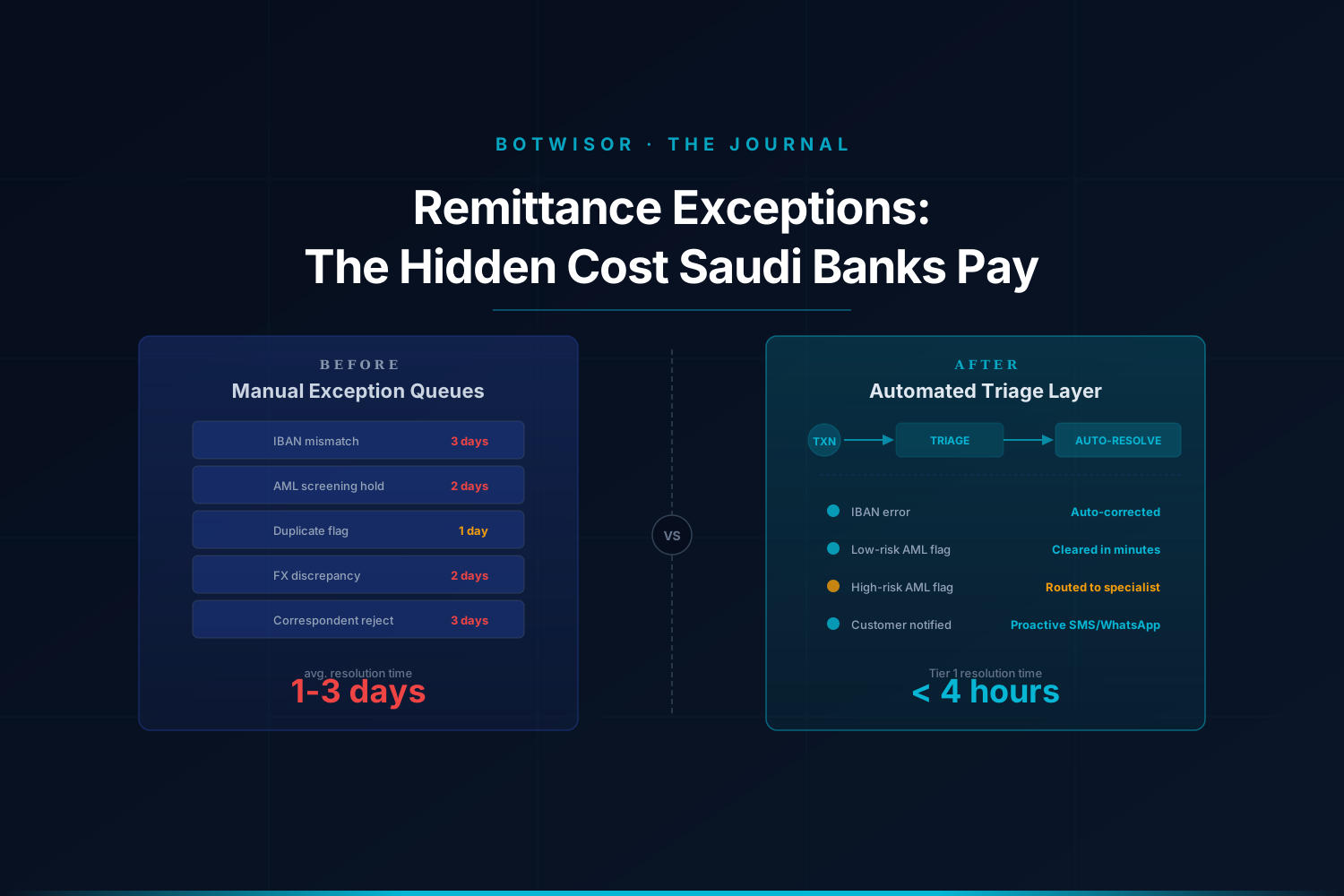
Saudi Arabia generates one of the world's largest remittance outflows, and every payment that fails straight-through processing lands in a human queue. When those queues grow faster than the teams assigned to clear them, the cost compounds in staff hours, customer attrition, and SAMA compliance exposure that most banks are not measuring.
What Qualifies as a Remittance Exception?
Every outbound or inbound transfer that cannot complete without human intervention is an exception. In Saudi banking operations, the most common triggers are:
- IBAN validation failure (incorrect format or account name mismatch)
- Sanctions and AML screening holds on watchlist hits or unusual corridors
- Duplicate transaction flags
- FX rate discrepancy between the booking rate and the settlement rate
- Missing or incomplete beneficiary data, particularly on SWIFT corridors that do not require IBANs
- Correspondent rejection on compliance grounds
Each of these requires a staff member to investigate, escalate internally, contact the customer, resubmit, or cancel. In a bank processing thousands of remittances daily, the queue never empties; it only grows or shrinks.
How Large Is the Volume?
Saudi Arabia consistently ranks among the top five remittance-sending countries globally. Outbound transfers concentrate on the ten largest worker corridors: Egypt, India, Pakistan, Bangladesh, the Philippines, Indonesia, Yemen, Jordan, Syria, and Ethiopia. Even a 3–5% exception rate, which many ops teams consider acceptable, represents tens of thousands of transactions monthly at a mid-size retail bank.
SAMA's push toward higher straight-through processing (STP) rates under the Financial Sector Development Program (FSDP) means this rate is no longer purely an efficiency metric. It is a regulatory expectation, and banks that cannot demonstrate consistent STP improvement are explaining themselves rather than reporting results.
The Manual Review Lifecycle
When a transaction enters the exception queue in a manually managed operation, the typical lifecycle looks like this:
- The system flags the transaction and routes it to a holding status.
- An ops agent picks up the case via email, internal ticketing, or a core banking queue.
- The agent investigates: checks the AML hit, calls the customer for clarification, or contacts the correspondent bank.
- If resolved: the agent resubmits or approves. If unresolvable: cancellation and return.
- The customer inquiry arrives separately when the transfer has not landed. The call center agent cannot see the exception status in real time.
Each step adds latency. An exception handled the same day may consume four agent-hours distributed across ops, compliance, and the contact center. One that crosses a weekend or a public holiday stretches to three business days. During Ramadan and Eid, when volumes spike and staffing is reduced, the queue backs up in ways that become visible to customers long before they become visible to management.
The Cost Banks Are Not Measuring
| Cost category | Manual exception handling | Automated triage and routing |
|---|---|---|
| Average resolution time | 1–3 business days | Under 4 hours for Tier 1 exceptions |
| Agent hours per exception | 3–6 hours across teams | Under 0.5 hours (human signs off on automated recommendation) |
| Customer contact rate | High: most exceptions generate inbound calls | Low: proactive SMS and WhatsApp status updates replace most inbound volume |
| SAMA STP compliance | Exception volume drags the bank's STP ratio below target | Measurable improvement in reported STP rate |
| Customer attrition | Senders and beneficiaries switch to licensed exchange houses or fintech apps after repeated delays | Retention supported by speed and real-time transparency |
| Correspondent friction | Repeated manual corrections can raise flags at correspondent banks | Fewer correction cycles reduces correspondent relationship cost |
The SAR figure most banks cannot answer: what does one remittance exception cost, fully loaded? When you aggregate ops agent time, call center time, potential refunds on FX differential losses, and the SAR lifetime value of customers who switch to an exchange house or a fintech after two delayed transfers, a mid-size retail bank processing 50,000 exceptions per year may be absorbing more than SAR 15M annually in costs it does not have a line item for.
What the Improved State Looks Like
Banks that have automated their exception triage do not eliminate human judgment. They concentrate it. The system handles:
- Automatic IBAN validation and format correction where the correction is unambiguous (a single-digit error, a leading-zero omission, a country code typo)
- Real-time AML hit scoring that distinguishes low-confidence flags (common name matches against broad watchlists) from high-confidence flags that warrant senior compliance review
- Proactive customer notification via WhatsApp or SMS the moment a hold is placed, which cuts inbound call volume before it reaches the queue
- Correspondent bank exception routing to the right internal owner, not to a shared inbox that no one monitors at 4 pm on a Thursday
- SLA tracking per exception type, with escalation triggers that surface stalled cases to a supervisor before the customer calls
What remains for a human agent is the genuinely ambiguous: an AML hit on a beneficiary that requires judgment, a customer who cannot be reached, a correspondent instruction that appears to conflict with SAMA guidance. These are the cases worth a senior compliance officer's attention.
The Vision 2030 Context
Saudi Arabia's Financial Sector Development Program set explicit STP rate targets across payment rails. The BUNA cross-border payment system, the Arab Monetary Fund's regional payment network for intra-Arab transfers, has increased the volume of structured, data-rich transactions that banks are expected to settle without manual touchpoints. SAMA's Payments Strategy pushes the same direction.
Banks that improve exception handling position themselves for three converging benefits:
- Higher STP ratios that satisfy FSDP benchmarks without requiring exceptions to be manually reclassified
- Faster settlement windows on BUNA as the network scales and latency expectations tighten
- Lower correspondent banking costs as their error and correction rate falls below the thresholds that trigger correspondent reviews
The ops teams running these banks are not short of motivation. They are short of a system that routes the right exception to the right person at the right time, with the context pre-loaded rather than requiring a 20-minute investigation before the agent can act.
Where Most Banks Start
The common entry point is not a full-stack replacement of the core banking system. It is a workflow layer above the existing queue: a system that receives exceptions from the core, applies a triage ruleset, routes and prioritizes cases, tracks SLAs, and sends the outbound customer notification automatically.
Banks in Riyadh and Jeddah that have piloted this approach typically see exception queue depth fall by 40–60% within the first quarter, driven almost entirely by same-day resolution of Tier 1 exceptions (clear IBAN and format errors) that previously required a human to open, investigate, and manually resubmit.
The remaining queue is smaller, cleaner, and genuinely requires human judgment. Ops teams spend their capacity on the cases that need them, not on mechanical triage that a ruleset could handle in seconds.
The shift is not about replacing the ops team. It is about not using a compliance professional's working day to fix a beneficiary IBAN that was missing one digit.
If your remittance ops team measures success by whether the queue cleared today rather than by exception resolution rate, STP ratio, or customer attrition by transaction type, that gap is worth examining. Book a free automation audit and get a clear read on where your exception handling stack stands and what a structured triage layer would cost to deploy.