
The Journal
Every Quarter, Saudi Banks Recompute Zakat from Scratch
Saudi banks rebuild their Zakat position from scratch every quarter because no system maintains a continuous ledger. Here is what that costs, and what changes when automation takes it over.
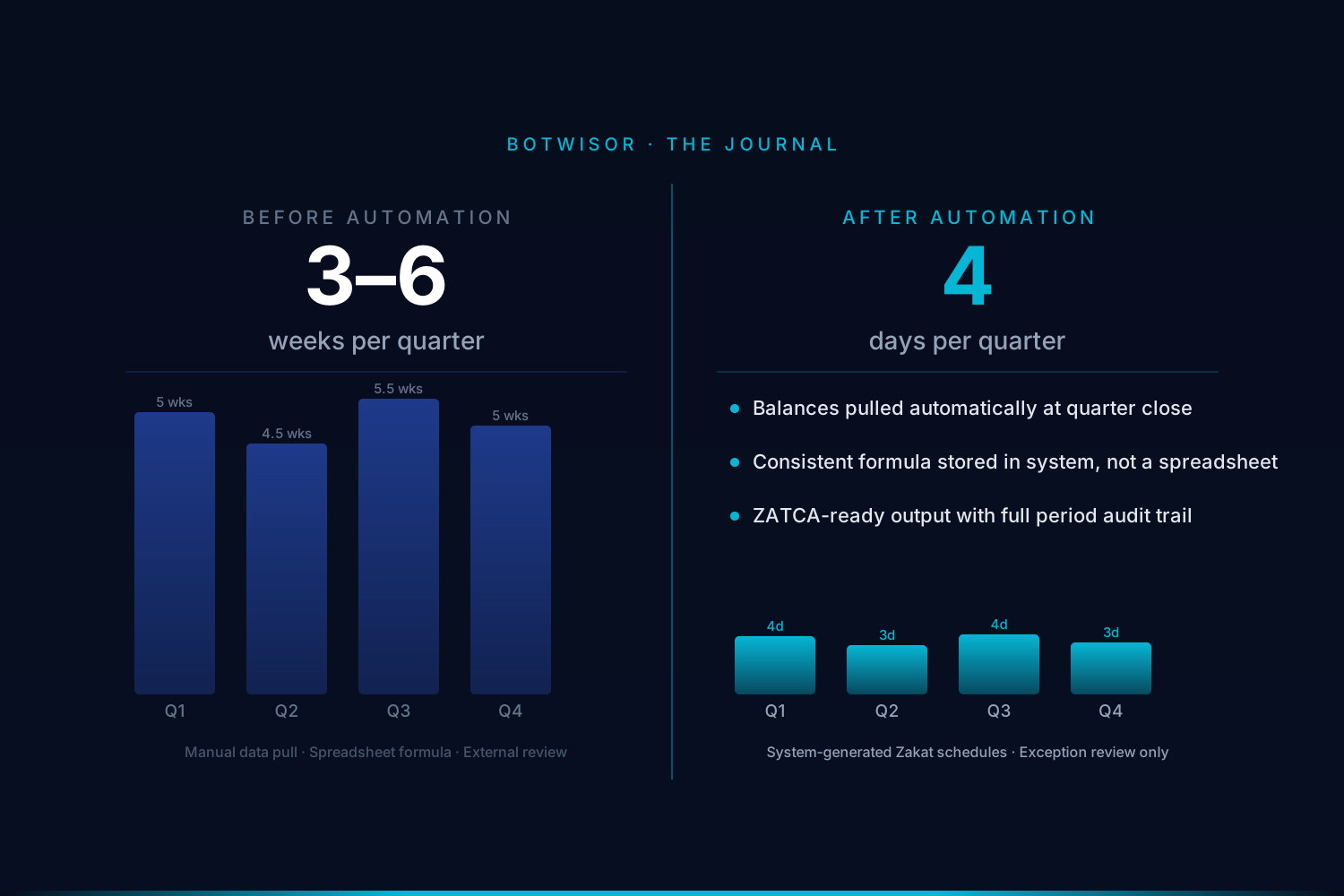
Saudi banks face a Zakat calculation challenge that most non-banking companies never encounter. Every quarter, finance teams pull data from multiple systems, apply a sharia-derived formula, and produce filing schedules for ZATCA from scratch. No bank system in Saudi Arabia maintains a continuous Zakat ledger, which means the rebuild repeats every 90 days.
Why Zakat for a Saudi Bank Works Differently
A retailer or construction firm calculates Zakat on its net Zakatable worth using a relatively bounded methodology. For a licensed bank operating in the Kingdom, the picture is considerably more complex.
Banks must:
- Identify and exclude non-Zakatable assets (fixed assets, long-term equity investments in non-Zakatable entities, and property held for operations)
- Determine the Zakatable base across financing portfolios, deposit structures, and treasury positions
- Apply sharia-committee guidance on the treatment of off-balance-sheet items and impairments
- Separate the bank's own Zakat share from any Zakat attributable to individual shareholders
IFRS 9 provisioning, changes in treasury positions, and shifts in portfolio classification all alter the Zakatable base from one quarter to the next. There is no configuration that survives from one period to the next without re-verification. The calculation must be rebuilt, not updated.
What the Quarterly Manual Cycle Looks Like Inside a Saudi Bank
In most Saudi banks with SAR 5 billion to SAR 50 billion in assets, the quarterly Zakat cycle begins with a data extraction from the core banking system. That output is then cross-referenced against treasury management system data and investment portfolio positions held by a custodian or securities platform. These systems rarely use a shared identifier across entities, so reconciling them requires a human intermediary who understands both the accounting and the system mapping.
Once data is consolidated, an analyst or senior accountant applies the Zakat formula to the cleaned dataset. The tool is almost always a spreadsheet with dozens of line items and look-up tables that carry forward certain balances from the prior quarter's submission. This workbook is typically owned by one person or a small team, and that same team also tracks which ZATCA assessment letters from prior years remain unresolved.
The output is reviewed by the finance director, cross-checked by the internal Sharia compliance function, and in most institutions reviewed by an external auditor before submission. The ZATCA return itself includes supporting schedules that must align with the general ledger and with the bank's prior filings.
From data pull to final submission, the cycle takes between three and six weeks in most mid-sized Saudi banks. Institutions with more complex portfolios, active subsidiaries, or GCC cross-border operations report even longer timelines.
Where Errors and Reassessments Enter the Picture
ZATCA operates a reassessment window of up to five years from the original filing date. Banks that underestimated their Zakatable base, misclassified an asset, or applied a formula that ZATCA later challenged may receive a reassessment notice years after the quarter in question.
Because each quarter's calculation starts from a fresh data pull, the prior-quarter logic is embedded in a spreadsheet that has typically been copied forward multiple times. When ZATCA auditors request support for a three-year-old filing, the workbook may no longer match the system-of-record data because portfolios have shifted, entities have been restructured, or reporting codes have changed. Reconstructing the audit trail becomes a separate project, usually falling on the finance team at the worst possible time.
Common sources of reassessment exposure include:
- Inconsistent treatment of murabaha and diminishing musharakah portfolios across quarters
- IFRS 9 provision movements that retroactively affect the Zakatable base
- Reclassification of equity investments between Zakatable and non-Zakatable categories
- Subsidiary consolidation adjustments handled differently in different periods
None of these are unusual in institutions where quarterly Zakat lives in a manually maintained spreadsheet.
What the Quarterly Cycle Costs
Direct labor is the most visible line item, but not the only one.
Headcount: A mid-sized Saudi bank typically allocates one to three full-time-equivalent finance staff to the Zakat cycle each quarter. At SAR 25,000 to SAR 45,000 per month per analyst, a three-week cycle with two analysts costs roughly SAR 35,000 to SAR 65,000 in direct labor per quarter. Annualized, that is SAR 140,000 to SAR 260,000 applied to a data-consolidation task that produces no margin.
External review: Banks that route Zakat returns through an external firm before filing typically pay SAR 40,000 to SAR 150,000 per engagement. For larger institutions, this may be quarterly rather than annual.
Reassessment defense: When ZATCA raises an assessment, defending it requires finance staff time, legal counsel, and usually an external tax advisor. A contested reassessment can cost SAR 100,000 to SAR 500,000 or more in professional fees, separate from any additional Zakat ultimately settled.
Opportunity cost: Every week the finance director spends reviewing Zakat workbooks is a week not spent closing the quarter faster, reviewing business margins, or supporting expansion decisions. This cost never appears on a cost center report.
| Cost element | Manual cycle (mid-sized bank) | With automation |
|---|---|---|
| Finance team time (quarterly) | 3–6 weeks, 2–3 FTE | 2–4 days, 1 FTE reviewer |
| ZATCA reassessment risk | High: spreadsheet logic, limited audit trail | Lower: system-generated trail, consistent methodology |
| External review fees (annual) | SAR 40K–150K | Reduced: automated schedules, narrower review scope |
| Reassessment defense cost | SAR 100K–500K+ per contested year | Lower: traceable logic, period-to-period consistency |
| End-to-end cycle time | 3–6 weeks | Under 1 week |
What Changes After Automation
Automating the Zakat calculation process does not replace the sharia committee's judgement or the external auditor's sign-off. It removes the data-aggregation, reconciliation, and schedule-preparation steps that currently consume most of the cycle's elapsed time.
In a bank that has connected its core banking, treasury, and investment platforms into a unified data layer, the Zakat calculation function can:
- Pull required balances automatically at quarter close, using mapping rules agreed upfront by finance and Sharia compliance
- Apply the formula consistently, with period-to-period logic stored in the system rather than in a copied spreadsheet tab
- Flag exceptions for human review rather than presenting the entire dataset to an analyst from a blank sheet
- Produce ZATCA-ready schedules directly, with supporting workpapers linked to source system records
The finance director's role shifts from verifying whether the data consolidation is correct to reviewing the exception report and approving the final return. External auditors spend less time reconstructing data lineage and more time on judgement-dependent items.
For a bank with SAR 10 billion or more in assets, compressing the Zakat cycle from six weeks to under one week has downstream effects: faster quarter-close, earlier investor reporting, and significantly lower exposure when ZATCA reassessment notices arrive years later.
The ZATCA Reassessment Risk Most Banks Under-Price
Most Saudi banks track their current Zakat liability and the direct cost of each filing. Almost none formally track the contingent liability represented by open ZATCA assessment windows on prior years.
As part of Vision 2030's drive to digitize government-to-business processes, ZATCA has been investing in automated data-matching and risk-profiling capabilities since 2022. Banks that filed Zakat returns for 2020 to 2024 using a spreadsheet process may carry inconsistencies in formula application, asset classification, or prior-year carry-forwards that do not surface until an auditor selects a specific quarter for review.
The cost of that exposure is not zero and not small. But because it lives in a contingent-liability bucket rather than an operating-cost line, it rarely drives the decision to automate.
Automation does not eliminate ZATCA's assessment window. It does create a period-to-period audit trail that makes responding to reassessment notices faster, cheaper, and far less disruptive to the teams that built the filing in the first place. That alone is worth more than most finance directors calculate before they start the next quarterly rebuild.
If your Zakat calculation is still a quarterly rebuild from raw data, your finance team is carrying a cost that does not need to be this high. A free automation audit from BotWisor takes two sessions: one to map your current Zakat data flow and one to identify where the cycle can be compressed without compromising accuracy or compliance. No commitment required.