
The Journal
When Saudi Retail Pricing Runs on Gut Feel Instead of Data
Saudi retailers on manual pricing cycles leave margin unrealised during demand spikes and over-discount when demand slows. What that gap costs operators at SAR 30M–200M in annual revenue.
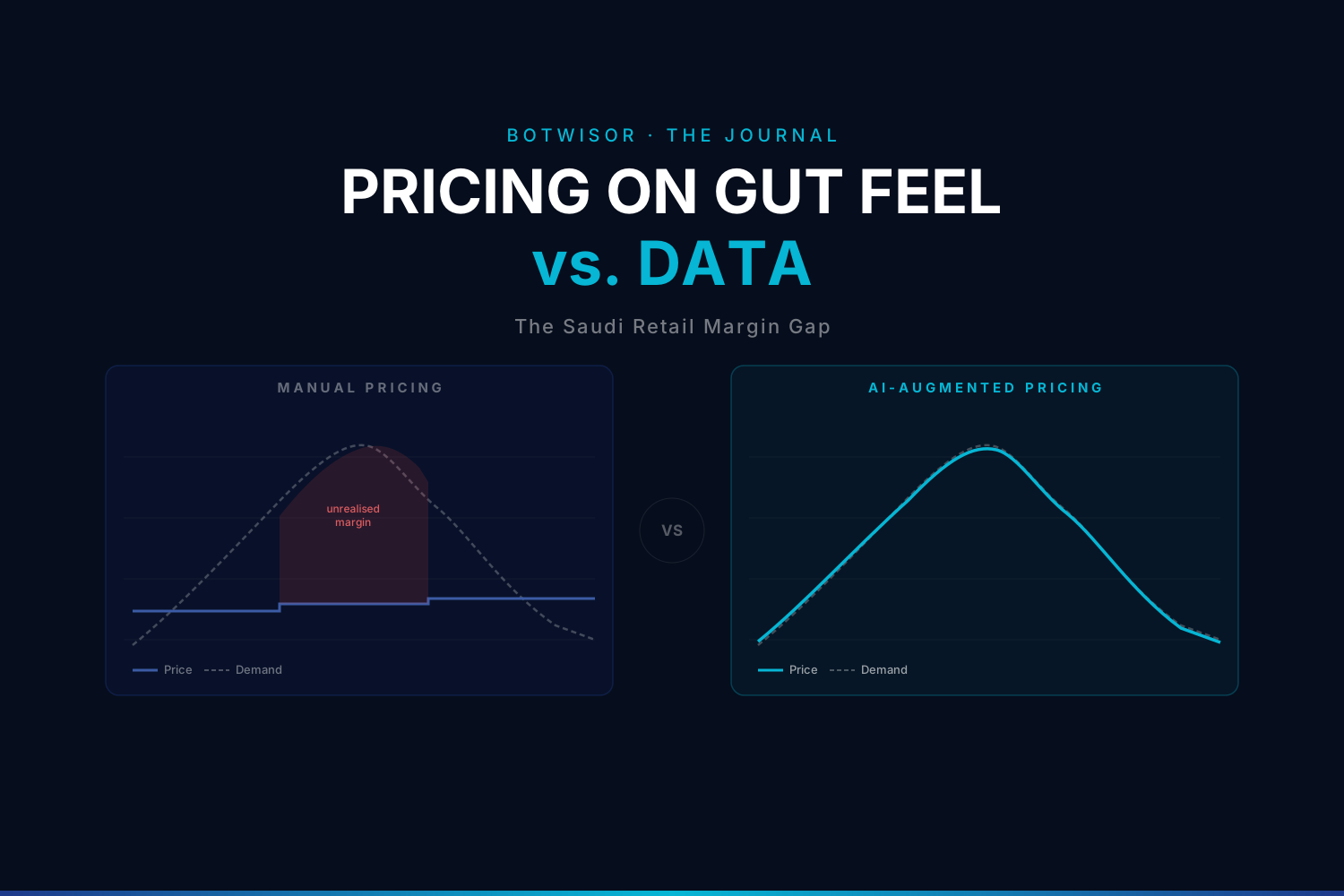
Saudi retailers typically set prices on monthly or quarterly review cycles, adjusting based on buyer intuition, historical sell-through data, and periodic competitor spot-checks. When demand shifts between those reviews, the business absorbs the difference: unrealised margin on the upside and unnecessary discounting on the downside. For an operator running SAR 60M in annual revenue with a 25% gross margin, that gap is rarely trivial.
How Saudi Retailers Set Prices Today
Most mid-size Saudi retailers run on one of three pricing approaches: category managers who review prices at set intervals, ERP-based cost-plus formulas that adjust when supplier costs change, or promotional calendars anchored to Ramadan, Eid, and National Day regardless of real demand signals.
Each approach shares the same structural flaw: prices are set against past data, not against the market as it stands today. The input is last month's sell-through rate, last year's seasonal pattern, or the finance team's required margin floor. By the time a price goes live, the conditions it was calibrated for have often already shifted.
The retail environment in Riyadh and Jeddah has changed enough over the past five years to make this lag more expensive. Greater price transparency through comparison platforms, faster restock cycles, and growing shopper optionality mean a price set three weeks ago can already be leaving margin uncaptured on the shelves.
Where the Gap Shows Up as Cost
Margin Left Behind During Demand Spikes
Demand spikes are the clearest opportunity cost. When a product sells faster than expected, a static price captures the volume at the original margin. An operator reading live demand signals would detect the velocity increase within hours and adjust upward. The manual operator detects it in next month's sell-through report, after the peak has passed.
Consider a multi-branch grocery retailer in Jeddah. A regional event drives a 35% uplift in demand for a household goods category. With monthly pricing reviews, the chain captures the volume at normal margin. For a category generating SAR 4M per month, even a conservative 10% pricing improvement opportunity during the event window represents SAR 400K in unrealised margin.
This is not a failure of effort. The category manager has no mechanism to respond faster; the review cycle is the mechanism, and the mechanism has a fixed cadence.
Discounting Into Slow Periods
The reverse problem is often more expensive in practice. When demand falls, the instinct is to discount broadly to clear stock. Category managers apply blanket markdowns across a product family because granular, SKU-level analysis at speed is not practical in a manual workflow.
The result: high-margin, low-inventory items get discounted alongside genuinely slow-moving stock. Industry data from comparable retail markets consistently shows that blanket promotional discounting is 30 to 40 percent broader than demand signals would justify. In Saudi retail, where Ramadan, Eid, and White Friday concentrate a large share of annual volume into short windows, the cost of over-discounting those windows compounds materially.
A buyer at a Riyadh fashion chain might apply a 20% sitewide markdown in the week after Eid to clear seasonal inventory, when data would show that roughly half the catalogue is still moving at full-price velocity. The markdown is real; the necessity is partial. The invisible cost is the margin lost on the items that would have cleared anyway.
Before vs. After: What Changes When Pricing Runs on Data
| Dimension | Manual Pricing | AI-Augmented Pricing |
|---|---|---|
| Review frequency | Monthly or quarterly | Demand-triggered, continuous |
| Competitor price visibility | Periodic spot-checks, often days old | Near-real-time monitoring |
| Response to demand shifts | 2 to 4-week lag | Hours to days |
| Markdown scope | Blanket by category | SKU-level, inventory-aware |
| Promotional discount depth | Set by buyer judgment | Calibrated to clearance target |
| Gross margin outcome | Baseline | Typically 8 to 15% improvement |
The 8 to 15 percent gross margin improvement range reflects deployments in comparable retail contexts, not a theoretical ceiling. It is also not automatic: the improvement depends on clean data inputs, product-level inventory visibility, and clearly defined pricing rules that govern what adjustments the system can make. Without those foundations, the uplift is smaller.
What Demand Data Actually Changes
The argument for AI-augmented pricing is not that an algorithm has better judgment than an experienced category manager. It is that no category manager can simultaneously monitor 4,000 SKUs across 10 locations, detect velocity changes within 12 hours, cross-reference live competitor pricing, and recalculate optimal price points before the demand signal has shifted again.
The algorithm does not have better judgment. It has the capacity to execute consistently on the rules a competent pricing team would apply if full information and sufficient processing time were available.
In practice, the shift is from pricing as a periodic decision to pricing as a continuous operational variable. The category manager stops asking "what should we price this at?" and starts asking "are the rules governing this decision still calibrated correctly?" The work moves from execution to governance, which is the work that actually requires experienced human judgment.
For Saudi retailers preparing for the scale that Vision 2030's consumer economy growth is driving, this distinction matters operationally. The National Retail Development Program expects consumer spending to grow substantially through the decade. A pricing infrastructure that scales with volume and SKU complexity is a fundamentally different kind of asset than one that requires proportional headcount to maintain.
The Competitive Dimension in Saudi Retail
Saudi retail is not immune to price transparency pressure. Comparison platforms and the growth of app-native shopping behaviour have made it easier for shoppers to evaluate alternatives before committing. A price set 20 days ago has been visible to competitors for 20 days and visible to price-aware shoppers for the same period.
This does not mean pricing should be reactive or destabilising. It means the interval between pricing decisions should shrink toward the interval at which the competitive environment is moving. In categories with high substitutability, that interval is measured in days. In categories where brand and quality dominate, it is longer. The judgment about which category warrants which response frequency is a strategic call; executing on that judgment consistently is an operational one.
What Moves the Decision to Act
The most common reason Saudi retail operators delay acting on pricing infrastructure is not disagreement with the business case. It is uncertainty about scope: which existing data is usable, which system integrations come first, and what the minimum viable version looks like before full deployment.
These are answerable operational questions. Moving from manual pricing to data-informed pricing does not require replacing ERP or POS systems. It requires connecting existing data streams, including demand signals, inventory levels, and competitor pricing feeds, to a layer that surfaces decision-ready information at the pricing team's preferred cadence. The integration scope is typically narrower than operators initially assume.
The cost of not acting is not abstract. For an operator with SAR 80M in annual revenue and a 25% gross margin, a conservative 10% pricing efficiency gap translates to approximately SAR 2M per year in unrealised margin. Held across two or three review cycles while the decision is deferred, that figure accumulates quietly against the business.
A Useful Starting Point
The right entry point is a pricing audit: which categories show the highest demand volatility between review cycles, which SKUs are most frequently discounted at the wrong time, and where the gap between price and actual market conditions is widest. That scoping exercise takes days, not weeks, and produces a prioritised list of categories where pricing improvement will return the fastest results.
If your pricing decisions are currently running a month behind the market, a diagnostic conversation about where the gap is largest costs nothing.
→ Book a free automation audit to identify your highest-value pricing categories and what closing the margin gap would realistically mean for your operations.