
The Journal
After the Keys: The Post-Handover Costs Saudi Developers Ignore
Saudi real estate developers budget generously for pre-sales and almost nothing for after-handover operations. Where the referrals go is predictable.
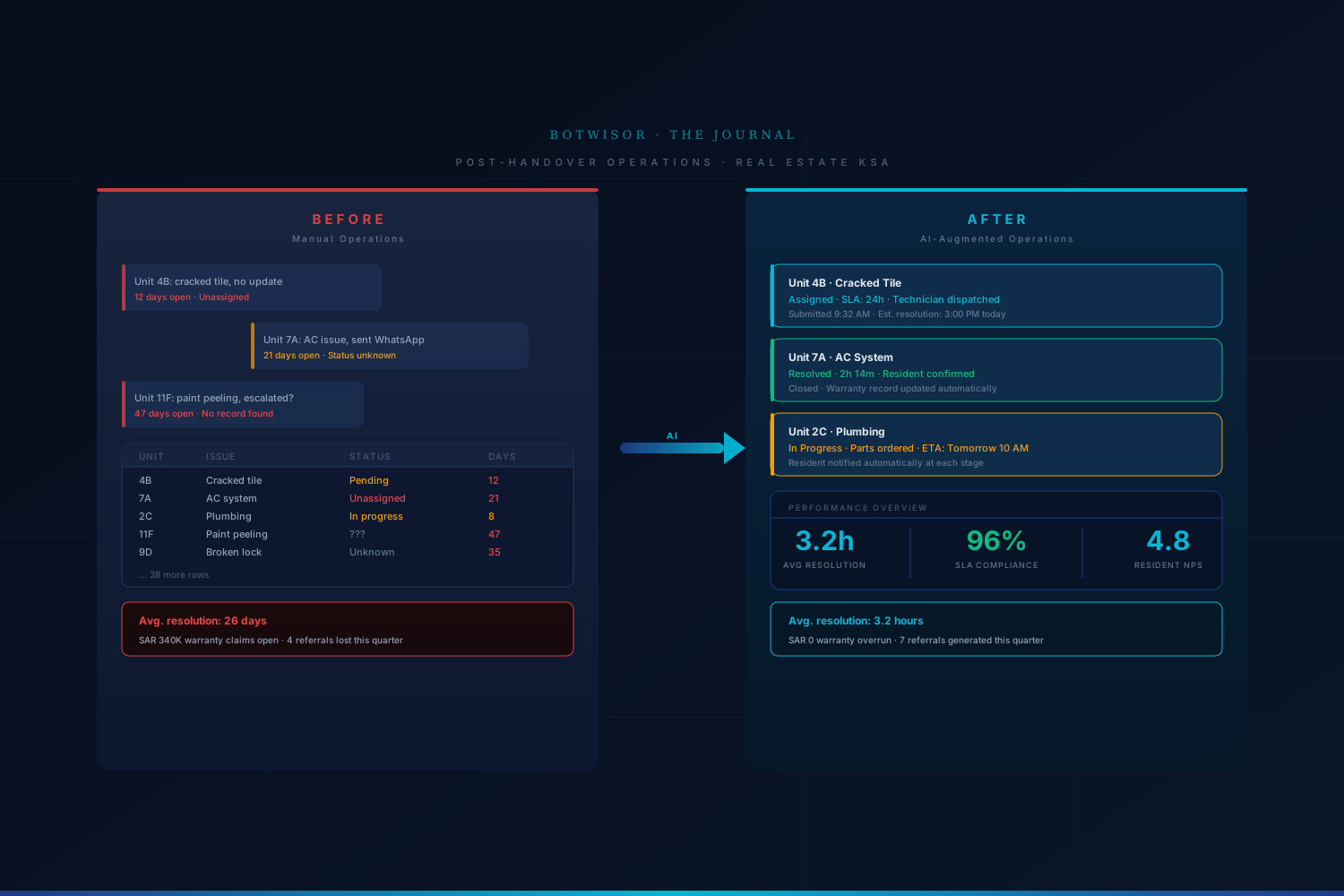
Saudi real estate developers compete on pre-sales: show units, lead generation, broker incentives. What happens after the keys change hands receives almost none of that attention. Yet those first 90 days post-handover determine whether a buyer becomes a referral source or a liability in the next project's sales cycle.
What Post-Handover Operations Look Like Today
Most Saudi developers operate post-handover with tools that were not designed for it. Resident snag reports arrive via WhatsApp. Maintenance requests go to a shared inbox. Escalations are tracked in a spreadsheet, if at all. The project team that handled construction is partially demobilized. The property management arm, if one exists, inherits an incomplete asset register.
This is not negligence. It is a structural gap that grew unnoticed because the development business has always measured success at the point of sale: certificate of completion, handover ceremony, signed acceptance form. After that, the buyer relationship is informally handed to a maintenance team operating without a clear service framework.
The result is a predictable degradation. Response times stretch from hours to days. Snag lists remain open past warranty periods. Buyers who expected a smooth transition into their new unit discover a fragmented service experience. Their first major opinion of the developer is formed, not during the sales pitch, but during the weeks they wait for a cracked tile to be replaced.
Where the Costs Hide
The financial damage from poor post-handover operations is real but distributed across categories that rarely get attributed to the same root cause.
Referral loss. In Saudi real estate, particularly in residential compounds and gated communities, word-of-mouth carries significant weight. A buyer who encountered unresolved maintenance issues within the first year of occupancy is unlikely to refer the developer to colleagues or family. Research across comparable markets consistently shows that post-purchase service quality is the primary driver of referral willingness, often more influential than the product itself.
Repeat-purchase attrition. Buyers who purchase a first unit from a developer often intend to purchase a second, either as an investment property or for a family member. Poor after-sale service interrupts that relationship before the next project launches.
Warranty liability accumulation. When snags are not tracked systematically, issues that fall within the statutory warranty period go unresolved. As the window closes, minor defects become major repair costs that the developer absorbs rather than the contractor.
Brand exposure in regulated projects. Under Vision 2030-linked housing programs such as Sakani and the Ministry of Housing's quality assurance frameworks, developers with documented post-handover service failures face compliance scrutiny on future approvals. The reputational cost extends beyond individual buyers.
Maintenance staff overhead. Teams managing post-handover requests manually spend a disproportionate share of their working hours on coordination rather than resolution. A technician dispatched without the right part, a supervisor who does not know the status of an open ticket, a site visit that repeats a prior visit because records were not centralized: these are budget leaks that accumulate month after month.
Before vs After: Post-Handover Operations Compared
| Dimension | Before: Manual Operations | After: AI-Augmented Operations |
|---|---|---|
| Snag reporting | WhatsApp message, email, or in-person request | Resident portal with structured form and photo upload |
| Ticket tracking | Shared spreadsheet or sticky notes | Centralized system with status, assignee, and SLA clock |
| Response time visibility | None | Real-time dashboard, auto-escalation at SLA breach |
| Contractor coordination | Phone calls and manual scheduling | Digital work order, geofenced dispatch, completion sign-off |
| Warranty window tracking | Manual calendar, frequently missed | Automated reminders keyed to each unit's handover date |
| Resident communication | Ad hoc WhatsApp updates | Automated status notifications at each stage |
| Management reporting | Monthly summary compiled manually | Live reports, cost tracking, resolution rate by unit type |
The outcome difference is not marginal. Developers operating with the manual stack above typically see average snag resolution measured in weeks. Those with an organized post-handover layer measure it in hours or days. The resident's experience is shaped by this gap more than by any other single factor after keys change hands.
Why Scale Changes the Stakes
This was manageable when a Saudi developer was handing over 50 units per year. It is not manageable when the same developer is handing over 500 units across three projects simultaneously, or when a giga-project under the Vision 2030 programme is onboarding thousands of residents across a new city district.
NEOM, the Red Sea Project, and Diriyah Gate collectively represent the largest coordinated residential handover pipeline in the Kingdom's history. Each involves not just physical keys but a service relationship that extends for years: maintenance, community management, shared infrastructure. Developers and operators involved in these projects are building post-handover infrastructure now, because the volume of units coming online makes manual processes operationally impossible.
The same pressure is playing out at the city level. Riyadh's residential pipeline under the National Housing Company and the broader Sakani programme means that hundreds of developers are handing over more units per quarter than their current teams were built to manage.
Developers who treated post-handover as an afterthought when they had three projects are finding that the same approach does not scale to eight. The structural gap becomes a structural failure.
What AI-Augmented After-Sale Service Looks Like
The shift is not about replacing a maintenance team with software. It is about ensuring the team spends its time on work that requires human judgment, not administrative coordination.
A post-handover service layer built on AI-augmented operations typically includes:
- A resident-facing portal or mobile interface where snag reports are submitted in structured form, with photos, unit details, and category pre-classification.
- A back-end ticketing layer that assigns jobs by category, technician availability, and location, and enforces SLA timers automatically.
- Warranty-date management that flags each unit's open items as the warranty window approaches closure, preventing silent liability accumulation.
- Escalation logic that surfaces stuck tickets to supervisors without requiring anyone to check a spreadsheet.
- A management dashboard that gives the developer a real-time view of service quality across all units and projects.
The resident experience shifts from "I sent a WhatsApp message and I am waiting" to "I submitted a request and I can see its status." That shift, simple as it sounds, is the difference between a buyer who forgives a minor defect and one who leads with it in every conversation about the developer.
The Referral Multiplier
Saudi real estate sales are relationship-driven. Referrals from satisfied owners convert at substantially higher rates than cold leads from digital campaigns, and at a fraction of the acquisition cost. Developers who treat the post-handover period as an extension of the sales relationship, rather than an afterthought of the construction process, build a referral pipeline that compounds across projects.
The math is straightforward. If a developer's after-sale service quality converts one additional referral per 10 units sold, the cost of that referral is near zero. Compared to the SAR 10,000 to SAR 30,000 cost per qualified lead in Riyadh's premium residential market, the economics of after-sale investment are favorable at almost any reasonable service-improvement cost.
Developers who have formalized post-handover operations report not only higher net promoter scores from initial buyers but measurably shorter sales cycles on subsequent projects, because the developer's reputation precedes their next launch.
Book a Free Automation Audit
If your post-handover operations run on WhatsApp and spreadsheets, the cost is larger than it appears in your maintenance budget. Book a free automation audit with BotWisor and we will walk through your current post-handover process stage by stage: where it breaks down, what a resident-facing service layer would realistically change, and what the SAR impact looks like across your active projects. No cost, no commitment.