
The Journal
Why Saudi Retailers Bleed Margin During Ramadan and Eid
Saudi retailers on manual operations lose significant margin during Ramadan and Eid. Peak season exposes every process gap at triple volume.
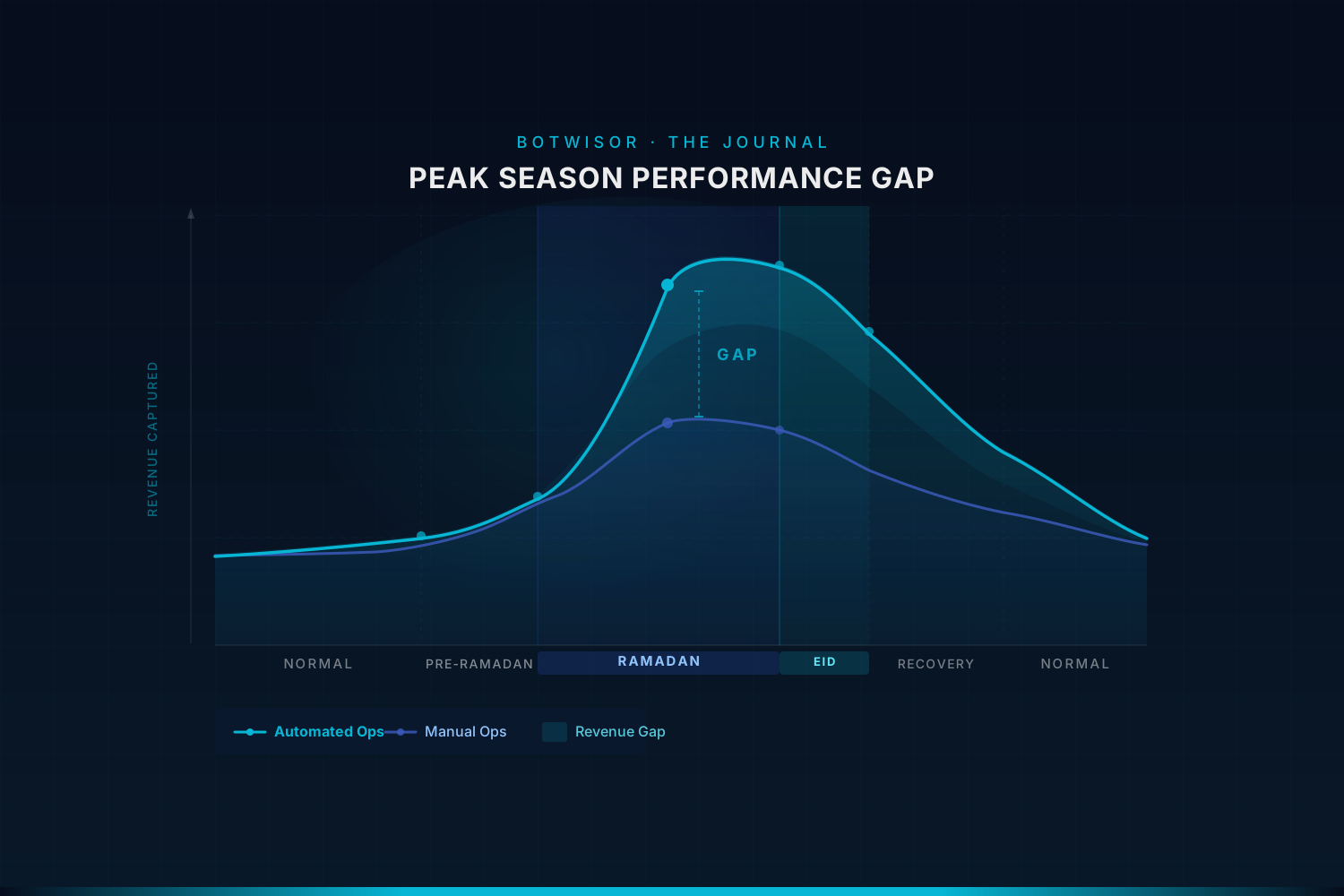
Saudi retailers on manual operations bleed margin during Ramadan and Eid because every process that handles volume sequentially becomes a bottleneck at three times the baseline. The result is not just slower service. It is stockouts during peak browsing windows, abandoned queries, and customers who find a more responsive retailer and do not return.
Why Do Ramadan and Eid Expose Manual Operations So Severely?
Saudi retail peaks are more compressed than most markets. Ramadan concentrates the largest consumer spending surge of the year into roughly four weeks. Eid al-Fitr adds another sharp spike immediately after. White Friday in November and Eid al-Adha in the summer complete a calendar with four distinct high-pressure events each year.
Each event tests the same fundamentals: can the operation absorb sudden volume increases, resolve customer queries quickly, maintain accurate stock visibility across channels, and process returns from prior purchases without creating a multi-week backlog?
A manual operation that functions adequately at normal trading volume hits a structural ceiling at two to three times that volume. The team can work longer hours. They cannot resolve 400 customer messages per hour instead of 100, or update a shared inventory spreadsheet across three channels in real time, or process a returns backlog that doubles daily while simultaneously handling new incoming orders.
That ceiling is not a failure of effort. It is a property of manual processes.
What Does a Saudi Retail Peak Actually Look Like From Inside a Manual Operation?
The pressure begins before Ramadan starts. A retailer anticipating the annual demand surge places advance orders with suppliers who are simultaneously receiving advance orders from every other retailer in the market. Lead times stretch. Safety stock arrives later than planned or in smaller quantities than ordered.
When Ramadan begins, order volumes climb. Day one is manageable. By the end of the first week, the customer support queue is running behind. Messages arrive through the website, WhatsApp, and social channels. Each one requires checking a courier portal, cross-referencing an order number, and writing a response. At six minutes per query, a hundred queries a day requires ten person-hours of support time. At three hundred queries a day, the queue no longer clears.
Meanwhile, the fastest-selling SKUs approach their out-of-stock thresholds. The inventory system, updated via a spreadsheet synced earlier that morning, does not reflect afternoon sales. A product appears available for purchase at 9 PM when it sold out at 3 PM. Orders confirm. Cancellation emails follow. Some customers do not contact support at all. They simply do not return.
Returns from purchases made in the weeks before Ramadan also start arriving. Each return requires a manual process: verify the order, confirm return eligibility, update the inventory record, issue the refund, and follow up if the customer asks about timing. At normal volume, the process takes two to three days. At peak volume, it takes six to ten days.
At the end of the season, the revenue number looks healthy by historical comparison. The compounding costs of the peak, including customer churn from cancellations, repeat buyers lost to a more responsive competitor, the premium paid on rush reorders, overtime costs, and a returns backlog clearing into the third week of Shawwal, are distributed across the business and invisible in the season's headline figure.
What Revenue Does the Post-Season Report Miss?
| Failure mode | Manual operation (peak) | AI-augmented operation (peak) |
|---|---|---|
| Customer query response | 4 to 8 hours during high volume | Minutes for common queries via automated resolution |
| Out-of-stock detection | Hours after threshold crossed, based on last sync | Real-time, with automated reorder workflow triggered |
| Supplier reorder coordination | Manual email and WhatsApp, delayed at peak | Automated purchase order draft triggered by threshold |
| Returns processing | 6 to 10 days during peak backlog | 1 to 2 days with automated eligibility and refund flow |
| Customer retention post-peak | Structurally reduced by slow response and stockouts | Protected by consistent experience through volume |
| Staff overtime cost | High, with diminishing returns as queues grow | Minimal: volume handled by the automation layer |
The table describes the operational experience gap between retailers who have invested in process automation and those managing peaks on spreadsheets and team messaging. Consumer research consistently finds that customers who receive a poor service experience during a peak period, including slow responses and order cancellations, are significantly less likely to make a repeat purchase in the ninety days following the peak.
For Saudi retail, that ninety-day window after Ramadan includes the Eid al-Fitr shopping period and the early summer trading season. The marginal customer lost during Ramadan is not just a Ramadan loss.
How Does an Automated Operations Layer Change the Peak-Season Picture?
The practical framing for Saudi retailers is not "automate the entire business." It is: remove the processes that require humans to work at machine speed and free the team to do what humans do well.
During a peak season with an automated operations layer, the volume pressure does not disappear. Orders are still three times the baseline. But the bottlenecks have moved.
Customer queries are resolved at the point of contact for the predictable 65 to 75 percent that follow recognizable patterns: delivery status requests, return eligibility questions, product availability checks, operating hours. The support team handles escalations, complex complaints, and exceptions, which is the work that requires human judgment. Their effective throughput increases substantially without headcount changes.
Inventory thresholds trigger automated reorder drafts rather than waiting for a staff member to notice a spreadsheet column has crossed a limit. The category manager reviews and approves a draft instead of building one from scratch. The same logic applies to cross-channel stock synchronization: the automated layer maintains consistent inventory visibility across all customer touchpoints, eliminating the gap between a physical sale and an online stock update.
The late-night and early-morning browsing windows that define Saudi Ramadan shopping, with peak traffic often running between 10 PM and 2 AM, operate at full responsiveness even when the core team is offline. A customer making a SAR 1,500 purchase decision at 1 AM on the second Friday of Ramadan receives the same experience as a customer browsing at noon.
What Do Saudi Retailers Learn After a Properly Instrumented Peak?
Manual peak-season operations leave records. They do not leave usable intelligence.
An automated operations layer records every query category, every stockout event, every returns reason code, every channel and time-of-day pattern, and every supplier lead-time performance. The post-Ramadan review is no longer a debriefing based on memory and imperfect exports. It is a data review.
Next year's purchasing decisions are built on this year's actual demand curves, not on what the team remembers about which SKUs ran out on which day. For Saudi retailers in the SAR 30M to SAR 300M revenue range, this intelligence compounds across multiple peak cycles. The operation improves structurally, each year delivering better peak performance than the last, without requiring more headcount or more hours to achieve it.
What Does Vision 2030 Mean for Saudi Retail Operations Readiness?
Saudi Arabia's National Retail Development Program, part of the Vision 2030 ecosystem, identifies operational efficiency and digital integration as sector priorities. The Saudi consumer profile reinforces this: among the highest smartphone penetration rates in the world, strong preference for fast digital service, and growing expectations for post-purchase responsiveness that match what the best global operations deliver.
The operational gap between consumer expectations and manual retail capability widens as e-commerce volumes grow and multi-channel complexity increases. A retailer operating adequately at SAR 20M annual revenue on a manual ops stack will not operate adequately at SAR 100M. The Ramadan pressure is a visible symptom of a structural readiness gap, not an isolated seasonal problem.
Saudi retailers who have built automated operations at a manageable scale absorb the transition more cleanly and begin accumulating the historical data that improves forecasting accuracy over time. Retailers who wait until the complexity is acute face the same transformation under pressure, on a compressed timeline, with less reliable data to work from.
What Should You Audit Before the Next Peak Season?
If your operations team spends significant hours each peak on tasks that should resolve automatically, if Ramadan preparation still starts with a spreadsheet rather than an inventory forecast, or if customer queries went unanswered for hours during the busiest trading windows of the last peak, the cost is already running.
A free automation audit identifies the specific bottlenecks where the revenue risk is highest and the automation return is clearest. For most Saudi retail operations in the SAR 20M to SAR 200M range, this typically points to three to five process areas: customer query resolution, real-time inventory signaling, and post-purchase operations including returns processing.
The audit is diagnostic, not prescriptive. The decision on how to proceed belongs to the operator.