
The Journal
The Payroll Validation Backlog Saudi Banks Build Every Month-End
The WPS payroll validation backlog at Saudi banks is a month-end cost centre that few operations leads have fully measured. This is what it adds up to.
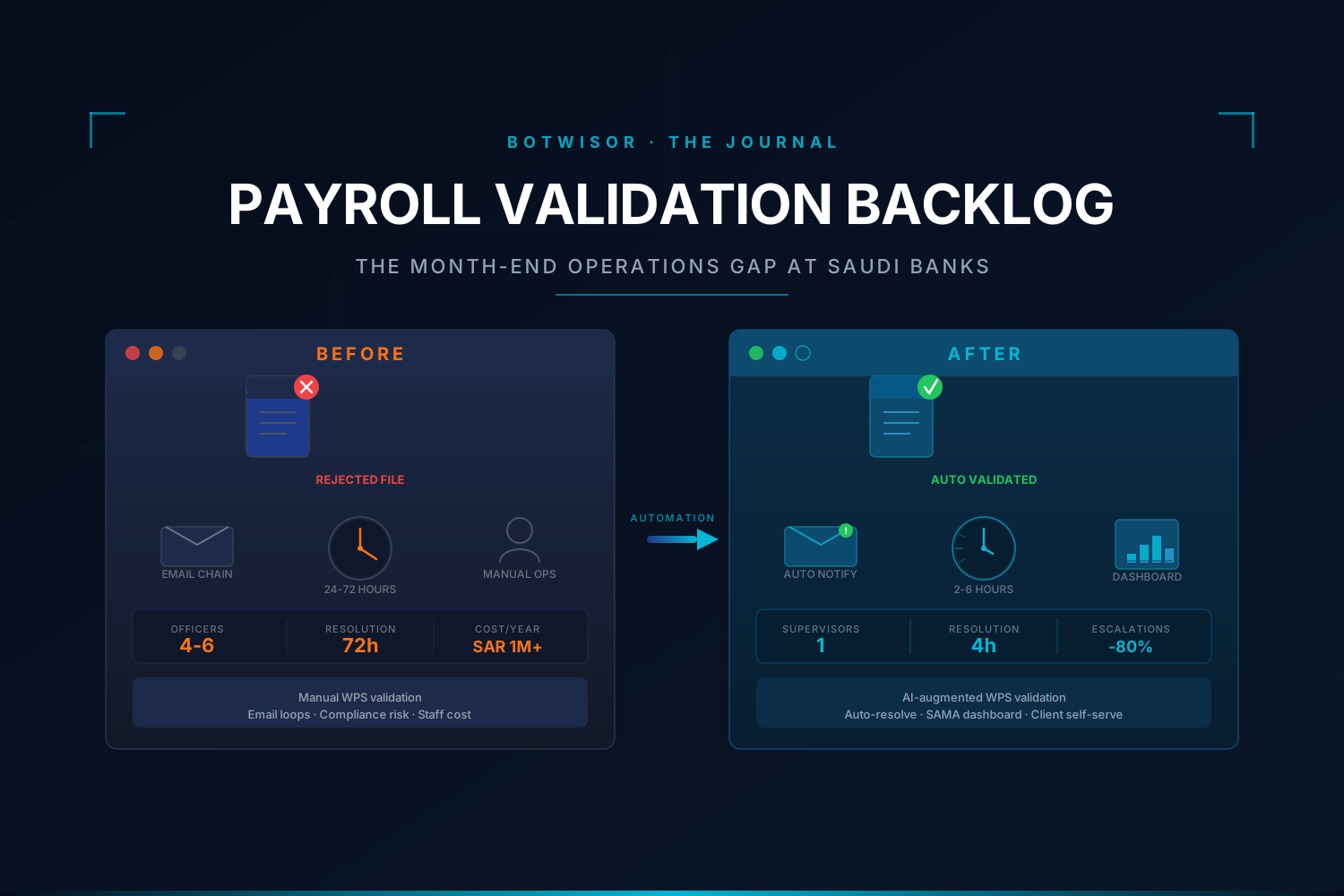
Saudi banks that process Wage Protection System payroll files for corporate clients carry an operations burden that grows every year without appearing on any cost dashboard. Each rejected salary file, unmatched IBAN, or late resubmission adds hours that accumulate across the month-end payroll cycle. The cost is real; most banks have simply learned to absorb it.
What the Wage Protection System Requires of Saudi Banks
The WPS is the Ministry of Human Resources and Social Development's mechanism for ensuring that Saudi employers pay salaries on time and in full. Every employer above a certain size must disburse salaries through a WPS-registered financial institution, and that institution is responsible for transmitting payroll data to the MOHRE platform and confirming that each transfer cleared.
For the bank, this creates a two-part obligation. First, the institution must validate each payroll file before submission: checking that employee IBANs are active and correctly formatted, that salary amounts are consistent with the employment records on file, that the employer's compliance status permits disbursement, and that the file structure conforms to MOHRE specifications. Second, when a file is rejected, the bank must manage the exception cycle. That means communicating with the client, tracking the corrected resubmission, confirming that the second pass clears, and maintaining a compliance record that SAMA can audit.
In a moderate month, this is manageable. At month-end, when 200 or 400 corporate clients submit simultaneously inside a five-day window, the obligation compounds faster than most operations teams anticipated when they were first staffed.
Where the Month-End Queue Forms
The timing pressure is structural. Saudi labor regulations require salaries to be paid by the last working day of the month. Most employers submit payroll files in the final week, compressing the validation window. If a file is rejected on the 27th and the correction cycle runs 48 hours, the employer misses the statutory deadline and faces Ministry of Human Resources penalties.
The exception types that drive the backlog are predictable:
-
IBAN mismatch or account closure. An employee has changed banks, and the employer's HR system has not been updated. The bank returns an error code, and an officer must identify which records are affected, notify the client's HR contact, and track the correction.
-
Employer compliance hold. The employer is under a Ministry hold for prior WPS non-compliance, unpaid social insurance contributions, or Saudization shortfall. No payroll can be processed until the hold is resolved, which requires coordination between the bank, the employer, and the relevant government authority.
-
File formatting errors. The employer's HR software generated a file that fails MOHRE field validations: a missing employee ID, an incorrect salary type code, or a field length the platform rejects.
-
Salary amount mismatch. The submitted salary differs from what the bank holds on file for that employee, triggering a secondary compliance check before the transfer can proceed.
None of these exception types is technically complex. Each one, however, requires a person to detect it, communicate with the client, wait for a corrected file, verify the correction, and resubmit. At a bank processing payroll for 400 active corporate clients, the month-end window can generate 80 to 120 simultaneous exception cases. The team that was sized for a normal operations cycle is now running at a different pace entirely.
What This Costs
The visible cost is headcount. A mid-size Saudi bank running WPS operations with four to six dedicated officers is spending SAR 60,000 to SAR 90,000 per month in salaries and overhead to manage a function that generates no revenue. That is SAR 720,000 to SAR 1.08 million per year for work whose output, from the client's perspective, is the absence of a problem they should never have needed to call about.
The invisible cost is relationship exposure. When a corporate client's payroll cycle stalls because the bank's exception queue ran long, the relationship manager receives a call from the HR director. A company with 500 employees explaining to its workforce that salaries are delayed because of a bank processing issue is not describing a minor administrative inconvenience. That conversation erodes trust in a relationship that took years to build, and it creates an opening for a competitor bank to make a reliability argument at the next contract review.
A corporate banking relationship covering current accounts, trade facilities, and FX transactions generates SAR 400,000 to SAR 1.5 million in annual net revenue for a mid-size Saudi institution. Losing that relationship because the operations team ran three days behind on payroll exception handling is a poor trade against the cost of automating the process.
The regulatory dimension also compounds. SAMA requires banks to report WPS compliance metrics. When exceptions are tracked in email threads and officer notebooks rather than a system of record, producing a clean compliance report means consolidating data manually at exactly the moment operations teams are most stretched. That introduces the conditions for reporting errors and draws supervisory attention the compliance function is not resourced to manage.
Before and After: What the Process Looks Like
| Dimension | Manual Process | AI-Augmented Process |
|---|---|---|
| File pre-validation | Batch error report generated after submission | Field-level validation before submission; inline IBAN correction suggestions |
| Exception detection | Officer reviews rejection report line by line | Automated classification by exception type with resolution instruction attached |
| Client communication | Email or call to HR contact; wait for response | Automated client portal notification with correction workflow and deadline |
| Resolution cycle | 24 to 72 hours per exception case | 2 to 6 hours for most standard exception types |
| Resubmission | Manual upload by officer after client corrects file | Client resubmits via portal; system validates and queues automatically |
| SAMA compliance export | Manual data consolidation at month-end | Real-time compliance dashboard with auto-generated regulatory export |
| Repeat error pattern | Same client errors recur monthly without escalation | Recurring patterns flagged to account manager for structured client advisory |
The difference in the right column is not marginal. It is the difference between WPS compliance being a reactive burden and being a client service.
The Vision 2030 Dimension
Saudi Arabia's labor market reforms have materially expanded formal employment. More workers are WPS-registered today than at any point in the Kingdom's history, and that number continues to increase as Vision 2030 workforce targets advance. Saudization requirements, expanded social insurance coverage under GOSI, and formalization of domestic worker contracts have each contributed additional payroll volume to the system.
Banks processing WPS payroll are absorbing a compliance surface area that has grown faster than their operations capacity. An institution that structured its WPS team in 2020 for 200 corporate clients is, in many cases, processing payroll for 350 to 500 clients today with the same headcount. The month-end queue is longer; the staffing is unchanged.
The banks that will hold the most valuable corporate payroll relationships over the next five years are those that can absorb WPS volume growth without proportional growth in exception-handling overhead. That is a technology problem, not a hiring problem.
What Changes When the Backlog Disappears
The operational case for automating WPS exception handling is direct: fewer officer-hours per payroll cycle, lower cost per corporate client served, and lower risk of regulatory reporting error.
The strategic case is less obvious and more significant. When exception handling runs automatically, the operations team stops being a month-end firefighting unit and becomes a compliance monitoring function. Account managers recover hours that were previously spent coordinating exception cycles and redirect that capacity toward advising corporate clients on cash flow timing, salary advance structures, and payroll-linked financing products.
The client experience shifts from reactive to proactive. A corporate HR director who receives an automated notification that three employee IBANs need updating, with a correction link and a four-hour resolution window, is experiencing a different quality of banking service than the one waiting two days for an email from an operations officer. That difference compounds across a twelve-month relationship.
Banks that have deployed automated WPS validation report lower client escalation rates, improved SAMA compliance scores, and higher corporate client retention in the year following deployment. The month-end payroll queue that once consumed the attention of a full operations team becomes a dashboard that one supervisor monitors, with alerts only for the exceptions that require human judgment.
The backlog does not disappear because exception volume decreases. It disappears because most exceptions resolve without anyone deciding to work on them.
If your WPS operations team is staffing for month-end rather than managing toward it, the next payroll cycle is a reasonable place to start measuring what that costs.
→ Book a free automation audit to understand where the hours are going and what an automated exception layer would change for your team and your corporate clients.