
The Journal
Payment Reconciliation Is Costing Saudi Banks More Than Their Headcount
Saudi banks reconcile SARIE, SWIFT, MADA, and wallet transactions manually at month-end. The payroll cost is visible; the float, write-off, and audit exposure losses are not.
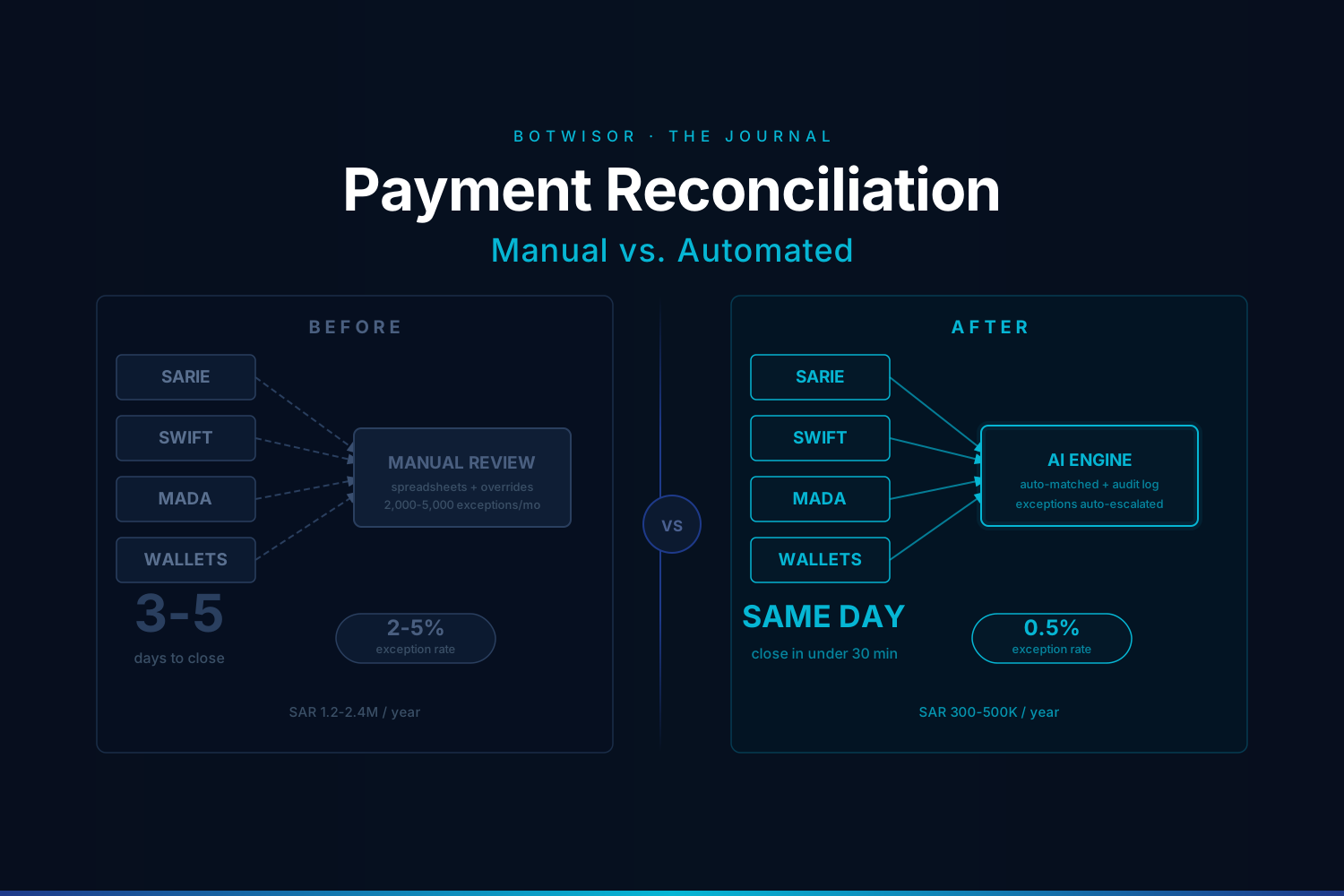
Saudi banks typically operate across four or five payment channels: SARIE interbank transfers, international wires, MADA card settlements, digital wallets, and internal branch transfers. Each channel closes on a different cycle. Reconciling them manually, at month-end and quarter-end, ties up skilled operations staff for days and still produces exceptions that ripple into compliance reporting.
What "Reconcile by Monday" Really Means at a Saudi Bank
Payment reconciliation is the process of matching every outbound and inbound transaction in the bank's ledger against the corresponding settlement record from each payment rail. For a mid-size Saudi bank, that means:
- SARIE credits and debits against the SAMA real-time settlement system
- Correspondent bank nostro account statements in USD, EUR, and other currencies
- MADA and international card settlements from the network processor
- STC Pay, Urpay, and other digital wallet reversals and credits
- Internal branch-to-branch and department-level transfers
Each source arrives on a different schedule, in a different format, and with a different reconciliation window. The team closing the books does not do this once at month-end; they run daily closes for cash and netting positions, weekly closes for card settlements, and a full ledger reconciliation at each period-end.
At a Saudi bank processing SAR 2–5 billion in monthly payment volume, the operations team handling reconciliation typically ranges from four to eight staff, depending on the number of correspondent relationships and the depth of digital channel integration.
Where Manual Reconciliation Breaks Down
Manual reconciliation across multiple payment rails generates a predictable set of failure points.
Format mismatch. SARIE delivers MT940 messages. Card processors send CSV or ISO 8583 files. Correspondent banks use SWIFT MT950 statements. Importing, normalizing, and mapping these into the core banking platform requires manual intervention whenever a file structure changes, which happens after processor upgrades or when a correspondent switches providers.
Timing gaps. A digital wallet reversal posted on day T may not settle until T+2. A correspondent bank may cut its nostro statement on a calendar that does not align with the Saudi bank's period-end. Staff must flag, hold, and chase these items manually until counterpart confirmation arrives.
Exception volume. Payment operations benchmarks suggest that 2–5% of transactions in a multi-rail environment generate exceptions that cannot be auto-matched. For a bank processing 100,000 transactions per month, that is between 2,000 and 5,000 items requiring individual review. At a conservative 15 minutes per item, the monthly labor hours are substantial.
Audit trail fragility. When a reconciliation officer resolves an exception by overriding a match, the audit trail depends on what they noted in a spreadsheet cell or a free-text field in the core system. When regulators or internal auditors ask who resolved which exception and why, manual processes rarely produce a clean answer.
Escalation gaps. An exception sitting in a shared spreadsheet does not automatically alert the right person when it ages past a settlement window or hits a regulatory threshold. The escalation path is ad hoc: whoever notices first. At month-end, when everyone is under pressure to close, aged items get resolved quickly rather than correctly.
Before and After: Two Ways to Close the Books
| Dimension | Manual Operations | AI-Augmented Reconciliation |
|---|---|---|
| Matching process | Staff import files, map columns, flag mismatches manually | Automated ingestion, normalized mapping, rule-based matching |
| Exception rate | 2–5% of transactions require human review | Typically falls to 0.5–1% after a 90-day tuning period |
| Time to close | 3–5 days at period-end; daily reconciliation takes 2–4 hours | Daily close in under 30 minutes; period-end completed same day |
| Audit trail | Notes in spreadsheets or free-text core fields | Timestamped, attributed resolution log per exception |
| Escalation path | Ad hoc; depends on who notices | Rule-triggered: exceptions above threshold auto-escalate |
| Headcount | 4–8 FTEs dedicated to reconciliation | 1–2 oversight roles; staff redeployed to higher-value work |
| Annual cost estimate | SAR 1.2–2.4M in salary and overhead | SAR 300–500K in platform and oversight |
The Hidden Cost Beyond Headcount
Salaries are the most visible line in the reconciliation budget. Several less visible costs take longer to surface.
Float and settlement penalties. When a payment sits unmatched past its settlement window, the bank may absorb a float cost or incur a late-settlement fee from a correspondent. These charges are small per item but accumulate across thousands of exceptions over a year.
Write-offs from aged exceptions. Items that remain open long enough become write-off candidates. Operations teams at Saudi banks with significant digital wallet volumes have reported aged items where the originating transaction could no longer be reliably traced. The write-off amount is often smaller than the cost of the investigation, so it disappears quietly into period-end adjustments.
Regulatory reporting lag. SAMA's reporting frameworks require banks to submit accurate position data on defined schedules. When reconciliation is delayed, the position reported for a given period may be based on a preliminary figure subject to revision. That revision process requires additional staff time and, if it falls outside the reporting window, may trigger disclosure obligations.
Opportunity cost. Senior operations staff who spend three days on reconciliation at each period-end are not available for higher-value work: reviewing complex transaction escalations, supporting treasury teams that need confirmed position data for decisions, or managing correspondent banking relationships that generate revenue.
What Changes When Matching Is Automated
Exception handling moves from days to hours. The primary gain from automated reconciliation is not the matching itself; it is the exception resolution workflow. In a well-configured environment, each unmatched item surfaces with a suggested resolution, the relevant transaction details from both sides, and a confidence score. An operations officer can approve or override the suggestion in under two minutes per item. A backlog of 2,000 exceptions that might consume three days of team capacity can be cleared in a single morning session.
The compliance signal becomes auditable. Automated reconciliation produces a clean, queryable log: every match, every override, every escalation is timestamped and attributed to the person who acted on it. When a SAMA inspection requests the resolution history on a specific nostro account, the bank can produce it in minutes rather than assembling it from spreadsheet rows and email threads.
Correspondent relationships improve. Banks that close their books faster can confirm positions to correspondents on tighter timelines. This matters for credit limits, overdraft facilities, and the bank's internal credit ratings from foreign correspondent partners, all of which affect the cost of international payments.
Payment Reconciliation and Vision 2030
Saudi Arabia's financial sector transformation under Vision 2030 is increasing payment complexity. The SAMA fintech strategy, open banking regulations, the rapid growth of MADA transaction volumes, real-time payment initiatives, and expanding cross-border remittance corridors all add channels and transaction volume to an environment that is already operationally demanding.
Banks entering this environment with manual reconciliation processes will face rising exception volumes without a proportional increase in staff capacity. The operations infrastructure built now will either support growth or become its ceiling. Automated reconciliation is not a future investment; it is the operational baseline that the next phase of Saudi banking will require.
If your operations team is still closing the books manually across multiple payment channels, the gap between current spend and what automated reconciliation costs is worth quantifying precisely. BotWisor offers a free automation audit for Saudi financial institutions: we map your current reconciliation workflow, quantify the exception cost, and show you what a practical automation path looks like before you commit to anything.