
The Journal
The Overstock Cycle Eating Saudi Retail Margin
Saudi retailers on manual demand planning over-order predictably, then absorb the gap through clearance pricing that trades margin for liquidity. The cycle repeats every season because the underlying forecast process has not changed.
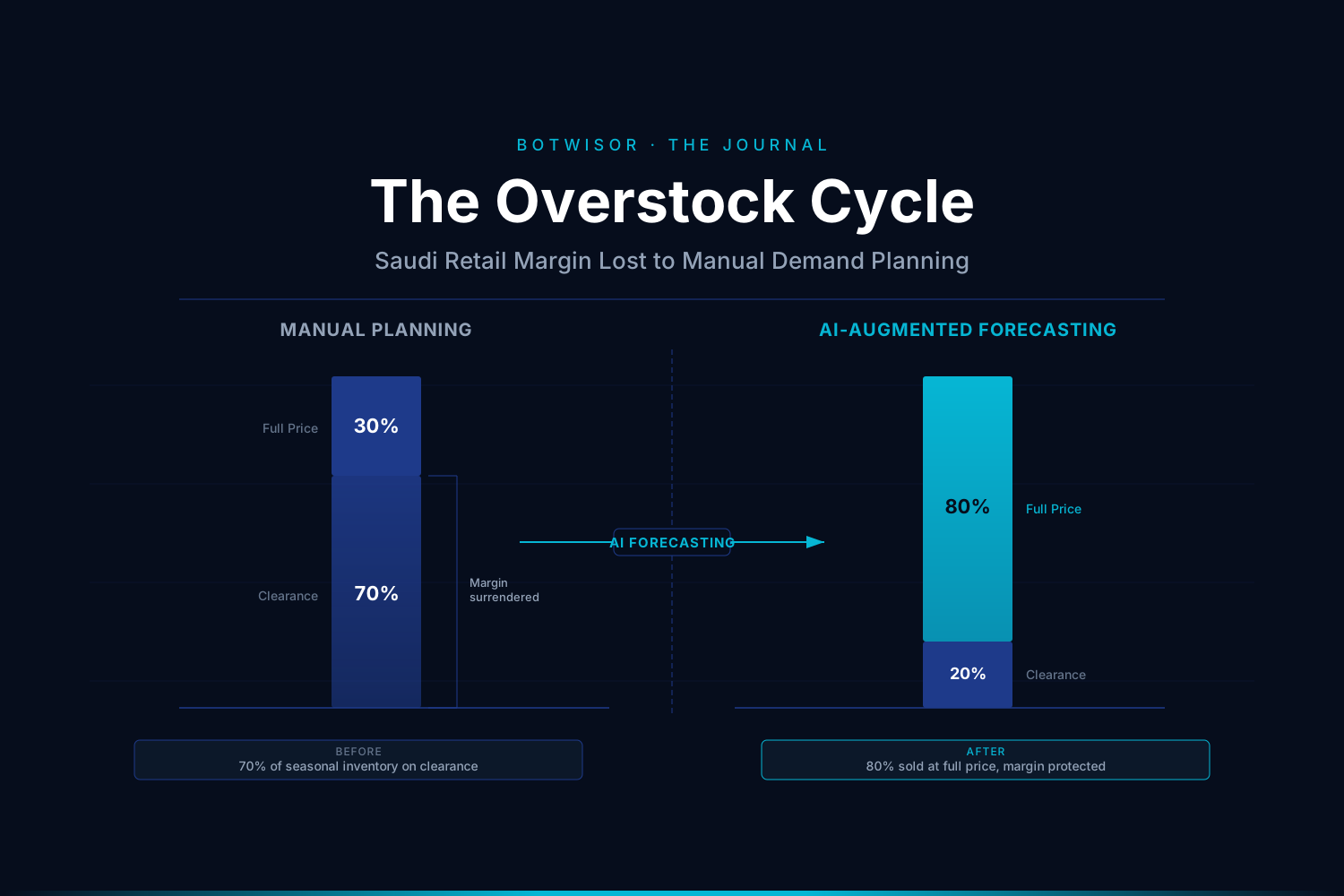
Saudi retailers running demand planning on last year's sales figures and buyer intuition over-order predictably. When sell-through underperforms, they absorb the gap through clearance pricing, working capital locked in slow inventory, and markdown cycles that erode the margin they were protecting. The pattern repeats every season because the underlying forecast process has not changed.
How Saudi Retailers End Up Overstocked
The typical demand planning cycle at a mid-size Saudi retailer follows a recognizable path. A buying team reviews last season's sales by category, adjusts for expected promotional uplift, adds a buffer for supply chain uncertainty, and places orders four to twelve weeks ahead of the selling window.
Each step is rational in isolation. The problem is structural: the entire process uses historical patterns as a proxy for future demand, and Saudi consumer behavior is no longer stable enough for that proxy to hold.
Several pressures compound the gap. Saudi retail is in a rapid expansion phase driven by Vision 2030's National Retail Development Program, which is deliberately diversifying the category mix, the channel mix, and the consumer demographic. A buying team estimating Ramadan 2026 demand using Ramadan 2025 numbers is working with data that predates the consumer shifts those programs are actively accelerating. In a market evolving this quickly, last year's sell-through rate is a weakening signal.
Multi-branch complexity adds another layer. Saudi retail chains have expanded across Riyadh, Jeddah, Dammam, and newer regional centers including Tabuk, Abha, and Al-Ahsa. Demand velocity at a flagship Riyadh mall location does not replicate at the same rate in a newer catchment. Manual planning aggregates at the category level and rarely optimizes at the branch-SKU level without analytical resource that most operators do not maintain.
The buffer mentality completes the over-order pattern. Orders sourced through Jeddah Islamic Port or regional distributors carry lead times of four to twelve weeks. Buyers add a stock buffer as insurance against stockouts, which is rational per SKU. Across a category of several hundred lines, that buffer systematically over-provisions the warehouse for the median demand scenario and guarantees overstock whenever consumer demand trends below the adjusted baseline.
The Real Cost of Clearance Pricing
End-of-season clearance is often described as a merchandising tool. For Saudi retailers running manual planning, it functions primarily as a cost-recovery mechanism: the process by which over-ordered inventory is converted back into cash, at a discount.
Margin Surrendered on Inventory That Should Not Have Been Ordered at That Volume
The direct cost is straightforward. A retailer maintaining a 40 to 45 percent gross margin who moves 25 to 30 percent of seasonal inventory through clearance at an average markdown of 35 percent has surrendered most of the gross profit earned on that stock. On a SAR 120M revenue base, if SAR 25M runs through clearance events at an average discount of 35 percent, the gross margin impact is approximately SAR 4M to SAR 6M per season, captured as liquidation proceeds rather than profit.
That figure is not exceptional. It is the structural cost of over-ordering at that scale, recurring every season.
Working Capital Locked in Slow Stock
Inventory financed but not sold ties up capital that would otherwise fund new-season buying, marketing, or operational expansion. A retailer carrying SAR 15M to SAR 20M in excess inventory across two or three slow-moving seasons is not simply paying warehouse costs; they are financing inaccurate forecasting at the cost of growth capital.
Saudi retail operators preparing for Vision 2030-driven expansion, whether into new formats, new regions, or new product categories, are deploying capital against growth. Excess inventory is a direct competitor for that capital.
Discount Conditioning Over Time
The third cost compounds most insidiously. Customers who receive consistent clearance offers learn to defer purchases. The consumer who buys at full price in October and finds the same item at 40 percent off in January does not repeat that decision. Across a retailer's customer base, systematic clearance events gradually shift purchase timing toward discount windows, increasing the promotional budget required to maintain the same revenue volume.
Saudi apparel, cosmetics, and home goods retailers with long promotional histories are already managing this dynamic without having named it as a distinct cost driver. Full-price sell-through rates decline slowly; the connection to clearance conditioning is rarely captured in a single metric.
Before vs. After: Manual vs. AI-Augmented Demand Planning
| Dimension | Manual Planning | AI-Augmented Forecasting |
|---|---|---|
| Data foundation | Last season's sales, buyer intuition | Real-time PoS data, browse signals, external factors |
| Forecast granularity | Category-level, periodically reviewed | Branch-level, SKU-level, continuously updated |
| Lead time buffer | Fixed and conservatively padded | Dynamic, adjusted per SKU by current sell-through velocity |
| Overstock detection | Post-season, during clearance preparation | In-season, within days of velocity divergence |
| Response to slow lines | Clearance pricing after the selling window closes | In-season reallocation across branches before stock strands |
| Clearance dependency | Structural and recurring every season | Reduced to genuine end-of-life and end-of-season SKUs |
| Working capital efficiency | 15 to 30 percent of inventory value tied in slow stock | Materially lower overstock exposure |
The shift in the table above is not about removing the buyer's judgment. It is about changing the inputs to that judgment. A buying team working from real-time sell-through velocity by branch, with flagged divergence from forecast and reallocation options surfaced automatically, makes different decisions than one working from a monthly category report and a buffer formula built on last season's anxiety.
Why Saudi Retail Amplifies the Forecasting Problem
Three structural factors make forecasting failure more expensive in Saudi Arabia than in comparable markets.
Demand concentration. Saudi consumer spending is heavily concentrated across a short list of peaks: Ramadan, Eid al-Fitr, Eid al-Adha, National Day, and White Friday. Miscalibrating the forecast on any single peak is not recoverable within the season. A retailer who over-ordered for Eid al-Fitr cannot unwind that position before Eid al-Adha arrives.
Import dependency and long lead times. A substantial share of Saudi retail inventory is sourced internationally, with purchase orders placed months before the selling window through Jeddah Islamic Port or GCC distribution hubs. The longer the lead time, the earlier the forecast must be fixed, and the less flexibility the business has to incorporate changing demand signals. Better forecasting does not eliminate lead times; it narrows the forecast error at the moment the order is placed.
Accelerating consumer change. Saudi Vision 2030 is compressing decades of consumer evolution into a shorter window: a younger, more digitally native buyer base with faster trend cycles and shifting category preferences. Demand planning built on historical patterns has a shorter validity window every year, not a longer one.
What Changes When Forecasting Runs on Data
Retailers who have shifted to data-driven demand planning describe a change in where inventory problems surface. Instead of discovering overstock at the end of a season during clearance preparation, they identify velocity divergences within weeks of a selling window opening, reallocate stock across branches before it becomes stranded, and adjust forward orders based on real sell-through data rather than adjusted historical averages.
The operational impact is not primarily captured in the clearance event that no longer needs to be as deep or as broad. It shows up in the cascade: less overstock means less clearance dependency, less clearance means less discount conditioning in the customer base, and less conditioning means higher full-price sell-through in subsequent seasons. The margin recovery compounds forward.
For a Saudi retailer operating at SAR 100M to SAR 300M in revenue, the improvement in full-price sell-through and working capital efficiency from more accurate demand forecasting is a structural operational lever. It is not a marginal efficiency gain at the edge of the P&L; it shows up in the gross margin line that funds everything else.
If your buying team is still working from last season's figures and a manually padded buffer, the overstock cycle will continue. A free automation audit identifies where forecast accuracy can be improved in your current operation and what the working capital impact looks like in practice.