
The Journal
The Omnichannel Order Gap Saudi Retailers Resolve on WhatsApp
Saudi multi-channel retailers have no unified order view. Manual reconciliation costs hours daily and suppresses repeat buyers. Here is what the gap costs and what changes.
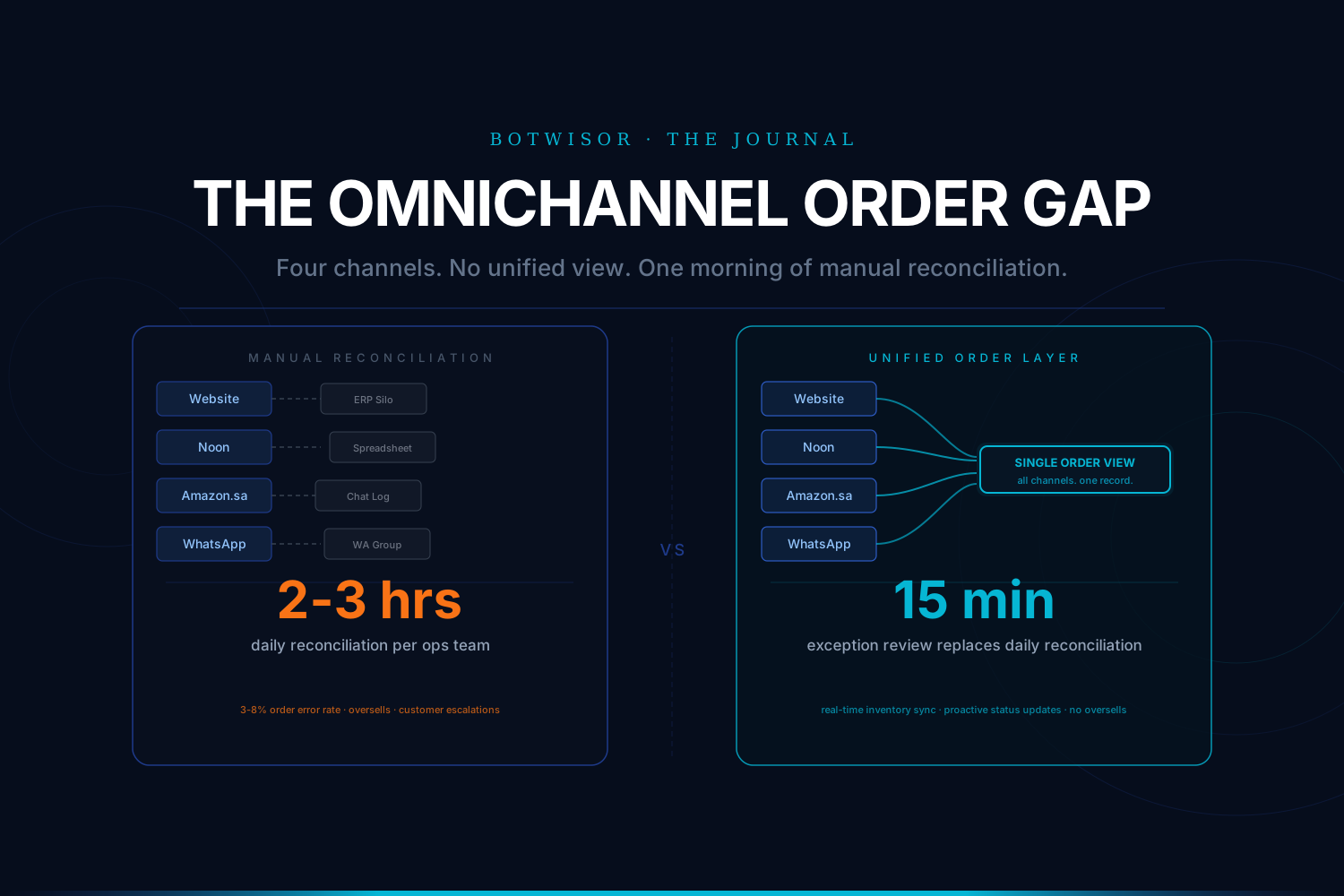
Most Saudi retailers operating across a website, Noon, Amazon.sa, and a WhatsApp channel have no single order view. Each storefront generates its own queue, reconciled manually every morning. The gap between what customers experience and what operations can see costs hours of labour daily, introduces order errors, and suppresses repeat purchase rates.
What Is the Omnichannel Order Gap?
The omnichannel order gap is the disconnect between the order reality your customers experience and the order reality your operations team can see. It appears in three recurring patterns.
A customer places an order on Noon and messages your WhatsApp channel asking for a delivery update. Two different team members respond from two different systems with two different answers. No one is wrong; they simply cannot see the same record.
A warehouse team receives a pick list from the website ERP without knowing that three units of the same SKU were committed on Amazon.sa thirty minutes earlier. The oversell resolves as a cancelled order, a customer service call, and a refund.
A customer service agent cannot confirm fulfilment status because the marketplace dashboard, the warehouse management system, and the WhatsApp thread show different states. The agent closes the call with an approximation, not a fact.
These patterns compound with scale. Saudi e-commerce has grown at a rate that consistently outpaces mid-market operational infrastructure. A retailer serving Riyadh, Jeddah, and Dammam across three or four storefronts can generate several hundred to several thousand order events per day, each with its own status lifecycle and its own demand on someone's attention.
How Saudi Retailers Manage It Today
The current state at most mid-sized Saudi retailers follows a recognisable pattern.
Marketplace orders arrive by download. An operations coordinator pulls order CSVs from the Noon and Amazon.sa seller portals each morning and imports them manually into a shared spreadsheet or ERP. This step alone takes twenty to forty minutes before the working day has formally started.
WhatsApp orders are logged separately. Saudi consumers and B2B buyers often prefer to order directly via WhatsApp because it feels faster and more personal. These orders live in a chat thread and are transferred manually to a separate tracking document.
Website orders feed the ERP directly. These are the only orders in the formal system of record. Everything else is reconciled against them as a separate morning exercise.
Customer queries get answered by whoever picks up the conversation. Without a unified order view, the customer service team answers from memory, from last-known status, or by asking a colleague on a WhatsApp group that serves as the informal communication layer.
Returns and exchanges are handled ad hoc. Different storefronts have different return processes, so the operations team tracks each replacement manually and often marks a case closed before confirming the replacement has shipped.
The daily reconciliation cycle typically runs one to three hours, involves two to four staff members, and produces errors that surface later as complaints, duplicated shipments, or warehouse discrepancies.
What Does the Gap Cost?
The direct costs are visible once you measure them. The indirect costs are larger.
| Cost category | Manual omnichannel state | AI-augmented unified order state |
|---|---|---|
| Daily reconciliation time | 2–3 staff-hours | Under 15 minutes automated exception review |
| Order error rate (duplicates, missed) | 3–8% of multi-channel volume | Under 1% with automated matching |
| Customer escalation rate (order status queries) | High; reactive | Low; proactive status updates |
| Same-day fulfilment capability | Limited; depends on reconciliation speed | Enabled by real-time order routing |
| Repeat purchase rate impact | Suppressed by inconsistent post-order experience | Recovered through consistent resolution |
At a retailer processing 500 daily orders across three channels, a 5% error rate means 25 orders per day requiring manual intervention. At an average order value of SAR 250, that is SAR 6,250 in at-risk transactions daily, before accounting for staff time or the proportion of those customers who simply do not return.
Over a quarter, the reconciliation labour alone can reach SAR 80,000 to SAR 120,000 in fully loaded staff cost. The repeat-purchase suppression effect is harder to quantify directly but consistently exceeds the labour cost: a customer who had to chase order status twice is unlikely to reorder.
Why Does the Gap Persist?
Most Saudi retailers did not build multi-channel operations by design. They started with a website, added Noon or Amazon.sa to access volume, then found that customers wanted to order via WhatsApp because it felt more immediate. Each channel arrived reactively, without integration.
The result is an architecture that was never designed to share state. The ERP predates the marketplace channels. The warehouse management system has no API connection to Noon. The WhatsApp sales channel has no order management layer at all.
Integration vendors typically quote this type of project at SAR 500,000 to SAR 2 million for a full layer, which most mid-market Saudi retailers cannot fund from operating budgets. So the gap is absorbed by the operations team rather than closed, and the cost is treated as a fixed overhead rather than a solvable problem.
This is the structural reason the gap persists: the perceived cost of solving it exceeds the perceived cost of living with it. That calculation changes when the daily cost is made visible.
What Does Unified Order Orchestration Change?
A unified order layer does not require replacing the existing ERP. It sits between your channels and your fulfilment infrastructure, normalising order events from each source into a single record with a shared status timeline.
The operational changes are practical and immediate.
All storefronts feed a single order queue. The operations team sees one view regardless of where the order originated. Customer service agents answer from the same record whether the query arrives via WhatsApp, email, or the website chat.
Inventory commitments synchronise in near-real time. A sale on Amazon.sa reduces available inventory for the Noon listing automatically, eliminating oversell events before they reach the warehouse.
Returns and exchanges route through the same system. Status updates from a marketplace return propagate to the customer-facing record without manual re-entry.
Exception routing replaces daily reconciliation. Instead of reviewing all orders for errors, the team reviews only the small proportion flagged by automated matching rules. A team that spent two hours reconciling each morning spends fifteen minutes on genuine exceptions.
The result is not only efficiency. It is consistency in what customers experience after they buy, which is what drives repeat purchase rates. Saudi consumer expectations are calibrated to the standards of platforms that have made same-day status updates a baseline. The gap between a manual omnichannel operation and a unified one is felt directly by customers.
The Business Case Is Already in Your Accounts
The cost of leaving this problem unsolved is already on your P&L: in the payroll of the staff who reconcile every morning, in the customer service time spent answering avoidable queries, in the refund rate on orders where two channels committed the same inventory, and in the repeat-purchase rate of customers who had to work for a status update.
If you run three or more channels and your team spends meaningful time each morning reconstructing the order picture, the gap is already costing more than the infrastructure to close it. The question is not whether to invest. It is whether the investment happens before the next Ramadan or 9.9 peak, when volume amplifies the gap, or after it.
Saudi retail is on a trajectory that Vision 2030's National Industrial Development and Logistics Program has accelerated: more digital storefronts, more marketplace participation, higher fulfilment expectations, and less tolerance for post-purchase friction. Retailers who resolve orders on WhatsApp today are not facing only an operations problem. They are facing a competitive position that weakens with every unit of volume they add.
Book a free automation audit to see where your order operations stand and what a unified layer would change for your team.