
The Journal
Off-Plan Payment Delays: The Cash Flow Hit Saudi Developers Absorb
Saudi developers routinely absorb 20 to 30 day payment delays on off-plan installments. Here is what that lag costs and what changes when collection is automated.
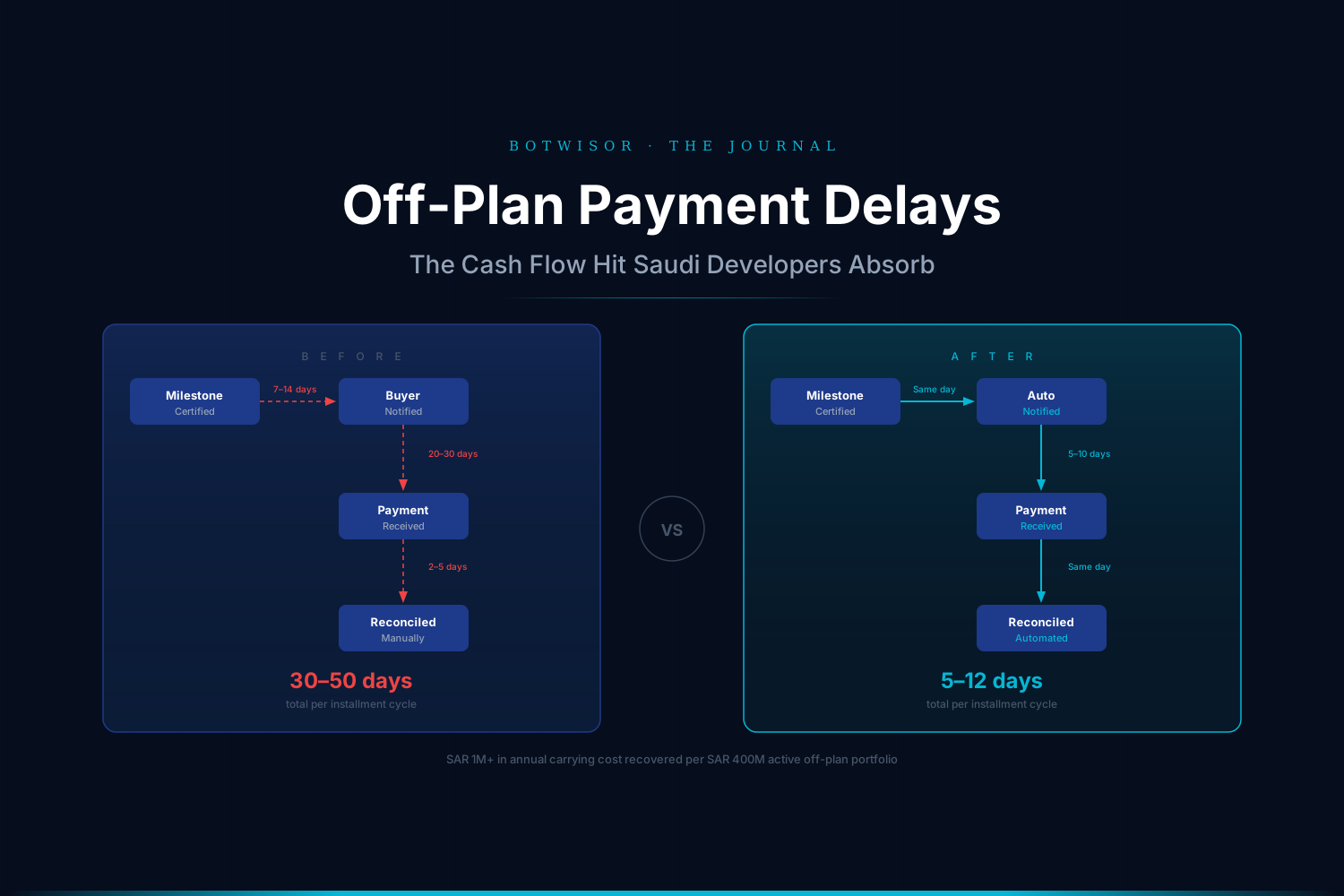
Saudi off-plan projects collect payments across five to eight construction milestones, each requiring notification, follow-up, and reconciliation. When that process runs on spreadsheets and phone calls, a mid-size development portfolio absorbs 20 to 30 days of unnecessary delay per installment. On SAR 400M in active off-plan sales, that lag represents a continuous carrying cost most developers track only loosely.
Why the Off-Plan Model Creates a Built-In Receivables Problem
The Saudi off-plan structure is set by regulation. RERA requires developers to register payment schedules tied to construction progress milestones, route buyer payments through licensed escrow accounts, and certify completion before releasing funds. This framework protects buyers correctly, but it creates a collection cycle with multiple handoffs between the project team, the finance department, and the buyer.
In a typical mid-size development selling 150 to 400 units, those handoffs look like this:
- The engineering or PMO team confirms milestone completion internally.
- The finance team reviews the confirmation, matches it to the relevant units and payment schedule, and prepares payment notices.
- The collections team sends notification to buyers by email, phone, or both.
- Buyers confirm receipt, arrange financing if required, and initiate payment.
- Finance reconciles the incoming bank transfer against the correct buyer, unit, and milestone.
Each step involves a separate team, a separate system, and a time gap. The average time from milestone certification to buyer notification at mid-size Saudi developers runs 7 to 14 days. That lag is before the buyer has even been asked to pay.
Three Friction Points That Compound the Delay
Understanding where time is lost makes the problem solvable.
Milestone-to-notification lag. Engineering teams sign off on construction progress through their own systems, often project management software that is not connected to the sales or finance platform. Someone must manually transfer the certification into the payment workflow. In busy periods, this step waits days.
REDF and bank financing preparation time. Roughly 60 to 70 percent of Saudi off-plan buyers use Real Estate Development Fund (REDF) financing or a commercial bank mortgage as part of their payment structure. Both financing sources require the buyer to initiate a disbursement request in advance. If a developer's notification arrives 7 to 10 days before the due date, the buyer may not have enough time to complete the disbursement process, and the payment slips to the next window.
Payment matching and reconciliation lag. When a buyer's bank transfer arrives, it lands in the developer's escrow-linked account without automatic context. The finance team must manually identify which buyer, unit, and milestone the payment corresponds to. In a 200-unit project with buyers paying across overlapping milestones, mismatches are common. A payment that arrived but remains unmatched means the collections team continues chasing a buyer who has already paid.
Each of these friction points is operational, not financial. They are not caused by buyers defaulting. They are caused by a process designed for smaller project volumes that has not been updated as portfolios have grown.
What Manual Collection Costs in Practice
The cost falls into three categories that are rarely summed together.
Carrying cost on delayed receivables. Saudi developers typically finance land acquisition and construction through syndicated facilities at SAIBOR-linked rates. A 20-day average delay on a SAR 10M installment tranche costs roughly SAR 27,000 in carrying charges at current SAIBOR-linked rates. Across eight milestones on a portfolio of six active projects, that accumulates to over SAR 1.3M annually in avoidable financing cost.
Finance team hours absorbed by follow-up. Collections on a 300-unit project typically occupy two to three finance staff during peak milestone periods. That time goes to phone calls, email chasing, spreadsheet updates, and manual reconciliation. None of it produces insight the team could not get from a real-time dashboard.
Cash flow forecasting distortion. When collections run on manual tracking, the CFO's receivables number reflects expected receipts, not actual matched receipts. Project-level cash flow reports run consistently 2 to 3 weeks behind reality. That lag distorts financing decisions, contractor payment scheduling, and quarterly profit projections.
| Manual Tracking | AI-Augmented Workflow | |
|---|---|---|
| Milestone to buyer notification | 7–14 days | Same day, automated trigger |
| Reminder touchpoints | 1–2 calls, timed by staff availability | Multi-channel, pre-scheduled in Arabic and English |
| Payment reconciliation | Manual match, 2–5 days | Automated, same-day confirmation |
| Overdue detection | Weekly report review | Real-time aging dashboard |
| Escalation | Unstructured, ad hoc | Rule-based at days 5, 10, 20 |
| Finance hours per project per month | 15–25 hours on follow-up | 2–4 hours on exception handling |
| Average collection cycle per installment | 20–30 days past due date | 5–10 days past due date |
What Changes When Collection Runs Automatically
An automated payment management workflow does not replace the developer's relationship with the buyer. It removes the operational friction that delays every touchpoint in the collection cycle.
When milestone completion is logged, the system triggers payment notification to each relevant buyer in their preferred language (Arabic or English) via WhatsApp, SMS, and email. The notification includes the payment amount, due date, payment instructions, and a link to confirm payment or flag a financing delay. Buyers who rely on REDF or bank financing receive an early advisory 21 days before the due date, giving them the preparation window the financing process requires.
If payment is not confirmed by day 3 after the due date, an automatic follow-up goes out. By day 7 overdue, the case routes to a collections agent with the full buyer profile, contract schedule, and all prior notifications already populated, so no time is spent on account lookup. By day 15, it escalates to a relationship manager with a summary of all touchpoints.
Payment reconciliation runs against bank feeds in near real-time. When a transfer arrives, it matches against open receivables automatically, marks the milestone settled, and updates the cash flow dashboard the same day. The CFO's receivables number reflects actual confirmed receipts, not estimates.
What Vision 2030 Project Volume Means for This Problem
Saudi Arabia's residential targets under Vision 2030 are adding off-plan volumes that were not present five years ago. The home-ownership target of 70 percent requires REDF and commercial bank financing to scale substantially. Mega-projects including NEOM, Red Sea Project, and Diriyah are generating thousands of residential units for sale over the next decade.
Each new financing source adds complexity to the collection cycle. A buyer managing REDF disbursements, a commercial bank bridge, and personal equity contributions involves three payment streams that the developer's collections process must track simultaneously. Manual developer workflows were not designed for this complexity at scale.
Developers who automate receivables management today are not just improving this quarter's cash flow. They are building the infrastructure to absorb significantly higher project volumes without proportional increases in finance headcount or collection risk.
The Question Worth Asking
Saudi developers generally accept installment payment delays as part of doing business. The harder question is whether those delays reflect unavoidable buyer behavior or avoidable operational process failures.
The pattern is consistent: delays are systematic, not buyer-driven. They follow the manual handoffs in the collection cycle, not the financial circumstances of individual buyers. That makes the pattern fixable.
On a portfolio of five to eight active projects totaling SAR 400M to SAR 600M in off-plan sales, the carrying cost, staff hours, and forecasting distortion together represent a material number. Comparing it to the cost of removing the problem is the conversation most finance directors have not yet had.
Ready to map what your receivables cycle is actually costing? Book a free automation audit and we will calculate it against your active project portfolio in one session.