
The Journal
What Saudi Developers Lose Between Milestone Completion and Escrow Release
Saudi off-plan developers wait six to ten weeks after milestone completion before the escrow tranche arrives. That gap is an ops cost, not a structural one.
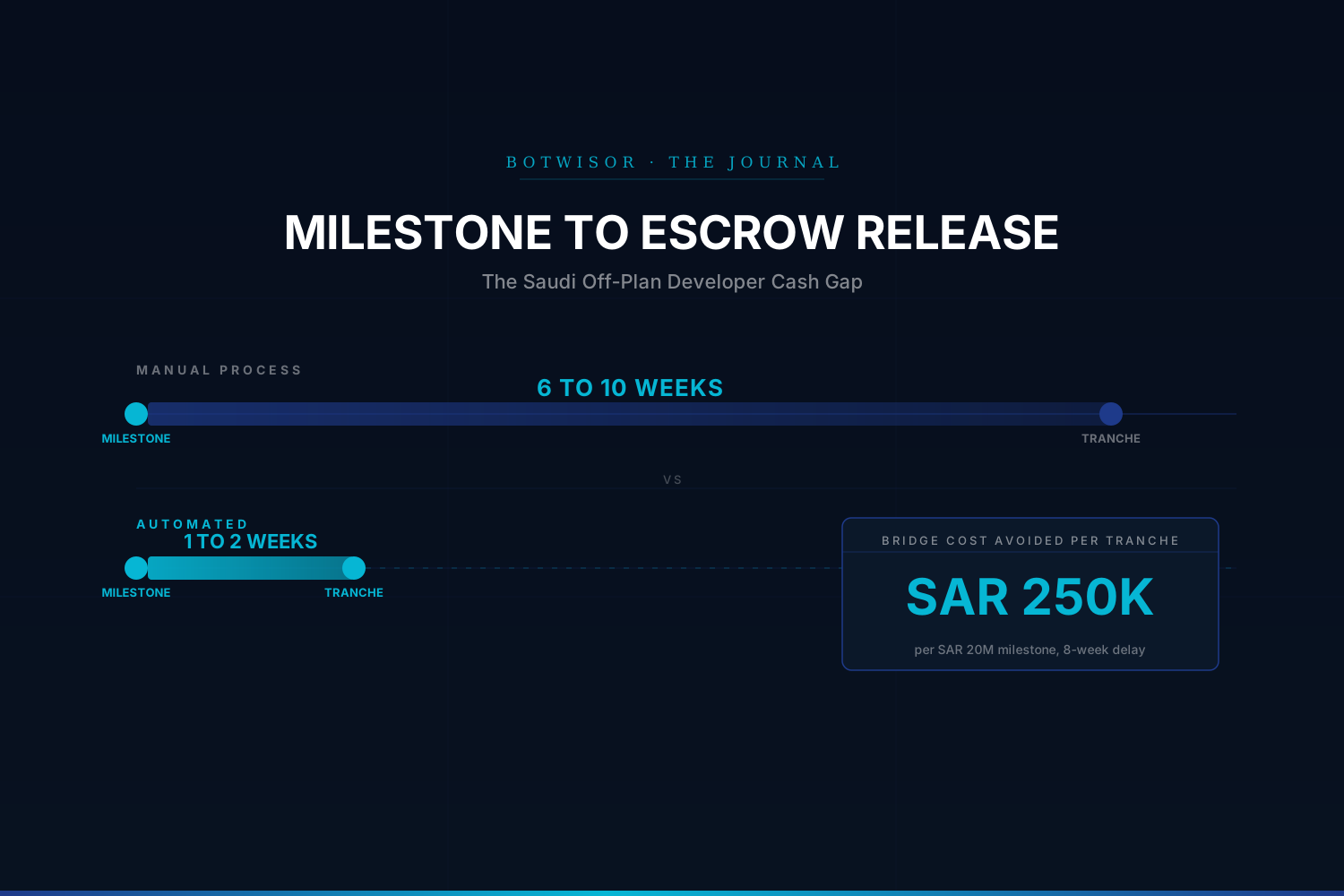
Saudi off-plan developers complete construction milestones weeks before they receive the corresponding escrow tranche. Manual milestone documentation, inspection scheduling, and submission workflows create a predictable cash gap that compounds across every project stage. The cost is not just opportunity loss but bridge financing pressure and contractor friction that quietly erodes final margin.
What Is the Wafi Escrow Milestone Process?
Under Saudi Arabia's Wafi program, developers who sell off-plan units are required to hold buyer proceeds in licensed escrow accounts. Funds are released in tranches, each tied to a verified construction milestone: land acquisition, foundation, superstructure, MEP rough-in, interior finishes, and practical completion. The escrow agreement specifies the exact schedule, and an independent escrow engineer must physically verify each milestone before the corresponding tranche is disbursed.
When a milestone is reached, the developer must:
- Formally document completion with inspections, certificates, and photographic evidence.
- Engage the licensed escrow engineer for an independent site inspection.
- Compile and submit the release package to the escrow agent.
- Await the agent's review and RERA verification before disbursement.
The process protects buyers. Its operational weight falls entirely on the developer's project team, and most project teams manage it by hand.
Where the Time Goes Between Milestone and Release
The technical moment a milestone is complete and the moment the finance team receives the tranche are rarely the same week. On manually-run Saudi off-plan projects, three friction points compound.
Documentation assembly. When a milestone finishes, the project manager knows before the paperwork catches up. Gathering photographs, subcontractor sign-offs, inspection certificates, and completion forms across a multi-building site typically takes one to three weeks, depending on how many site teams are involved and how consistently records were maintained during construction.
Inspection scheduling. The escrow engineer must physically inspect the site before authorizing the release. Coordinating this inspection involves outbound calls, schedule alignment, and follow-up across multiple parties. This step alone commonly adds two to three weeks.
Submission completeness. Incomplete packages are returned by the escrow agent, restarting the clock. Because documentation is assembled manually, missing attachments are common. A single returned package typically adds two to four additional weeks.
The compounded result: on manually-run Saudi off-plan projects, the average gap between milestone completion and tranche receipt runs from six to ten weeks. Most project finance teams have absorbed this delay into their cash flow projections as a fixed assumption. It is not fixed; it is operational.
What Each Week's Delay Costs a SAR 400M Project
Consider a residential development in Riyadh with a total value of SAR 400M. Across six milestones, each tranche averaging SAR 18M to SAR 22M, the developer carries a rolling working capital gap between physical completion and cash receipt. At a conservative bridging rate, each SAR 20M tranche delayed by eight weeks costs roughly SAR 200K to SAR 250K in financing expense.
Across six milestones on one project, that is SAR 1.2M to SAR 1.5M in financing expense traceable directly to documentation and submission lag. Developers running two or three concurrent projects amplify this cost proportionally, yet the figure rarely appears in project reporting because it is absorbed across bridge facility interest, contractor extended-terms premiums, and procurement decisions rather than isolated as an ops cost.
The cash flow model absorbs it as "float." The margin model absorbs it as "financing." Neither names it for what it is: a documentation delay.
The Three Costs Most Project Finance Teams Absorb Without Naming Them
The escrow release delay is not one cost; it is three costs running in parallel, each attributed to a different budget category.
-
Bridge financing interest. When construction must continue while the tranche is delayed, developers draw on bridge facilities or unsecured credit lines. The interest is categorized as financing cost, not as an ops inefficiency, even though eliminating the documentation lag would eliminate most of the bridge requirement.
-
Contractor extended-terms premiums. When payment to subcontractors is delayed because the tranche has not arrived, developers often negotiate short-term extensions. These carry explicit premiums or create relationship costs that surface in the next contract negotiation. Neither appears as a named line item.
-
Procurement deceleration. Project teams that know the tranche will be late begin slowing procurement for the next phase. This creates a compounding delay effect: the documentation gap for one milestone slows mobilization for the next, extending the overall project timeline and its carrying costs.
Each of these costs is real. None is typically attributed to the escrow documentation workflow. That attribution gap is why the cost persists.
Before and After: The Milestone Release Workflow
| Step | Manual Process | AI-Augmented Process |
|---|---|---|
| Milestone completion detection | Informal, dependent on project manager awareness | Automatic flag when project system marks completion |
| Documentation compilation | 1 to 3 weeks across site teams | Auto-compiled from connected project and site data |
| Inspection scheduling | 2 to 3 weeks, phone and email coordination | Auto-triggered; calendar integration with inspector |
| Submission package check | Manual review; gaps common | Automated completeness check; gaps flagged before submission |
| Escrow agent submission | Physical or email; returns frequent | Structured digital submission; return rate substantially reduced |
| Average time: completion to tranche receipt | 6 to 10 weeks | 1 to 2 weeks |
The same project managers handle both workflows. The difference is that documentation and coordination begin immediately and automatically, rather than when a team member has capacity.
Why the Pattern Persists
Saudi developers have run the escrow release cycle manually long enough that the delay has been priced into project models. Most finance teams build eight to twelve weeks of additional float into cash flow projections simply to account for the documentation lag. Once a cost is priced in, no one is assigned to eliminate it.
A second reason: the cost is distributed. Bridge financing interest, contractor extended-terms premiums, and procurement delays each appear on different reports. No single dashboard shows the aggregate cost of the escrow cycle gap. When no one owns the number, no one is assigned to close it.
The Vision 2030 Backdrop
Saudi Arabia's off-plan residential market has grown significantly under Vision 2030 housing targets. The Ministry of Municipal, Rural Affairs and Housing has set commitments requiring a material increase in annual housing completions through the early 2030s. Developers scaling their project pipelines carry proportionally more escrow exposure at any given point in time.
A developer running three concurrent projects may have SAR 50M to SAR 80M in deferred escrow liquidity at any moment, with no single project appearing cash-constrained on its own. At scale, the systematic documentation lag becomes a meaningful working capital drain, not just a per-project inconvenience. For developers building at Vision 2030 pace, the compounding effect is proportionately larger.
What an Automated Milestone Cycle Looks Like
When the milestone-to-release workflow connects to a project management system, the trigger is no longer a phone call or a calendar reminder. Milestone completion in the system initiates a documentation compilation workflow, queues the inspection request, and assembles the submission package against the checklist defined by the escrow agreement. The package does not leave for the escrow agent until the checklist is satisfied.
The project manager's role shifts from assembler to reviewer. Instead of chasing certificates and re-submitting documentation, they focus on site issues and contractor relationships. The escrow agent receives fewer incomplete packages. The tranche arrives in one to two weeks rather than six to ten.
This is not a technology project. It is an operational workflow that removes the manual steps that create the gap.
To identify which steps in your own milestone release cycle are adding the most time, our team runs a free automation audit for Saudi real estate developers. No commitment required.