
The Journal
What Saudi Online Retailers Absorb When Marketplace Stock Runs Unsynced
Saudi online retailers absorb cancellations, ranking drops, and a hidden buffer cost when inventory sync across marketplaces runs manually. Here is what that gap actually costs at scale.
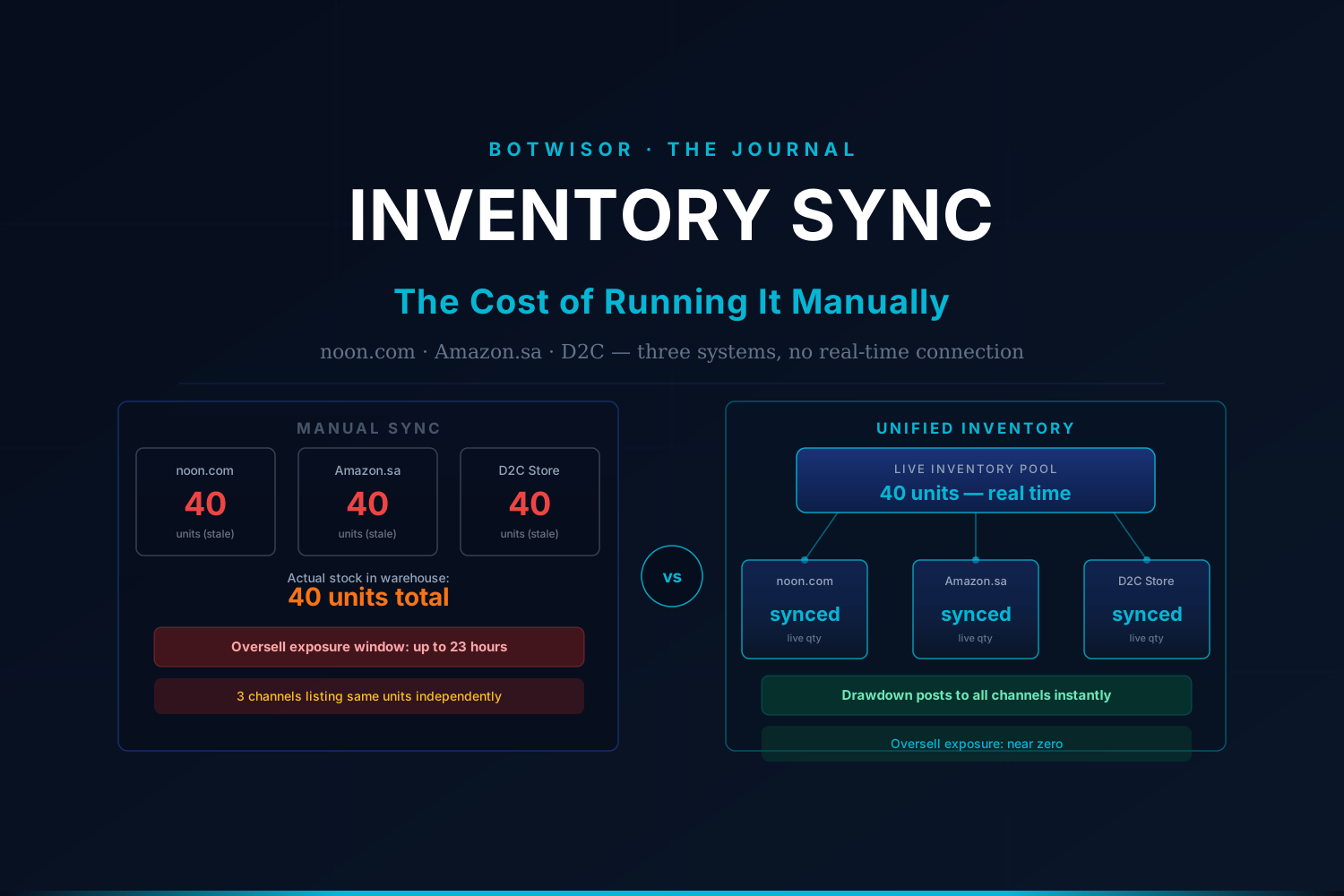
Saudi online retailers selling across noon.com, Amazon.sa, and a D2C website share a structural problem: their inventory exists in three separate systems, and those systems do not update each other. Every cancelled order, every out-of-sync quantity, and every buffer unit held back to prevent oversell carries a cost that appears in different places on the operations spreadsheet but rarely totals to one line on the P&L.
How Saudi Multi-Channel Retail Inventory Gets Out of Sync
Most Saudi online retailers manage inventory across platforms through some version of the same routine. A warehouse manager or operations coordinator exports a stock report each morning, manually updates quantities on each marketplace's seller dashboard, and uploads the corrected file. On noon.com this means navigating the seller portal directly. On Amazon.sa it means updating the inventory file in Seller Central. For the D2C site it may mean adjusting the back-end directly or through a basic inventory module.
The lag between that morning update and the next one is where the problem lives. Orders arrive on noon.com and Amazon.sa throughout the day, and the D2C site handles its own inventory drawdown separately. By midday, the quantities shown on each platform no longer reflect what is actually in stock. A retailer with 40 units of a fast-moving SKU may show 40 on noon.com, 40 on Amazon.sa, and 40 on the D2C site, even after 50 combined orders have come in across the three channels since the last sync.
The exposure window is the period between each manual update. For retailers updating once per day, that window is 23 hours. For those updating twice, it is 11 hours. Any order arriving during that window is an implicit bet that the same units have not already been sold on another channel.
The Cancellation Cascade
When that bet fails, the result is an oversell event: an order accepted by one marketplace for units that are no longer available. The retailer must either fulfil from a different location, expedite a supplier replenishment, or cancel the order.
Cancellation is the most common outcome. Noon.com's seller performance metrics track cancellation rates directly. Accounts that exceed the cancellation threshold face listing suppression, reduced search visibility, and in persistent cases account suspension. A retailer that cancels two percent of orders may still be within the threshold in a normal month, but cancellations during a high-traffic window, such as a noon flash sale or the first 48 hours of a Ramadan campaign, compress weeks of ranking damage into a short period.
Amazon.sa applies similar logic through its Order Defect Rate metric. Cancellations before shipment contribute to a figure that, above a threshold, triggers account warnings and listing restrictions.
Beyond the platform penalties, each cancelled order represents a Saudi customer who received a cancellation notification and has no product and a refund in transit. For standard electronics, clothing, and household goods, the repurchase rate after a cancellation is substantially lower than for a first-time visitor. The retailer absorbs both the cancellation administration cost and the reduced probability of retaining that customer.
Manual Inventory Sync vs. Automated Unified Inventory
| Manual Multi-Channel Sync | Automated Unified Inventory | |
|---|---|---|
| Update frequency | Once or twice daily, file upload | Continuous, real-time via API |
| Oversell exposure window | 11 to 23 hours per cycle | Near-zero; drawdown posts to all channels instantly |
| Cancellation source | Oversell events from lagged quantities | Occasional supply errors only |
| Buffer stock required | 10 to 20% of active SKU quantity | Minimal; safety stock by velocity rule |
| Ops time per day | 2 to 5 hours across coordinator team | Configuration and exception review only |
| Marketplace ranking impact | Periodic drops from cancellation rate | Stable; cancellation rate near baseline |
| Campaign readiness | Pre-campaign stock lock-up is manual | Automated hold per SKU, auto-released post-campaign |
The Buffer Tax Saudi Retailers Pay to Protect Against Oversell
The most common response to oversell risk is to underreport inventory. A retailer with 100 units of a SKU may list 80 on each platform, keeping 20 back as a buffer against sync lag. This is rational as a short-term fix and expensive as a long-term policy.
For a Saudi online retailer with SAR 12 million in annual multi-channel revenue and a catalog of 300 to 800 active SKUs, a 10 to 15 percent inventory buffer across live listings withholds a meaningful fraction of available stock from buyers. If those buffered units turn over at the same sell-through rate as listed units, the revenue forgone from keeping them off-market runs between SAR 1.2 million and SAR 1.8 million per year. Not all buffered inventory would have sold, but for high-velocity SKUs in the weeks before Ramadan or Eid, the buffer is typically applied to the products with the highest demand because those are exactly the ones most likely to oversell on a manual cadence.
The buffer creates a secondary problem at season end. Inventory held back to prevent oversell is still on hand when the selling window closes, contributing to the markdown pressure that erodes margin on slow-moving stock. The same SKU that was withheld to protect against oversell during peak demand is discounted to clear it a month later.
The Daily Ops Hour Burn
Manual sync is not only a source of revenue leakage. It is a daily operational commitment. For a retailer with 500 active SKUs across noon.com, Amazon.sa, and a D2C site, a morning inventory reconciliation typically takes between two and five hours, depending on how many platforms use file uploads versus API connections and whether overnight orders require manual adjustments before the update can run.
That time scales with catalog size. A retailer who expands from 200 to 600 active SKUs triples the coordination load without any proportional change in the team that handles it. Many Saudi online retailers solve this by adding headcount, which works in the short term but converts the sync cost into a fixed labour line rather than eliminating it.
The coordination also produces downstream tasks. When quantities fall below safety thresholds, someone must update them manually before the next review window. When a campaign on noon.com draws down 20 units in two hours, the operations team may not know about it until the next morning file pull, by which point Amazon.sa has continued accepting orders against a quantity that no longer exists.
What Unified Inventory Management Makes Possible
When Saudi retailers connect their inventory to a central pool with live API integrations to each marketplace, the update cadence shifts from daily batches to continuous. Every fulfilled order on noon.com subtracts from the same pool that Amazon.sa and the D2C site are drawing from. The quantities shown on each platform reflect actual on-hand stock in near real time.
The practical results are measurable. Oversell events drop to near zero for supply-side reasons, because the system posts the drawdown before another platform can accept a duplicate order. The buffer stock requirement shrinks because the protection the buffer was providing is now handled by real-time sync instead. The daily reconciliation task becomes configuration and exception review rather than file management.
Channel prioritisation becomes practical too. When a specific SKU is running low, the system can be configured to maintain availability on the highest-margin or highest-velocity channel and suppress the listing on channels with lower returns. During peak weeks, when certain gift categories move faster on D2C than on marketplace, that rule can redirect availability automatically without a coordinator manually adjusting listings across three portals each morning.
Saudi e-commerce is expanding. Multi-channel complexity grows with it. Retailers building their operations on manual sync today are accumulating a structural cost that compounds as the catalog and channel count grows, and the Vision 2030 National Retail Strategy targets for online penetration make that complexity a near-certain outcome for any brand operating at scale.
When Is the Right Time to Fix the Sync Problem?
The right time is before the next peak season, not during it. Noon White Friday, the Amazon.sa seasonal sales, and the Ramadan surge each concentrate order volume in a short window, amplifying every oversell event and compressing the ranking damage that follows. A retailer entering peak season with a manual sync process is more exposed during that period than in any other month.
The fix is not a one-time project that clears the calendar after it ships. It is an integration that replaces the daily coordination task with a continuous process. The setup has a cost, but it is a fixed cost that does not scale with catalog size or order volume.
The buffer inventory that gets freed up when oversell risk is managed at the system level can be relisted, reducing the hidden revenue drag at exactly the moment demand is highest.
Book a free automation audit to see exactly what multi-channel inventory sync is costing your operations team, and what a unified inventory approach recovers across your marketplace mix.