
The Journal
The Marketplace Commission Leak Saudi Online Retailers Cannot Measure
Every settlement cycle on Noon or Amazon.sa leaves Saudi retailers with unreconciled fees and missed credits that manual processes cannot surface at scale.
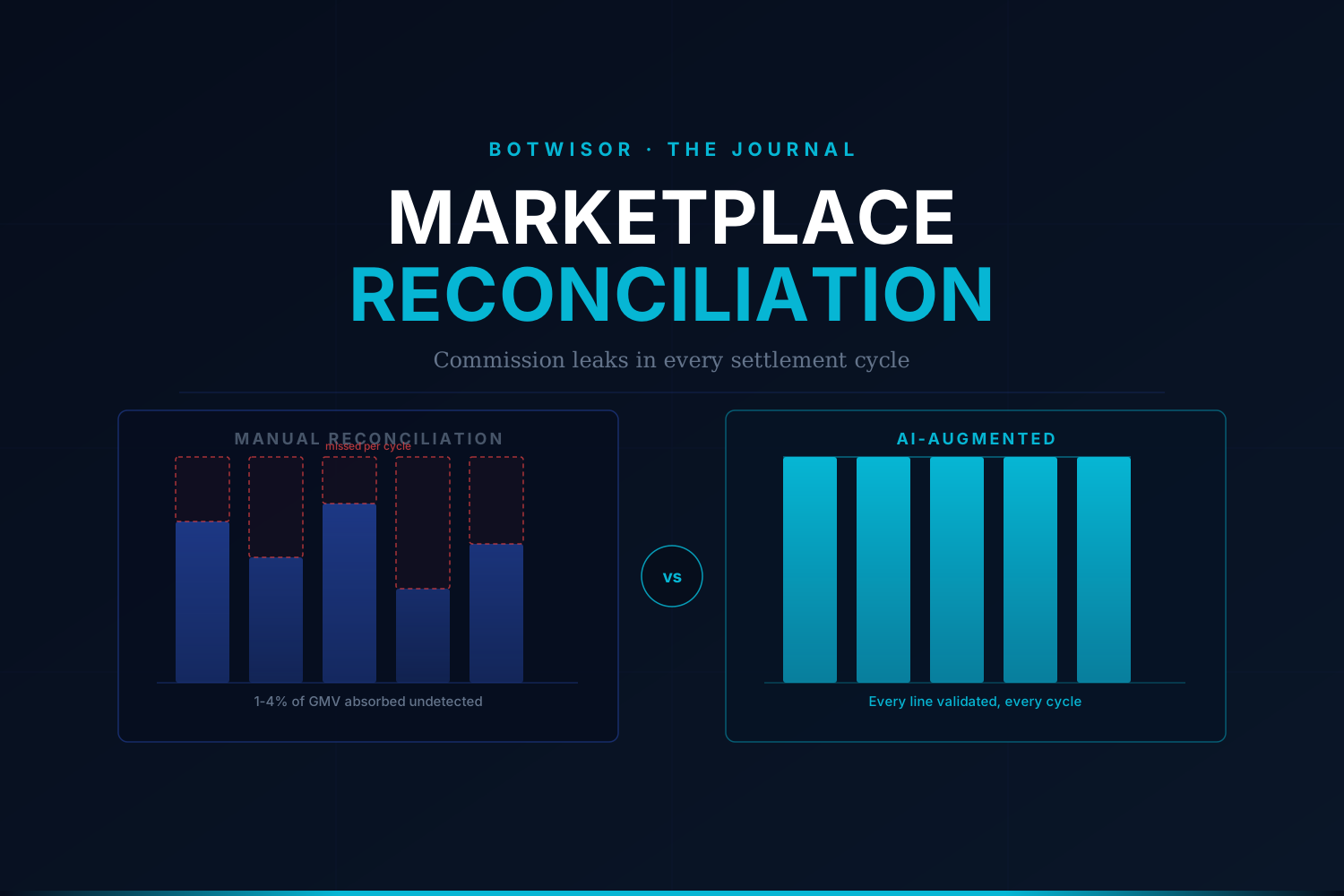
Saudi retailers selling through Noon, Amazon.sa, and other regional marketplace platforms lose a portion of their margin every settlement cycle to fees they never agreed to, credits they never claimed, and deductions that slip through a reconciliation process built for a smaller order volume. The amount is real, repeating, and almost entirely preventable.
Why Marketplace Fees Are Harder to Track Than They Look
The initial appeal of marketplace platforms is clear: an existing buyer base, built-in logistics infrastructure, and no need to drive traffic independently. Saudi e-commerce through platform marketplaces has expanded sharply since 2021, with Noon consolidating its position as the dominant local platform and Amazon.sa accelerating its Saudi fulfilment footprint.
What many retailers underestimate is the complexity of the fee structure they are agreeing to. A single marketplace seller account carries multiple intersecting charges:
- Base commission: Category-specific, typically ranging from 5% to 18% of the item sale price. Rates shift by product sub-category and are not always adjusted automatically when a product's classification changes mid-listing.
- Fulfilment and warehousing fees: Retailers using the platform's own logistics pay per-unit storage, pick-and-pack, and last-mile charges that fluctuate seasonally and by product dimension.
- Promotional cost-shares: Joining a flash sale, platform-curated campaign, or seasonal push event often carries a retroactive commission uplift or a fixed promotional fee billed through the settlement ledger, not as a separate invoice.
- Return handling and disposal charges: Each returned item may trigger a restocking fee, a quality inspection charge, or a disposal cost if the unit cannot be resold at full value.
- Advertising spend: Pay-per-click and sponsored placement budgets are debited through the same settlement account as product revenue.
For a retailer operating 2,000 to 6,000 active SKUs across one or two marketplace accounts, the monthly settlement file contains tens of thousands of line items across these fee categories. A spreadsheet-based reconciliation process cannot verify all of them.
What Manual Reconciliation Actually Looks Like
The typical finance workflow inside a Saudi mid-market retail operation involves one or two accounts-payable staff downloading settlement reports at the end of each cycle, cross-referencing payouts against expected revenue using a master spreadsheet, and flagging obvious discrepancies. Anything that does not appear clearly wrong is accepted and closed.
The difficulty is that most marketplace billing errors are not obvious. They appear as:
- Commission rates applied at an incorrect category tier because a product was reclassified without a corresponding rate update in the fee schedule.
- Promotional fee deductions applied to orders outside the campaign's authorized window.
- Return charges billed twice due to a synchronization error between the retailer's inventory records and the platform's fulfilment system.
- Settlement credits for disputed items processed by the platform but never reflected in the retailer's own ledger.
Each individual discrepancy may involve SAR 80 to SAR 600. At 2,000 orders a month, the cumulative effect over a quarter is material. Retailers generating SAR 3M to SAR 8M in quarterly marketplace GMV commonly find, when they conduct systematic audits, that 1% to 4% of that revenue was absorbed by unreconciled deductions they had no mechanism to surface.
The secondary cost is the time consumed in recovery. Marketplace dispute processes require documentation, case submission, and follow-up through vendor portal queues that commonly take 30 to 60 days to resolve. Finance staff who could be closing month-end accounts are instead managing disputes for errors they only found by chance.
Before and After: The Same Settlement Cycle, Two Outcomes
| Stage | Manual Process | AI-Augmented Process |
|---|---|---|
| Settlement data ingestion | Downloaded manually, reformatted in Excel per cycle | Pulled via seller API, parsed and normalized automatically |
| Commission rate validation | Spot-checked against last cycle's rates | Every line matched against the current contracted rate card |
| Promotional fee verification | Reviewed only if visibly large | Cross-referenced against signed campaign authorizations |
| Return charge audit | Checked for obvious duplicates only | Flagged automatically when a charge exceeds policy or appears for a return not in the retailer's system |
| Credit recovery tracking | Tracked in a separate sheet, often missed in volume | Matched against outstanding credits; recovery tasks auto-generated |
| Dispute filing | Filed manually when an error is large enough to notice | Auto-drafted with supporting documentation; tracked to resolution |
| Settlement close | 7 to 14 days after end of cycle | Same day as cycle close |
The structural difference is not speed. It is coverage. Manual review catches what a person notices. Automated matching validates every line against every rule, every cycle. The errors that accumulate in manual operations are precisely the low-value, high-volume discrepancies that fall below the threshold any individual reviewer would consider worth raising.
The Dispute Window Problem
Marketplace platforms typically impose a dispute submission window, commonly 30 to 90 days depending on the fee type. After that window closes, discrepancies become unrecoverable.
In a manual reconciliation process, the lag between the settlement cycle and the identification of a discrepancy often runs four to six weeks, because finance staff work through the ledger in batches around month-end close. By the time a promotional fee error from early in the quarter is spotted, the dispute window for that transaction may have already expired.
This is not a policy problem. It is an operations problem. The platform's dispute mechanism is accessible; the retailer simply does not have a system that scans for errors fast enough to use it.
An automated reconciliation layer changes the timing entirely. Errors are flagged within the settlement cycle they occur, dispute documentation is generated before the window closes, and the recovery rate improves not because the platform became more cooperative but because the retailer is now filing on time, with evidence, for every eligible discrepancy.
What Saudi Retailers Are Actually Leaving on the Table
Across a quarter at SAR 5M in marketplace GMV, a 2% to 3% reconciliation recovery represents SAR 100,000 to SAR 150,000 in previously absorbed margin. For a retailer operating across four marketplace platforms with overlapping fee structures, the potential recovery range widens further.
This is not speculative. Retailers who move to systematic reconciliation frameworks typically find that the first audit cycle surfaces more errors than expected, because years of accumulated manual processing have normalized the gap. The margin did not disappear gradually; it was always there, uncollected, because no process was looking for it consistently.
Why This Matters in Saudi Arabia's Retail Landscape
Saudi Arabia's Vision 2030 retail targets call for increased formalization of the sector, greater participation of Saudi brands in online commerce, and higher transparency in operational accounting. Retailers building for that environment cannot afford informal reconciliation practices that quietly absorb 1% to 4% of their marketplace revenue every quarter.
There is also a competitive dimension. As Saudi marketplace retail matures and category margins compress, the brands that sustain profitability will be those operating at a lower cost-per-order and a higher recovery rate across every revenue stream. Systematic fee governance is one direct input into that efficiency.
PDPL compliance adds another dimension: proper reconciliation systems integrate cleanly with financial reporting and avoid the ad-hoc spreadsheet handling of transaction-level data that creates compliance exposure for retailers managing large volumes of personal and order data.
What Changes After the Integration
An AI-augmented reconciliation function does not replace the finance team. It changes what the finance team reviews. Instead of parsing settlement files line by line, they work from a prioritized exception list: these specific line items this cycle need a decision. Everything else has been validated and cleared.
Dispute management becomes proactive rather than reactive. Promotional cost-shares are pre-authorized before they appear in the ledger. Return charge policies are enforced automatically rather than accepted by default. The finance team's role shifts from executing reconciliation to overseeing it.
For any Saudi retailer generating meaningful GMV across marketplace platforms, the question is not whether this margin gap exists. The question is how many settlement cycles have passed with the gap open, and how much has already become unrecoverable.
A free automation audit from BotWisor will map exactly where your marketplace fee structure is creating exposure and what a reconciliation integration would recover in your first cycle. Book your audit here.