
The Journal
What Manual Property Ops Cost Saudi Real Estate Firms
Saudi developers on manual property ops pay the cost in extended vacancies, high staff overhead, and tenant churn that compounds with portfolio scale.
Saudi real estate firms running manual property operations pay for it in ways that rarely appear as a single line item: extended vacancy periods, high staff overhead, slow maintenance resolution, and tenant churn that compounds across a growing portfolio.
What "Manual Property Operations" Looks Like in Practice
For most Saudi developers and property managers operating in 2026, the baseline model is a familiar one. Lease paperwork moves through email and WhatsApp threads. Maintenance requests arrive via phone calls that get logged into spreadsheets, assigned by hand, and tracked in morning team huddles. Occupancy figures are assembled weekly by a coordinator pulling data from three separate systems that do not communicate with each other.
This describes the standard operating model at mid-market Saudi firms managing between 500 and 5,000 residential or commercial units. The problem is not that these processes fail. They function. They are expensive, slow, and increasingly mismatched to the velocity that Vision 2030-era development volumes demand.
The Before State: Where Costs Accumulate
The cost of manual property operations rarely shows up as a clean number on the P&L. It hides in:
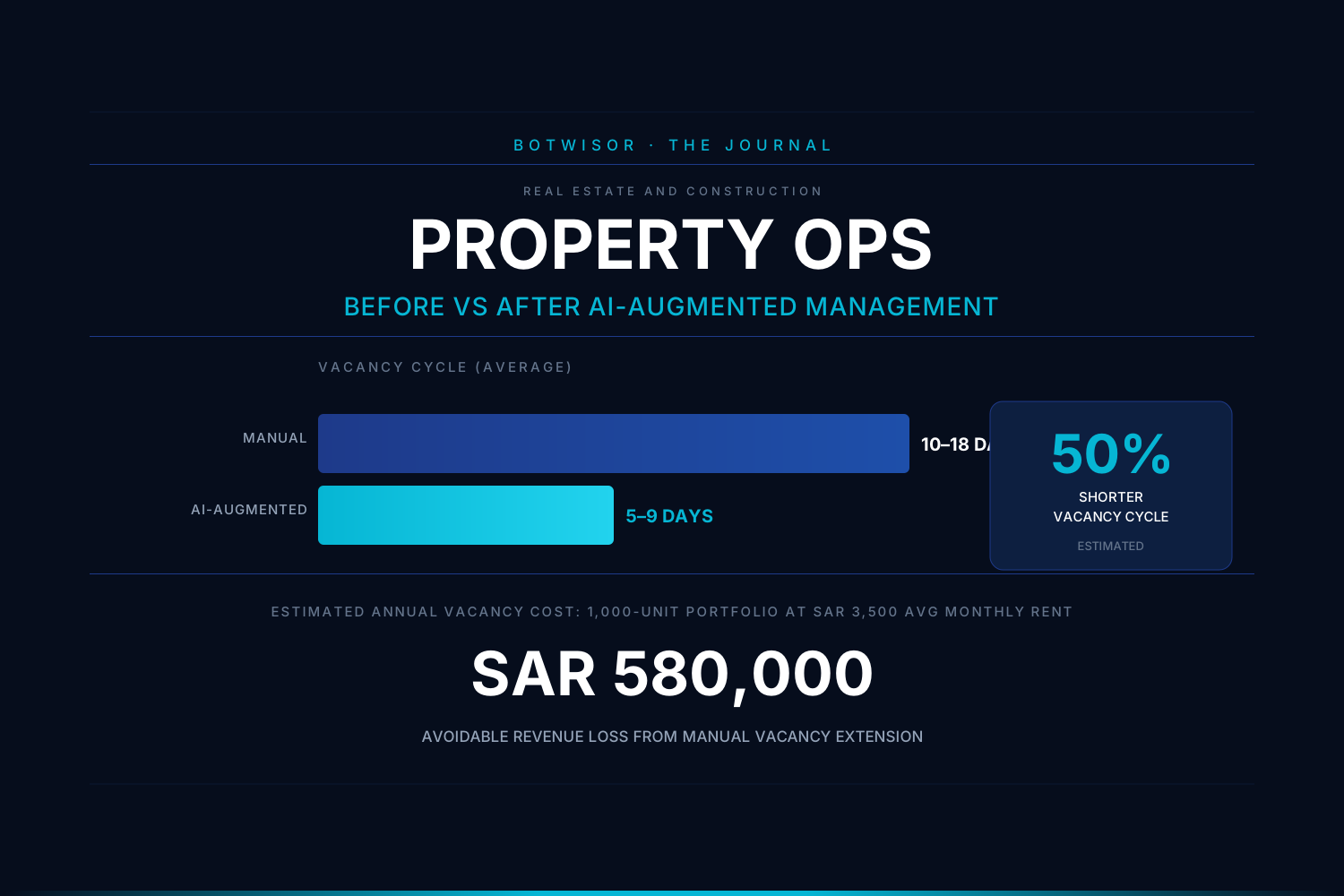
Extended vacancy cycles. When a unit is vacated, the manual chain of communication, inspection scheduling, listing updates, and prospect follow-up adds days to the empty period. At scale, even a 5-day average extension compounding across hundreds of units represents material foregone revenue. For a 1,000-unit residential portfolio with an average monthly rent of SAR 3,500, a five-day extension per cycle costs approximately SAR 580,000 annually in lost rent.
Staff overhead on repetitive tasks. A significant portion of property operations staff time goes to questions tenants could resolve through a well-configured communication layer: lease renewal status, maintenance ticket progress, payment confirmation, parking allocation, visitor pass requests. These tasks are not complex. They are high-volume and repetitive, meaning costs scale directly with portfolio size. When a firm grows from 1,000 to 3,000 units, it either hires proportionally or accepts that response times will degrade.
Maintenance resolution lag. When a request arrives by phone, gets transcribed into a spreadsheet, assigned without priority logic, and tracked through a group chat, resolution time stretches. Tenant satisfaction surveys consistently identify maintenance response time as the leading driver of non-renewal decisions. A single month of lost rent on a non-renewed tenancy typically exceeds the annual cost of automating maintenance routing for that unit.
Reporting latency. Monthly occupancy reports compiled manually are backward-looking by design. Portfolio decisions on pricing adjustments, marketing spend, and leasing team focus are made on data that is often two to three weeks old by the time the report reaches the decision-maker. For a developer managing multiple projects across Riyadh and Jeddah, this lag turns routine corrections into expensive course changes.
The After State: AI-Augmented Property Operations
The shift to AI-augmented operations does not require replacing the leasing team or eliminating the property manager. It requires routing the right tasks to automated systems so that the team concentrates on what requires human judgment.
Here is what the comparison looks like across the key operational dimensions:
| Dimension | Manual Operations | AI-Augmented Operations |
|---|---|---|
| Tenant communications | Phone, WhatsApp, email with inconsistent response times | Automated responses in Arabic and English, available around the clock |
| Maintenance routing | Manual assignment by coordinator | AI triage by urgency and technician capacity |
| Occupancy reporting | Weekly manual compile | Real-time dashboard, updated continuously |
| Lease renewals | Coordinator tracks and follows up individually | Automated renewal pipeline with escalation rules |
| Prospect follow-up | Leasing team calls every inquiry manually | Automated qualification and scheduling; team handles warm leads only |
| Vacancy cycle | 10–18 days average (estimated) | 5–9 days average (estimated) with automated listing sync |
| Staff-to-unit ratio | Scales linearly with portfolio growth | Improves as portfolio grows |
The vacancy figures are directional estimates built from observed industry patterns. The precise numbers depend on portfolio type, location, and the starting process maturity of the firm. The consistent finding is that automation compresses the cycle.
Where Vision 2030 Changes the Calculation
Saudi Arabia's housing targets under Vision 2030 have reshaped the real estate landscape at a pace that manual operations were not designed to absorb. Mega-projects including NEOM, the Red Sea development, and Diriyah Gate, alongside the residential expansion around Riyadh's new urban zones and the continued infrastructure build in Jeddah and Dammam, are delivering new unit supply at scale.
For developers and property managers absorbing this inventory, the challenge is not simply managing more units. It is managing more units while maintaining bilingual service quality in Arabic and English, and meeting PDPL data requirements that add compliance overhead to every tenant data workflow.
Manual operations scale poorly. Every 1,000 units added to a portfolio requires either another coordinator hire or an acceptance of degraded service quality. AI-augmented operations scale without the same linear cost increase. The ratio of staff-to-managed-units improves materially when routine communication, routing, and reporting tasks are handled by the system.
Firms that delay automation do not merely pay for today's inefficiencies. They also accept that their cost-per-managed-unit will remain high exactly when competition intensifies and tenant expectations rise. That is a compounding cost, not a static one.
What Saudi Property Firms Should Measure Before Automating
The diagnostic that precedes any automation engagement should answer four operational questions:
-
Average vacancy duration per unit cycle. This is the metric with the clearest revenue attachment. If the firm cannot produce this number readily, that data gap is itself a problem automation will address.
-
Staff time allocation by task type. Specifically: what percentage of property operations staff hours goes to tasks that are repetitive, rule-based, and document-heavy? In most mid-market Saudi portfolios, this figure sits above 60%.
-
Tenant satisfaction scores by maintenance resolution time. If these are not tracked, lease renewal rate serves as a lagging proxy. Both matter for building a credible automation case and for measuring improvement once a system is in place.
-
Reporting lag. How old is the occupancy data when portfolio decisions are made? If the answer is "last week's report," the firm is optimizing from a rear-view mirror. For a developer with projects in multiple cities, the cost of that lag accumulates fast.
These four numbers define the starting point and, by extension, the size of the opportunity. The automation roadmap follows from the gaps, not from a feature checklist.
PDPL and Tenant Data in Property Operations
Saudi real estate firms collecting and processing tenant data, payment history, maintenance records, and lease documents have obligations under the Personal Data Protection Law (PDPL). Any AI-augmented workflow that touches tenant data needs data residency, consent capture, and retention limits built in from the start rather than added later.
This applies across the automation stack: automated communications that log tenant interactions, AI-driven maintenance routing that records service history, and dashboard systems that aggregate occupancy and financial data. The PDPL alignment is a design-time decision. Firms that treat it as an afterthought discover the cost of that choice when they attempt to scale.
The Compounding Cost of Waiting
Saudi property firms running manual operations are not facing a slow, gradual erosion of competitive position. The cost is present today, in every extended vacancy, every tenant who does not renew because a maintenance request took two weeks to close, and every portfolio decision made on three-week-old data.
The question is not whether AI-augmented operations deliver better outcomes at the operational level. At the scale these firms operate, the evidence is consistent. The question is how long the gap between manual and AI-augmented competitors remains invisible in portfolio performance before it begins to show up in asset valuations and investor reporting.
If your portfolio operation still measures itself by coordinator headcount rather than tenant satisfaction scores and vacancy velocity, the audit is the right first step.