
The Journal
How Manual Project Coordination Drains Margin for Saudi Developers
Saudi construction developers running manual project coordination absorb the cost in RFI delays, rework cycles, and change-order disputes that compound across the full project lifecycle.
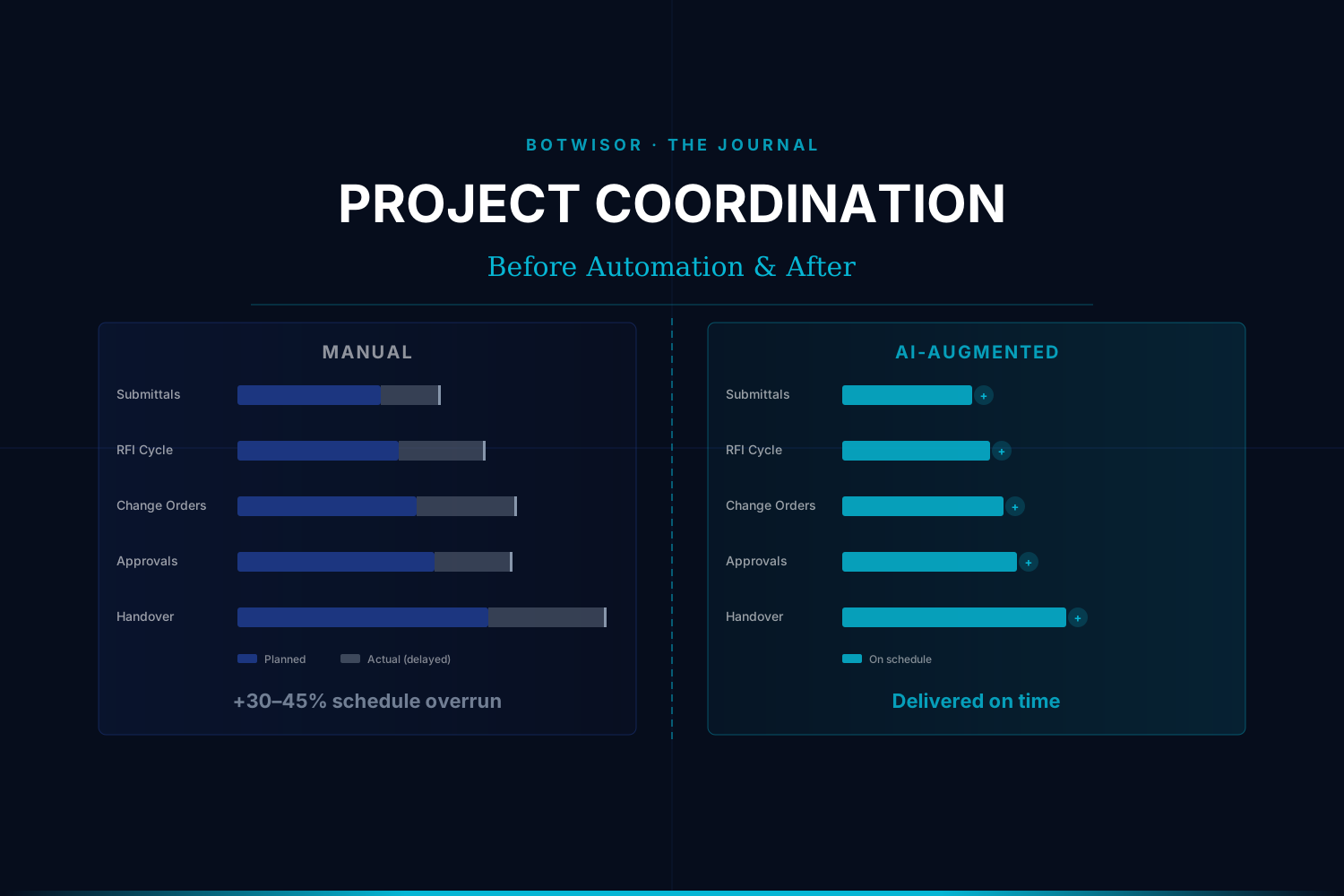
Saudi construction projects running on manual coordination absorb the cost in ways that rarely surface as a single line item: delayed RFI responses, version-conflicted drawings, unresolved change orders, and approval bottlenecks that push delivery timelines and trigger penalty clauses buried in every major contract.
What Manual Project Coordination Looks Like in Practice
For most Saudi developers and construction managers in 2026, the coordination model running major projects is a familiar one. Requests for information travel through email chains between the developer, the project management consultant, the main contractor, and subcontractors. Drawing revisions circulate via WhatsApp folders with file names like "Final_v3_revised_APPROVED_USE THIS.pdf." Progress reports are assembled by a project engineer who spends two days each week extracting data from unconnected systems before a meeting that may or may not produce a decision.
This describes the coordination reality at mid-to-large Saudi development firms managing projects worth SAR 50 million to SAR 500 million. The model functions in the sense that projects eventually complete. The cost of that model, in time lost, margin consumed, and decisions delayed, is significant, recurring, and largely avoidable.
Where Margin Disappears: The Before State
The margin erosion from manual project coordination accumulates across four recurring failure modes.
RFI and submittal processing delays. A request for information sits unanswered in an inbox for three to five business days. The contractor cannot proceed on the affected scope. Concrete pours wait. Subcontractors bill for idle time. In a SAR 200 million project with several hundred active RFIs across a 24-month timeline, each additional day of average RFI delay extends the schedule. Saudi construction contracts with Liquidated Damages clauses commonly set penalties at 0.1% of contract value per week of delay. On a SAR 200 million contract, that is SAR 200,000 per week.
Change order disputes and unresolved scope. When a change occurs in the field, the documentation trail that establishes its cause, cost, and schedule impact gets reconstructed days later from memory, WhatsApp messages, and site diary entries. By the time a change order is formally raised, the actual cost has already been incurred. The negotiation becomes adversarial because neither party holds a contemporaneous record of what was agreed and when. Saudi contractors routinely submit change order claims materially above what clients will settle, and the gap between submission and agreement can stretch project close-out by months.
Reporting latency and decision bottlenecks. Project status reports that take two days to compile are already stale when they reach the developer's board. In a fast-moving project environment, a one-week lag in identifying a critical-path activity at risk means the recovery window has already narrowed. Decisions on resource acceleration, scope adjustment, or procurement fast-tracking require current data. Manual reporting cannot provide it.
Version control failures. When the latest structural drawing is not reliably distinguishable from the previous version across all parties, construction proceeds on superseded information. Rework from version-control failures is one of the highest unit-cost waste categories in construction. Industry surveys consistently identify it as a top-three cause of unplanned cost increases on complex projects, with rework typically running 5% to 15% of total construction cost on projects where coordination is manual and multi-party.
| Coordination Dimension | Manual Operations | AI-Augmented Operations |
|---|---|---|
| RFI tracking and response | Email chains; 3–7 day average response cycle | Automated routing and priority flagging; 1–2 day average cycle |
| Drawing version control | File-naming conventions; version confusion common | Single source of truth; all parties access current revision |
| Change order documentation | Reconstructed from messages and memory after the fact | Logged at point of occurrence with timestamps and attachments |
| Progress reporting | 2–3 days to compile; weekly cadence | Near-real-time dashboard; exception-based alerts |
| Approval workflows | Email approvals; no consistent audit trail | Structured sign-off chain with logged timestamps |
| Subcontractor coordination | Unstructured; WhatsApp and phone calls | Centralized task assignment with completion confirmation |
| Delay identification | Discovered during weekly review meetings | Flagged automatically against schedule baseline |
The After State: AI-Augmented Project Coordination
The shift to AI-augmented project coordination does not replace the project manager or the site engineer. It routes the right information to the right person at the right moment, so that human judgment is applied to decisions rather than to data assembly.
In practice, RFIs are logged automatically at submission, assigned to the relevant technical authority based on content classification, and escalated when response time exceeds the contractual requirement. Change events are captured at the point of occurrence, tagged to the relevant specification clause, and routed through an approval chain that produces a documented record before costs are incurred and dispute windows open. Drawing revisions are distributed from a single repository to every party simultaneously, with read-confirmation logging that establishes the moment each party received the current version.
The project manager's morning changes. Instead of asking a junior engineer to pull this week's progress data from three separate spreadsheets, they open a dashboard that has already flagged the two critical-path activities showing schedule variance beyond tolerance. Their attention goes to the decision. The data assembly that previously consumed a professional's week is handled by the system overnight.
This is not about removing people from the project. It is about ensuring that the people on the project spend their time on the problems that require them.
How Vision 2030's Construction Scale Changes the Math
Saudi Arabia's construction pipeline under Vision 2030 has grown to a scale that manual coordination was not designed to manage. NEOM, the Red Sea Project, Diriyah Gate, and the Riyadh urban expansion programs together represent construction activity at densities that strain even well-staffed project management organizations.
For Saudi developers operating in this environment, the coordination challenge is compounded by several factors specific to the Kingdom.
The supply of experienced construction project managers in Saudi Arabia has not scaled at the same pace as construction volume. Firms are managing more complex projects with teams that are stretched, and where reliance on manual processes is therefore highest. Each senior project manager's attention is rationed, and manual coordination processes consume a disproportionate share of it on tasks that AI systems handle reliably.
Bilingual coordination requirements, in Arabic and English, across Saudi and international consultant and contractor organizations, create additional friction in every document routing cycle. Automated systems handle bilingual document tagging and routing without the errors that accumulate in manual processes run at scale.
PDPL obligations also apply to project data, including contractor personnel records, inspection documentation, and payment processing. Any coordination system that handles this data needs built-in compliance architecture from the design phase, not retroactively. For developers running manual workflows, that retrofit is a future cost that compounds with every project added to the pipeline.
Developers who delay automation do not pay a static cost. They accept higher coordination overhead on every project they start while competitors with AI-augmented operations close the same scope faster, with fewer disputes, and with cleaner documentation for claims resolution.
What to Measure Before Automating Project Coordination
The diagnostic that precedes any automation engagement should answer four questions:
-
Average RFI response time, by responsible party. If this number is not tracked consistently, that data gap is itself an indicator of where the first automation benefit will appear.
-
Change order close-out duration. From the date a change event occurs to the date the change order is formally agreed: how long? Firms that cannot produce this figure reliably are absorbing change-management cost without visibility into its scale.
-
Rework volume as a percentage of total construction cost. Industry benchmarks for complex multi-party projects typically run 5% to 15%. If the firm does not track this, the baseline for measuring improvement after automation does not exist.
-
Reporting cycle time. How many person-days per reporting period go to data assembly rather than analysis? This number defines the human cost of manual coordination most directly and translates most cleanly into automation ROI.
These four figures define the scope of the opportunity. The automation roadmap follows from them, not from a feature checklist.
The Compounding Cost of Waiting
Saudi construction developers running manual project coordination are not facing an abstract future risk. The costs are present in every project under execution today: in RFIs sitting unanswered, in change orders under negotiation without a contemporaneous record, in drawings existing in multiple versions across contractor laptops, and in decisions deferred because last week's progress report is still being assembled.
The question is not whether AI-augmented project coordination delivers better outcomes. In complex, multi-party construction environments at the scale Saudi Vision 2030 demands, the operational evidence is consistent. The question is how long margin erosion from manual coordination remains invisible before it appears in project profit-and-loss statements, delivery-commitment conversations with government clients, and investor reporting that no developer wants to have without a clear story.
If your project operations still measure coordination health by the number of coordinators on the org chart rather than by RFI response times and change-order close-out rates, the audit is the right first step.