The Journal
Manual KYC vs AI-Augmented Onboarding for Saudi Banks
Where SAMA-regulated banks lose days, hours, and customer goodwill in onboarding today, and what an AI-augmented operating model actually changes on the desk.
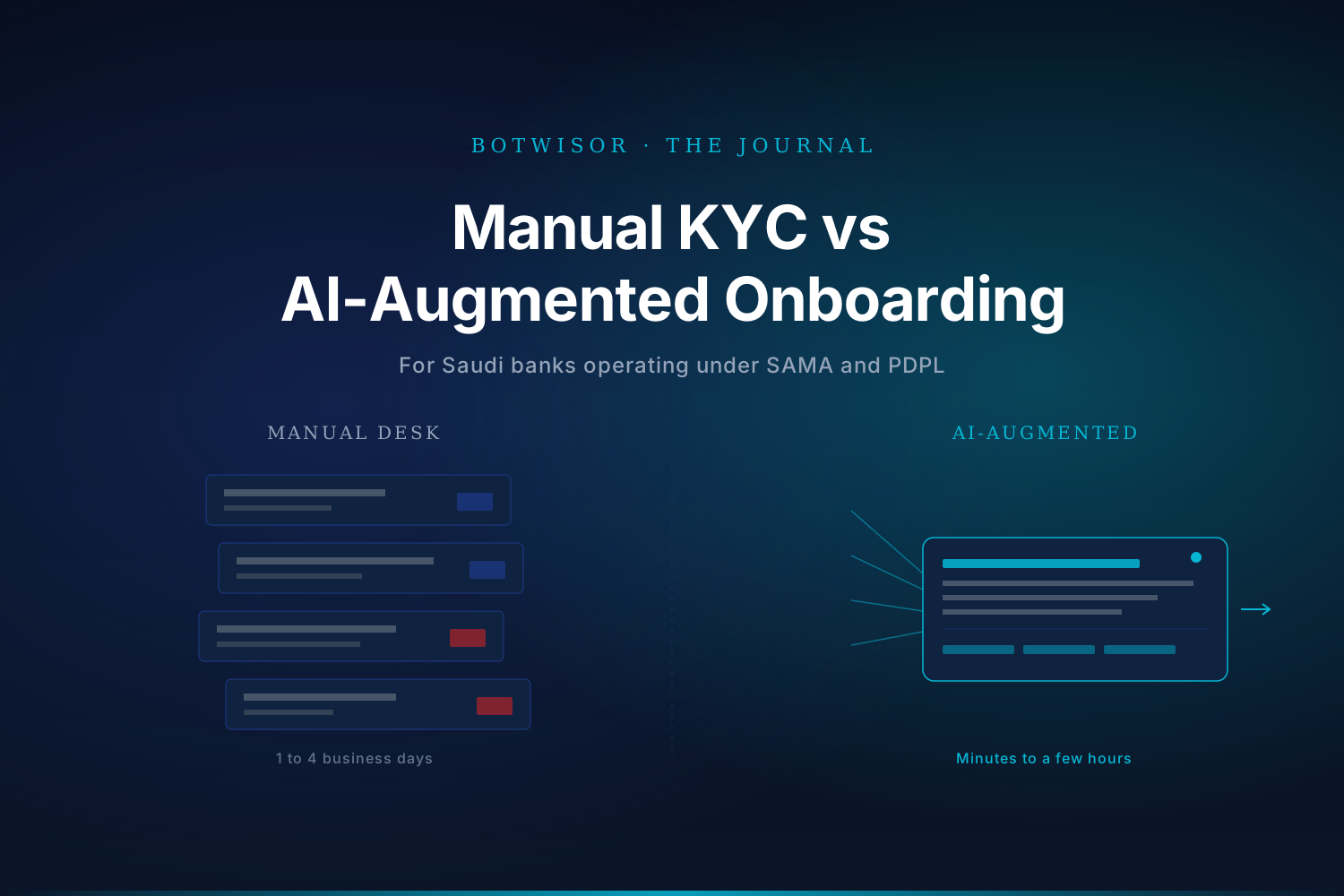
A Saudi bank's onboarding desk in 2026 still measures itself in business days. AI-augmented onboarding compresses the customer-facing wait to minutes for most segments, leaves SAMA and PDPL controls intact, and frees the compliance team to focus on the cases that actually need a human.
What does manual onboarding actually cost a Saudi bank in 2026?
A typical mid-size Saudi bank spends most of an onboarding cycle on three things: classifying and reading documents, running the same record against several screening lists, and translating between Arabic and English at every handoff. None of that is glamorous. All of it is necessary. Most of it is repeatable.
The cost shows up in three places.
The customer waits. A retail account that "should be open same day" routinely sits two to four business days. A corporate onboarding for a Riyadh-based mid-market firm can sit a week or longer once SAMA-mandated checks, beneficial-owner verification, and document re-requests stack. By the time the welcome email lands, half the goodwill is gone.
The compliance team is over-allocated. A senior KYC analyst who should be reviewing edge cases is instead matching a freshly issued National ID against a CR record, both rendered in slightly different transliterations. That is not what the bank pays them to do.
The branch and the relationship team eat the slack. Documents come in by email, by branch upload, and through the corporate portal. Each channel has its own queue, its own format, and its own human triage step. Most of the day is reconciling versions of the same file.
None of this is a bank-specific problem. It is a structural one. Manual document-heavy compliance scales linearly with volume, and Saudi onboarding volumes are not flat. They are climbing every year as Vision 2030 programs pull more SMEs and individuals into the formal banking layer.
How does an AI-augmented onboarding desk look different?
Three changes show up first.
Document classification and KYC review
When a customer or relationship manager uploads paperwork, an AI-augmented system identifies what each document actually is (CR, ID, passport, proof of address, board resolution, audited financials), reads the structured and unstructured fields with bilingual extraction, and presents a single normalized customer record back to the analyst. The analyst is no longer transcribing. They are confirming.
What this changes operationally: the time from "customer uploads documents" to "compliance analyst sees a complete file" drops from hours, sometimes days, to under a minute for clean cases. The analyst's queue is now sorted by exception severity, not by arrival order.
AML and sanctions screening
Screening against multiple lists (UN, OFAC, the regional and SAMA-acknowledged feeds, internal blacklists) is, in the manual model, a serial loop with human re-checks for transliteration variants. An AI-augmented layer runs parallel checks, flags fuzzy matches with confidence scores, and surfaces only the genuine review-worthy cases. False-positive triage that consumed analyst hours collapses to seconds.
The bank still owns the decision. Auto-approval is reserved for the cleanest paths; everything ambiguous goes to a human, with the system's reasoning visible. SAMA's expectation of explainability survives intact.
Bilingual handling without manual translation
Saudi onboarding is irreducibly bilingual. The customer experience is Arabic-first or English-first depending on segment; the regulatory documents are mixed; many internal systems still want one or the other. AI-augmented document understanding handles both natively, including dialectal variations on names, mixed-script addresses, and the common transliteration mismatches between an ID and a CR.
The operational effect is that Arabic-language onboarding is no longer slower than English-language onboarding. Today, in most banks we see, it is.
Exceptions and the human-in-the-loop
The point of the AI layer is not to remove humans from compliance. It is to put them on the cases that actually require judgment. A senior analyst reviewing a flagged beneficial-owner discrepancy with full document context in front of them is doing a different, higher-leverage job than the same analyst rekeying a customer's address.
Manual vs AI-augmented onboarding, at a glance
| Workflow step | Manual desk (typical 2026) | AI-augmented desk |
|---|---|---|
| Document classification | Human reads each upload, tags type, files it | Automatic classification, normalized record in seconds |
| KYC field extraction | Manual transcription, dual-language re-keying | Bilingual extraction, single canonical record |
| AML / sanctions screening | Serial list checks, manual fuzzy-match review | Parallel screening, confidence-scored exceptions only |
| False-positive review | 60–80% of analyst day | Under 20% of analyst day |
| Beneficial-owner verification | Email-and-spreadsheet trail | System-of-record graph with provenance |
| Bilingual handling | Arabic queue often slower than English | Parity, both languages native |
| Customer wait (clean case) | 1–4 business days | Minutes to a few hours |
| Edge-case decision time | Same as average | Faster, because exceptions are isolated |
| Reporting and audit trail | Reconstructed at audit time | Generated as a byproduct of the workflow |
What this looks like at scale, a SAR view
A bank that opens, say, 3,000 retail and SME accounts a month, with a fully loaded SAR cost of around 180 per onboarding cycle in the manual model, is spending around SAR 540K a month on the onboarding desk alone. That number does not include the cost of customer abandonment, the cost of relationship managers spending half their week chasing documents, or the cost of compliance analyst burnout in roles that are 70%+ administrative.
A serious AI-augmented operating model does not eliminate that spend. It redistributes it. The proportion that goes into automation infrastructure is small relative to the human-hours released back to higher-leverage work, and the customer-experience uplift typically pays for the build inside a single calendar year.
This is the part operators tend to underweight. The headline is the time saved. The harder-to-measure value is what the freed analyst hours unlock: faster product launches, better complaint handling, deeper KYC for the customers that warrant it.
Where should a Saudi bank start without rebuilding everything?
Two things tend to be true at every Saudi bank we work with: (1) the document and case data already exists in usable form somewhere, and (2) the appetite for a year-long platform replacement is zero.
The right first move is narrow. One customer segment (often SME corporate onboarding, where the manual pain is most acute), one or two document types as the initial classification training set, and the existing case-management system left in place. The AI layer attaches to the workflow rather than replacing it. The compliance team sees an analyst-facing assistant, not a new system to learn.
A useful self-test for an operator considering this: if the only thing that changed for the compliance team next quarter was that 70% of the document classification and screening work disappeared from their queue, what would they do with the time? If the answer is "exactly what they should have been doing all along," that is the case for moving.
A note on PDPL and Saudi data residency
Two questions come up from compliance and legal in every conversation. They have clear answers.
PDPL alignment is a design choice in the AI layer, not a side effect. Data minimization, purpose limitation, and customer-rights handling (access, correction, erasure) sit at the architecture level. The compliance team should expect to see this articulated up front, not added as a checkbox at the end.
Saudi data residency is non-negotiable for most banks. In-Kingdom hosting of both the document corpus and the model inference path is achievable today and increasingly the default rather than the exception. Cross-border compliance edges, where they exist, should be made explicit. They tend not to be a blocker; they tend to be a contract item.
If your onboarding desk still measures itself in business days, the gap above is the one to close. We help Saudi banks scope the first AI-augmented workflow, against the existing compliance stack and within SAMA and PDPL constraints, on an eight-week path to a measurable result.