
The Journal
How Saudi Retailers Lose Revenue to Manual Inventory Gaps
Manual inventory gaps cost Saudi retailers in stockouts during peak seasons, overstock carrying costs year-round, and lost customer trust on every order cancellation.
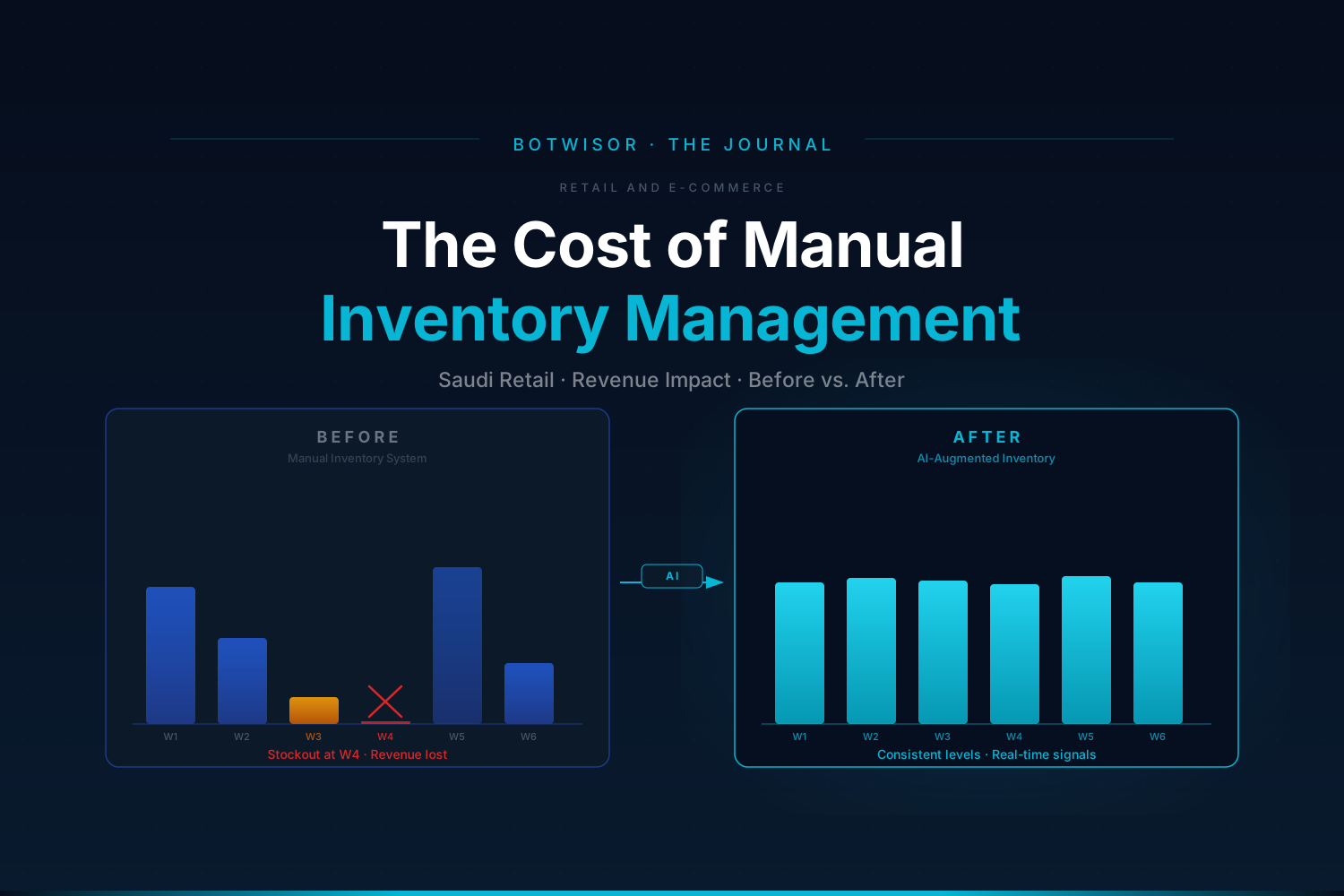
Saudi retailers running on manual or semi-manual inventory systems see between 5 and 8 percent of potential revenue lost to stockouts, while overstock carrying costs consume a further 20–30 percent of excess inventory value each year. These two failure modes compound: missing peak-season sales while simultaneously funding the storage of product that should not have been ordered.
What does manual inventory management actually cost a Saudi retailer?
The cost does not appear as a single line item. It is a cluster of compounding losses that rarely surface together in the same P&L view, which is precisely what allows them to persist quarter after quarter.
Stockouts at peak demand hurt more in Saudi Arabia than in most markets
Ramadan, Eid Al-Fitr, National Day, and White Friday create demand spikes that are among the most compressed in global retail. Saudi operations regularly see 3–5 times normal trading velocity during peak weeks, concentrated into a short window that leaves no margin for error. A manual inventory system calibrated during a quieter month will be structurally wrong at exactly the moments precision matters most.
The result is predictable: fast-moving SKUs exhaust on day three of a Ramadan peak. Emergency replenishment arrives late. The customer who spent time comparing products places the order with a competitor instead, and that transaction is gone permanently.
Cross-channel reconciliation creates an oversell loop
Saudi retail now spans physical stores, branded e-commerce sites, and marketplace presence across the GCC. A customer browsing online sees a stock quantity that reflects a spreadsheet updated three hours ago. By the time the order confirms, that inventory may have moved to a Jeddah branch and sold to a walk-in customer.
Every cancellation email that follows is not just a lost sale. In a market where alternative retailers are one scroll away, it is an active reason to stop trusting the brand. Manual reconciliation between channels takes hours per inventory sync, and the error rate compounds across thousands of SKUs.
Manual reorder cycles are structurally too slow
A purchasing team relying on periodic physical counts and spreadsheet-based reorder points always works from stale data. By the time a stock depletion shows in a weekly report, a purchase request is drafted, approved, and sent to a supplier, and the supplier lead time runs its course, the stockout is already history.
For domestic suppliers in Saudi Arabia, lead times run 3–7 days. International suppliers add weeks. The tolerance for late reorder signals on high-velocity items is essentially zero.
Overstock carries a real SAR cost that manual systems hide
Overstock is the mirror problem. A manual system that misses a declining velocity signal keeps ordering at historical rates. The carrying cost of excess inventory, including financing charges, warehouse space in a market where Riyadh and Jeddah logistics real estate has appreciated substantially through the Vision 2030 period, and the margin erosion from clearance discounting, can consume 20–30 percent of that inventory's value annually.
A SAR 50 million retailer holding 25 excess days on 20 percent of SKUs could be carrying over SAR 2 million in invisible annual cost. That number never appears as a single P&L line. It is distributed across finance, logistics, and merchandising, which is exactly why it persists.
Lost upsell moments disappear without a report
Manual inventory systems treat stock as a logistics variable, not a revenue signal. When a customer purchases a product, the opportunity to suggest a complementary item only exists if that item is actually available in the channel the customer is using. Manual systems cannot confirm this in real time, so most retailers default to static catalog suggestions or skip the prompt entirely. The margin opportunity disappears without an alert or a visible cost.
How these failures interconnect
These five pain points are not independent. The manual reconciliation gap creates the conditions for the oversell. The oversell triggers the cancellation. The cancellation erodes the customer relationship that would have generated the upsell. And the overstock generated by the same system's inability to detect declining velocity sits in the warehouse, compounding its carrying cost. It is a single, interconnected operational failure that a P&L report distributes across five different lines.
Before vs. after: what AI-augmented inventory actually looks like
The table below describes the operational experience on both sides. It is not a description of a technology installation; it is a description of what running the retail business actually feels like.
| Operating condition | Manual inventory | AI-augmented inventory |
|---|---|---|
| Reorder timing | Triggered by weekly count or staff observation | Triggered by real-time depletion signals with lead-time awareness |
| Seasonal planning | Based on prior-year averages and buyer judgment | Incorporates event calendar, channel velocity, and demand signals |
| Cross-channel sync | Manual reconciliation, hours to update | Near-real-time across all channels |
| Overstock detection | Visible only in end-of-period reports | Flagged early, with carrying-cost projection |
| Upsell confidence | Disabled or based on static catalog | Available when in-stock status is confirmed in real time |
| Team focus | 30–40 percent of purchasing time on data gathering | Shifts to exception handling and supplier negotiation |
The before state is not a failure of the people running it. It is the ceiling of what a manual process can achieve at scale. The after state describes what comparable retailers in the GCC region have already reported operating at.
What changes when inventory becomes intelligent
The most significant change is not speed, though the speed gains are measurable. The most significant change is what the operations team actually does with its time.
In a manual environment, most cognitive effort goes into assembling information: compiling counts, reconciling channel records, chasing supplier confirmations, and cleaning spreadsheet errors. In an AI-augmented environment, that assembly is automated. Human judgment shifts to exceptions, supplier relationships, and product decisions that actually require expertise.
For a Saudi retailer managing 5,000 to 50,000 active SKUs across two or three channels, the practical effect is the difference between a purchasing team that is perpetually reactive and one that can plan the next peak season with enough lead time to negotiate better terms with suppliers and avoid the rush-order premium that erodes margin every Ramadan.
The financial picture changes as well. The real cost of inventory mismanagement, the stockout revenue loss, the overstock carrying expense, and the customer churn from failed fulfillment promises, becomes visible in near-real time rather than reconstructed from a month of data after the season ends. What was an invisible drag on the business becomes a managed variable.
Why the timing argument matters in a growth market
Saudi retail is expanding. Consumer spending has grown consistently through the Vision 2030 execution period, with entertainment-linked retail, hospitality-adjacent merchandise, and cross-border e-commerce all outpacing the broader market. The operational complexity of inventory management scales with each new channel, SKU line, and geographic footprint.
Retailers that build AI-augmented inventory operations at a manageable scale absorb the transition more cleanly and begin accumulating the historical data that improves forecasting accuracy over time. Retailers that wait until the complexity is acute face the same transformation under pressure, on a compressed timeline, with less clean data to work from.
The cost of a Ramadan stockout is not only the transaction lost that day. It is the customer who bought from a competitor and learned a new habit. That is not a recoverable figure, and it repeats every peak season until the underlying system changes.
Is your inventory system costing more than you can see?
If your purchasing team spends more time gathering data than acting on it, if Ramadan preparation still starts with a spreadsheet, or if order cancellations due to inventory discrepancies occurred in the past 12 months, the gap is already costing you.
A free automation audit identifies exactly where the revenue leak is and what a realistic augmentation path looks like for your specific operations and supply chain.