
The Journal
When COD Settlement Runs by Hand: The Saudi E-Commerce Ops Cost
Manual cash-on-delivery settlement costs Saudi e-commerce operations more than most teams track. The daily reconciliation overhead compounds with order volume and grows alongside the business.
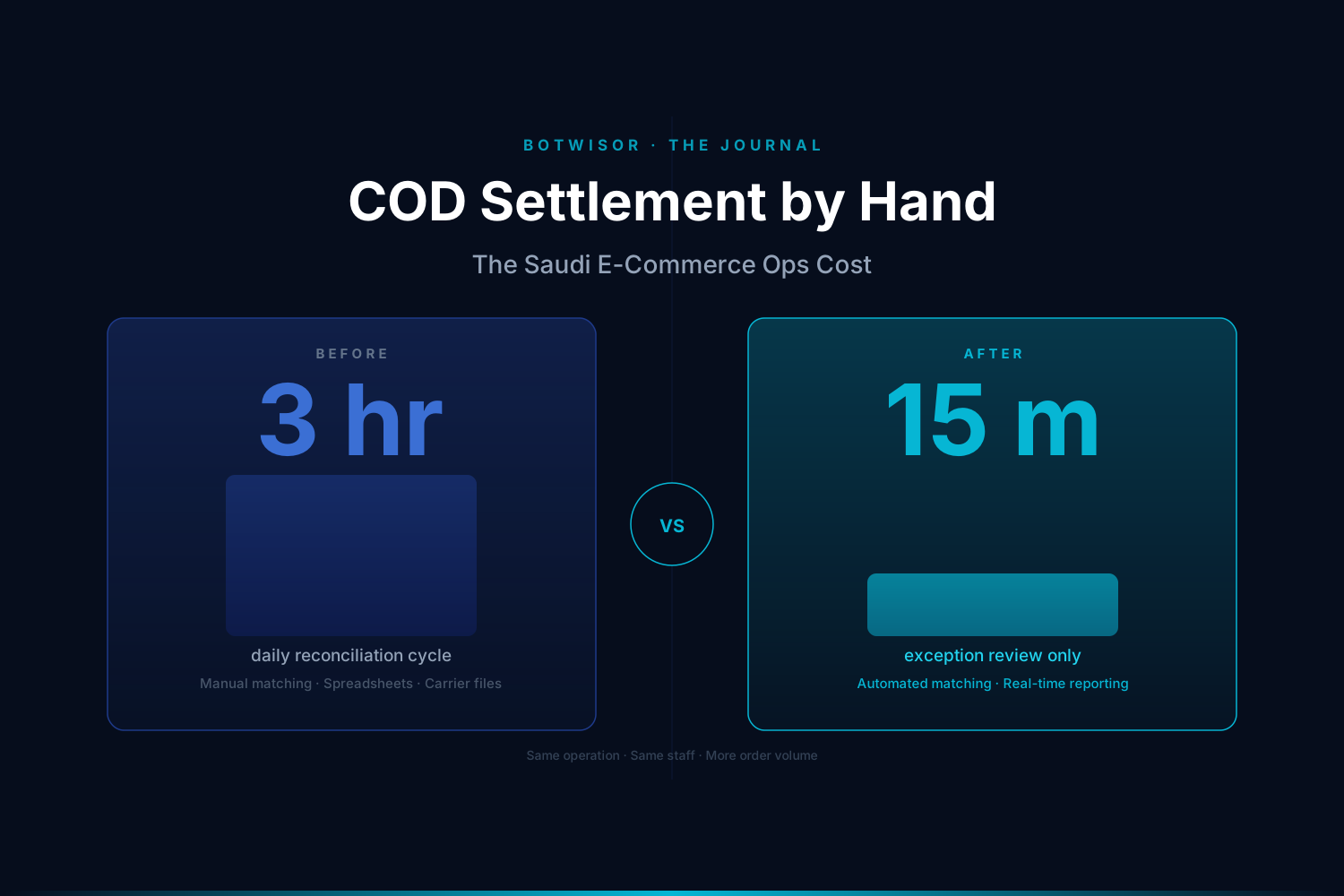
Cash-on-delivery accounts for a significant share of Saudi e-commerce orders, and settling those orders involves more manual effort than most operations teams measure. Saudi retailers that still reconcile COD payouts by hand carry a recurring ops overhead that compounds as order volumes grow. Identifying where that overhead lives is the first step toward eliminating it.
Why Does COD Still Account for a Large Share of Saudi E-Commerce Orders?
Cash-on-delivery is not a legacy artifact in Saudi Arabia. It remains a structural preference for a meaningful segment of Saudi online shoppers, particularly across product categories where brand familiarity is lower or purchase values are higher. Concerns about return logistics, card security, or long-standing habit sustain COD volumes even as digital wallet and BNPL adoption grows across Riyadh, Jeddah, and Dammam.
For Saudi multi-channel retailers, the COD share rarely falls below 30% of online orders. In some categories, including electronics, furniture, and fashion for first-time shoppers, it exceeds 50%. Vision 2030's trajectory toward a cashless economy is clear, but the transition is long. For operators handling 500 to 5,000 orders per day, COD is a daily operational reality with a reconciliation process attached to every single order.
What Does Manual COD Settlement Actually Look Like Each Day?
The settlement cycle begins when a delivery is marked complete. The courier or in-house driver collects cash, issues a receipt, and returns to the depot at the end of the route. Collected cash is counted, compared against the manifest, and handed to the finance team or operations lead. Each order on the manifest then needs to be matched against the order management system (OMS), the courier's delivery log, the collected cash amount, and the returns report.
For an operation running 200 COD orders per day, this is a daily multi-step matching exercise. Every exception requires manual investigation: a driver who deposited SAR 50 short, a return not yet marked in the OMS, or a courier's batch file that arrived with format inconsistencies. Teams working with multiple carriers face separate reconciliation formats, separate remittance files, and separate settlement cycles with different payout schedules.
The daily reconciliation typically runs one to three hours for a mid-sized operation. It requires at least one finance or ops team member whose full attention is occupied during that window. Discrepancies not resolved same-day roll into the next cycle, compounding the backlog.
Where Do Errors Enter the COD Reconciliation Process?
Driver-to-System Cash Reporting Gaps
The most common error source is the gap between what drivers report as collected and what the OMS records as delivered. In operations using paper manifests or manual driver apps, the cash figure and the delivery confirmation are entered by different people at different times. By the time the monthly reconciliation runs against the bank, the total variance can be substantial and difficult to trace back to individual orders.
Return-Initiated COD Reversals
Returns on COD orders create a specific reconciliation problem. The customer received a cash-collected delivery, returned the item, and the credit must now be traced back to the original COD record. If the return was processed by a different team on a different system than the original order, the reconciliation requires manual linkage across two records. In high-return categories such as fashion, this problem repeats at scale every day.
Multi-Carrier Aggregation
Saudi e-commerce operators commonly work with two to five courier partners simultaneously, routing orders by region, speed tier, or cost. Each courier remits COD amounts on its own schedule, in its own file format. Aggregating those remittances into a single settlement view requires converting, aligning, and validating data from multiple sources each day. The work is repetitive, and the margin for input error rises with each additional carrier relationship.
Manual vs. Automated COD Settlement: What Changes?
| Dimension | Manual COD Settlement | Automated COD Settlement |
|---|---|---|
| Matching method | Spreadsheet comparison, manual exception review | Automated matching against OMS and courier data |
| Error detection timing | Found during reconciliation cycle, often next day | Flagged at point of data ingestion |
| Return reversal tracking | Manual linkage between return and COD order | Automated linkage via order ID |
| Multi-courier aggregation | Separate file conversion and alignment per carrier | Single normalized feed from all couriers |
| Daily ops overhead | 1–3 hours per reconciliation cycle | Under 15 minutes for exception review |
| Cash variance resolution | Investigated per order, manually | Exceptions surfaced automatically with full order context |
| Finance reporting | Prepared at end of reconciliation cycle | Available in real time |
What Is the Cumulative Cost Across a Growing Saudi E-Commerce Operation?
An operation processing 300 COD orders per day handles approximately 9,000 COD orders per month. At a conservative estimate of 2.5 minutes of manual settlement time per order, encompassing daily reconciliation work, exception handling, and multi-carrier aggregation, the monthly manual burden reaches 375 hours of finance and ops team time.
At a blended staff cost of SAR 75 per hour, that is SAR 28,125 per month in direct labor attached solely to COD settlement. The figure excludes the cost of errors: cash variances that go undetected, credit memos that are missed, or returns that remain unlinked until the next monthly close.
The cost also does not scale linearly. As order volumes grow, the reconciliation overhead grows faster. A brand doubling its daily COD volume from 300 to 600 orders does not double its settlement team; the backlog grows faster than headcount grows, creating longer settlement cycles, more unresolved exceptions, and growing finance reporting lag. The problem is not just today's cost. It is the structural relationship between order growth and ops overhead that makes the cost compound.
What Does the Operation Look Like After Automated Settlement?
In an automated COD settlement environment, the daily reconciliation cycle shrinks from hours to minutes. Courier remittance files are ingested, normalized across formats, and matched against OMS order data without manual intervention. Returns are linked automatically to originating COD records the moment the return is logged. Exceptions, those orders where the courier amount does not match the OMS record, are surfaced immediately with full order context for rapid resolution.
The finance team's role shifts from executing the reconciliation to reviewing exceptions and approving matched batches. Settlement becomes an oversight function rather than a production task. Finance reporting is available in real time rather than at the end of each daily cycle.
For the operations team, the multi-carrier aggregation problem disappears. Each courier relationship continues on its existing terms; the automation layer handles format normalization and timing differences. Adding a courier partner does not add a new reconciliation track to the manual workload.
The broader implication is operational leverage. The same finance and ops headcount can support significantly higher COD volumes without a proportional increase in settlement effort. For Saudi e-commerce brands targeting order growth in the next two to three years under Vision 2030's digital commerce tailwinds, that leverage compounds with each quarter.
Every order your team reconciles by hand is an order that does not need to run through a manual process. If your COD settlement is still a daily spreadsheet exercise, the overhead in this article is already in your operation.
Book a free automation audit to map exactly where your COD settlement overhead lives and what an automated process would save.