
The Journal
What Saudi Corporate Treasurers Pay for Manual Cash Positioning
Saudi corporate treasuries running on spreadsheets pay for it in yield drag, FX exposure gaps, and reconciliation hours that compound quarterly.
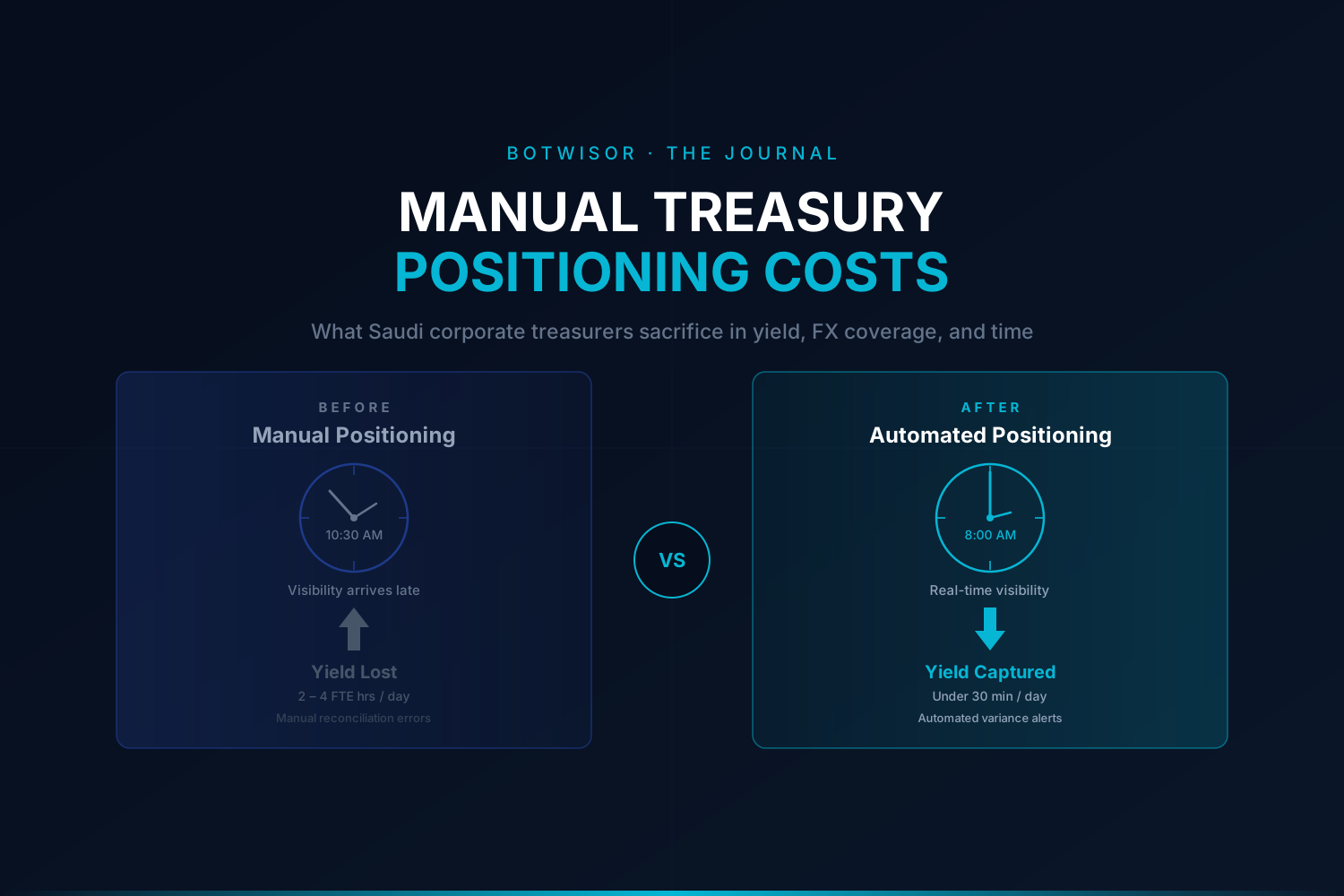
Saudi corporate treasuries that manage intraday cash through spreadsheets and bank-portal exports are not simply working harder than they need to. They are forfeiting yield on idle balances, leaving FX exposure windows open longer than necessary, and absorbing reconciliation errors that introduce audit risk. The cost is measurable and scales with transaction volume.
What Manual Cash Positioning Actually Looks Like
At most Saudi corporates with revenues above SAR 200M, the treasury morning routine follows a familiar pattern. A treasurer or senior analyst exports statements from several bank portals, consolidates cash positions into a master spreadsheet, adjusts for outstanding payments and receivables communicated by email, and arrives at a liquidity estimate by mid-morning.
The cycle repeats at midday and at end of day. For corporates running operations across Riyadh, Jeddah, and Dammam with accounts at multiple Saudi banks, this consolidation involves anywhere from three to seven portal logins and a corresponding number of export-and-reconcile cycles per day.
This is not an edge case. It describes the operational reality at a substantial share of Saudi private-sector firms managing significant treasury books: property developers holding project escrow balances, retail groups managing supplier payment cycles aligned with Ramadan and Eid seasonality, and contracting firms tracking progress payments from government and semi-government clients.
Where the Yield Goes
Idle cash sitting uninvested is the most direct and quantifiable cost of slow cash positioning. When a treasury team's consolidated view of available liquidity arrives at 10:30 a.m. rather than 8:00 a.m., the window to deploy overnight or short-duration instruments narrows. For a corporate with SAR 300M in average daily available cash, a 90-minute delay in visibility translates to missed short-duration investment opportunities every working day.
Treasury management research consistently shows that organizations with automated, real-time cash positioning earn measurably higher yield on surplus balances compared to those relying on end-of-morning manual aggregation. The mechanism is straightforward: faster visibility leads to earlier deployment decisions, and earlier deployment on short-duration murabaha or money market instruments accumulates over the calendar year.
In the Saudi context, where SAR-denominated short-duration instruments tied to SAIBOR and SAMA's policy rate have been more accessible since market-development reforms, the gap between an organization that deploys at 8:00 a.m. and one that deploys after 10:30 a.m. is not theoretical. At scale, it represents a real cost that compounds across 250 working days a year.
FX Exposure Windows
For Saudi corporates managing import payments, cross-border supplier settlements, or USD-denominated project costs, manual treasury creates a second cost category: extended FX exposure windows.
When the treasurer's consolidated position depends on a spreadsheet last updated at 9:30 a.m., any USD purchase decision taken in the afternoon is made against a position estimate that is several hours stale. The company may be overhedged, underhedged, or operating on incorrect assumptions about how much SAR liquidity is available for conversion.
SAMA's foreign exchange framework and Vision 2030's expansion of private-sector participation in international trade mean that more Saudi corporates now carry meaningful FX flows than a decade ago. Contracting firms embedded in the gigaproject supply chain, retailers sourcing internationally, and logistics firms billing in mixed currencies all face this exposure. As transaction volume grows, operating with a multi-hour visibility lag carries correspondingly higher risk.
The Operational Overhead
Beyond yield and FX, manual cash positioning carries direct labor costs that are easy to overlook because they are distributed across the working day.
Industry surveys of corporate treasury functions find that manual cash consolidation and reconciliation consume between two and four FTE hours per day at organizations with complex multi-bank, multi-entity structures. In a Saudi context, where treasury teams are lean relative to international peers and where a senior treasury analyst commands SAR 18,000–26,000 per month in the Riyadh and Jeddah markets, that time has a real cost.
The less visible cost is error rate. Manual consolidation introduces transposition errors, formula discrepancies, and timing mismatches between what the spreadsheet shows and what the bank has actually credited or debited. When these mismatches surface during SAMA reporting cycles or external audits, the remediation cost per incident can be significant. Treasury teams manage this risk through checkers and approval layers that add more hours, not fewer.
Before and After: A SAR 400M Corporate's Cash Day
The table below compares how a typical treasury day runs at a SAR 400M Saudi corporate under manual and automated cash management:
| Dimension | Manual Cash Positioning | Automated Cash Positioning |
|---|---|---|
| Consolidated position available | 10:00–10:30 a.m. | Real-time, refreshed every 15 minutes |
| Short-duration deployment window | Post-10:30 a.m. | Before 9:00 a.m. deployment possible |
| FX exposure visibility | 2–4 hour intraday lag | Continuous |
| Daily FTE hours on consolidation | 2–4 hours (senior analyst) | Under 30 minutes (exception handling only) |
| Reconciliation error detection | Manual checker layer | Automated variance alerts |
| Audit trail | Spreadsheet version history | Timestamped, immutable transaction log |
The transition from left column to right does not require switching banks or replacing an ERP. It requires connecting existing bank data feeds to a treasury layer that aggregates, reconciles, and surfaces investment and FX decision prompts at the right moment.
The Vision 2030 Scaling Effect
Vision 2030 is driving a structural increase in private-sector financial complexity. Developers participating in NEOM, Red Sea Project, and Diriyah Gate pipelines are managing escrow accounts, milestone-based disbursements, and cross-entity cash consolidation at a scale that exceeds what a spreadsheet-based treasury can handle reliably.
Retail conglomerates aligned with Vision 2030's expansion in entertainment, hospitality, and sports are managing higher transaction volumes and more complex supplier payment structures than five years ago. For both groups, the cost of manual treasury scales non-linearly: double the transaction volume, and manual processing time roughly doubles, while the yield opportunity and FX risk scale with the balance sheet rather than the headcount.
Organizations that have tolerated manual treasury because it works well enough at current scale will encounter its ceiling faster than expected. The prudent move is to address the operational model before it becomes a constraint during a project's critical disbursement phase.
What Changes When the Model Shifts
When cash positioning moves from a morning spreadsheet cycle to a continuously refreshed, automated workflow, the treasury team's work changes in character, not only in volume. The analyst who spent two hours on consolidation each morning now focuses on exceptions, investment parameters, and hedging strategy rather than assembling data.
The organization gains an auditable, real-time record of cash decisions that simplifies SAMA reporting preparation. The CFO gains live liquidity visibility across entities that currently requires a call or an email to obtain.
For Saudi companies operating at SAR 200M revenue and above, the economics of this shift are clear. The question is not whether the capability exists; it is who implements it and how cleanly it integrates with existing banking relationships and ERP infrastructure.
To understand the yield drag and operational overhead your treasury is carrying today, → request a free automation audit. The conversation takes 45 minutes and produces a quantified cost estimate for your specific structure.