
The Journal
Saudi Property Operators Paying for Maintenance Delays They Cannot See
Saudi property operators know maintenance delays frustrate tenants. Few calculate the full cost: emergency callout premiums, SLA penalties, and tenant churn compounding every quarter.
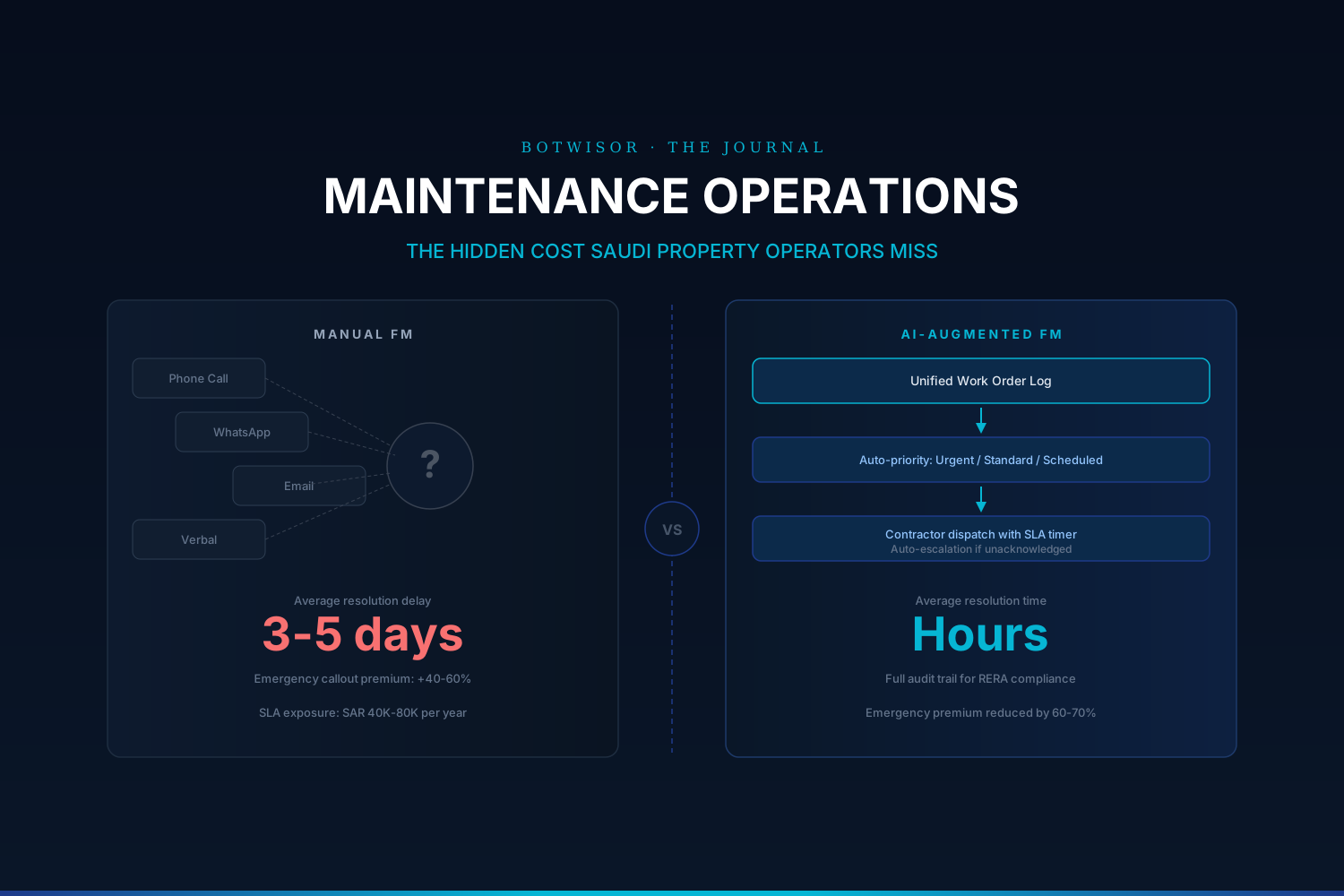
Saudi property operators know that maintenance delays frustrate tenants. What most have never calculated is the full cost: emergency callout premiums running at 40–60% above scheduled rates, contractual SLA penalties in commercial leases, and tenant churn that turns a minor service gap into a vacancy problem. The gap is measurable. The fix is operational.
The Invisible Bill Behind Every Delayed Ticket
When a tenant submits a maintenance request — a faulty HVAC unit in a Riyadh villa complex, a plumbing fault in a Jeddah mixed-use tower — the clock starts. In buildings managed manually, that request travels through WhatsApp groups, gets forwarded to a supervisor, reaches a contractor through a phone call, and may sit in a dispatcher's informal queue over a weekend.
The tenant does not see that process. What they see is: nothing has happened.
Facilities management benchmarking across GCC residential and commercial portfolios consistently shows that reactive FM operations in mid-size buildings carry an average delay of 3 to 5 business days from ticket submission to resolved status on non-emergency faults. For urgent issues, response tightens, but the fix comes at a premium. Emergency contractor mobilization in the Kingdom typically costs 40–60% more than pre-scheduled maintenance for an equivalent scope of work.
The numbers compound. A property with 200 units generating 1.5 maintenance tickets per unit per quarter produces 300 requests over three months. If 20% of those escalate to emergency status because the initial response was slow, the cost premium on those 60 jobs adds materially to the operating budget before any tenant satisfaction effects are counted.
How Saudi FM Operations Typically Run
The baseline for most Saudi property management firms handling between 500 and 3,000 units is consistent across operators.
The Request Intake Problem
Requests arrive through multiple channels simultaneously: phone calls to a building supervisor, direct WhatsApp messages to a property manager, emails to a generic inbox, and in some cases verbal handoffs to security staff. There is no single log. Duplicate requests accumulate. Priority is set by whoever reaches the manager first, not by asset risk or SLA exposure.
The same fault can appear in three places at once: a supervisor's phone, a manager's spreadsheet, a contractor's verbal backlog, with no single source of truth showing whether it has been assigned, is in progress, or has been quietly dropped.
The Contractor Dispatch Gap
Even when requests are captured, the dispatch step is manual. Most property management firms in Saudi Arabia work with a preferred contractor network — electrical, plumbing, HVAC, civil works — reached by WhatsApp or phone. Job acceptance is verbal. There is no time-stamped audit trail, no automated escalation when a contractor goes quiet, and no integration with the work order log that would let a property manager see, in real time, how many open items are sitting with each contractor.
When a RERA audit or tenant dispute requires documentation of timely response, the evidence is typically fragmented across multiple chat threads.
What the Backlog Actually Costs
The true cost of manual FM operations is distributed across four categories that most operators track separately, if at all.
| Cost Category | Manual FM (500-unit building, per year) | AI-Augmented FM |
|---|---|---|
| Emergency callout premium vs. scheduled | SAR 180K–SAR 240K | SAR 60K–SAR 90K |
| Staff hours on request routing and follow-up | 1.5–2 FTE equivalent | 0.4–0.6 FTE equivalent |
| Tenant churn attributable to FM dissatisfaction | 8–14% of annual turnover | 4–7% of annual turnover |
| SLA penalty exposure (commercial leases) | SAR 40K–SAR 80K | Near-zero with audit trail |
The figures above are modeled from GCC FM benchmarking data and operator interviews. Individual buildings vary by age, tenancy mix, and asset class. The directional pattern holds: the cost is real and largely invisible because it is never aggregated into a single report connecting FM performance to financial outcome.
Most operators see the emergency callout line item. They do not see the tenant churn attributed to FM service quality, because churn is tracked in leasing reports and maintenance performance lives in a separate system owned by a separate team. The causal link is never drawn.
What AI-Augmented FM Operations Deliver
The shift from manual to AI-augmented FM is not about replacing the maintenance team. It is about giving them an information layer they have never had.
An AI-augmented FM operation routes incoming requests from any channel, in Arabic or English, into a unified work order log with automatic priority classification. A water leak in a ground-floor apartment is flagged differently from a burned-out lobby light. The system applies the building's asset register, the lease SLA schedule, and the priority matrix the property management firm has already defined.
Contractor dispatch happens against a pre-qualified roster with automated confirmation and escalation rules. If a contractor does not acknowledge a job within a set window, the system re-assigns. Every step is time-stamped. When a tenant asks what happened to their request, the property manager pulls a full timeline in seconds, not a chat thread they need to scroll through and reconstruct.
For commercial tenants with contractual SLA obligations embedded in their lease agreements, this is not a convenience feature. It is the documentation infrastructure that prevents SAR 40K–SAR 80K in annual penalty exposure from materializing.
Why Vision 2030 Residential Delivery Raises the Stakes
Saudi Vision 2030 has set a homeownership target of 70% by 2030, driving substantial residential delivery across Riyadh, Jeddah, and the Eastern Province. NEOM, Red Sea, and Diriyah Gate projects are simultaneously adding hospitality and mixed-use stock at a scale the Kingdom has not previously managed at once.
The delivery side of this pipeline is well-funded and well-tracked. The operations side, keeping handed-over buildings running at the standard residents and commercial tenants expect, is where the sector is structurally underprepared.
RERA's increasing focus on service charge transparency and maintenance response standards means that property operators without documented FM processes face growing regulatory exposure. An AI-augmented FM platform generates automatic documentation of every request, dispatch, and resolution, creating a compliance record without requiring any additional administrative effort.
Operators managing large institutional residential portfolios face a second pressure. Institutional investors and REITs increasingly include FM service-level data in due diligence. A track record of systematic maintenance response, with data showing average resolution times by category, has moved from a nice-to-have to an underwriting input.
Closing the Visibility Gap
Property management firms that retain institutional tenants and maintain net operating income under pressure share a common capability: they can answer three questions without digging through WhatsApp threads. How many open maintenance items exist right now? What is the average resolution time by fault category? Which contractors are underperforming against their agreed response windows?
Manual FM operations cannot answer those questions clearly. AI-augmented FM operations can answer them in seconds.
The gap between those two situations is not primarily a technology question. It is an operations question. The cost of staying on the wrong side of it does not stay flat. Emergency callouts accumulate. Commercial tenants claim penalty clauses. Residential tenants leave at renewal. Each quarter that passes without closing the visibility gap adds to a cost that does not appear on any single report but is very real in the aggregate.
If your FM operations run on group chats and spreadsheets, the real cost is larger than your current reporting can show. A free automation audit will identify the highest-impact gaps in your property operations and map a concrete path to closing them.