
The Journal
Loan Pricing on Spreadsheets: The Revenue Leak Saudi Banks Ignore
Static spread tables leave Saudi banks underpricing corporate and SME risk on every deal. The annual margin gap on a SAR 2B commercial book typically exceeds SAR 5 million in foregone net interest income.
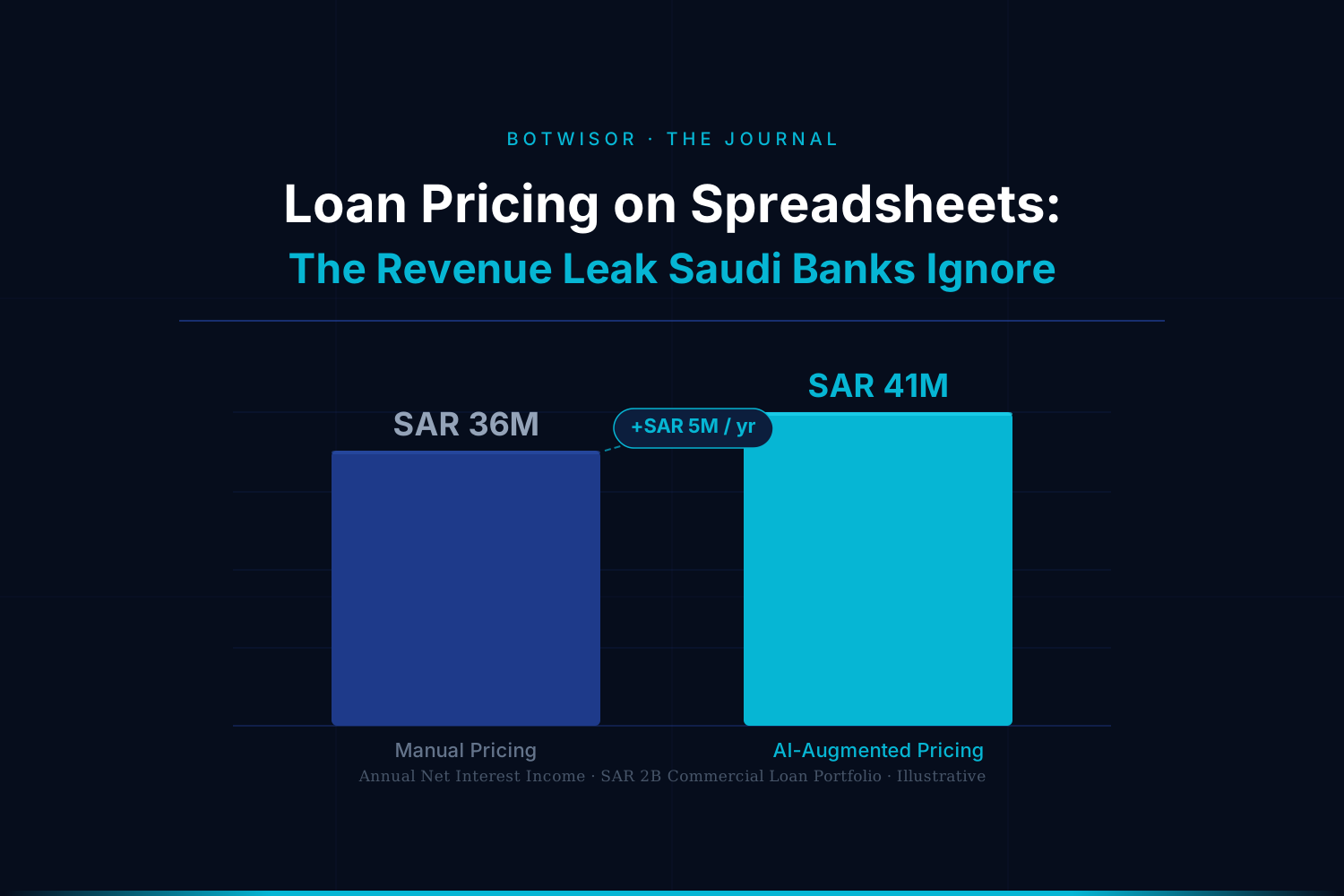
Saudi banks pricing corporate and SME loans through spreadsheets and static spread tables routinely leave 20 to 40 basis points uncaptured on every deal. Across a SAR 2 billion commercial lending portfolio, that gap translates to SAR 5 million or more in foregone net interest income each year, before accounting for the mispriced credit risk that surfaces later as unexpected provisions.
What Loan Pricing Actually Decides
Loan pricing is not a back-office calculation. It is the mechanism by which a bank decides, on every transaction, whether it is accepting adequate compensation for the risk it is taking on. Price too high and the bank loses deals it should have won. Price too low and the bank books loans that cannot cover expected losses, effectively subsidising them with margins earned on better-priced deals elsewhere on the book.
For Saudi banks expanding their corporate lending footprint across Vision 2030-linked projects, infrastructure credit lines, and a growing national SME supplier base, this decision is happening hundreds of times per month. The discipline behind that decision, or the absence of it, determines net interest margin across the entire book. When pricing runs through a shared Excel template and a credit committee discussion, the discipline is inconsistent by design.
The Before Picture: How Most Saudi Bank Loans Are Still Priced
The standard manual pricing workflow at a Saudi commercial bank follows roughly four steps:
- A relationship manager opens a pricing template, enters the notional amount, tenor, and the risk grade drawn from the credit application.
- The template calculates a floor rate using SAIBOR plus a static spread table last updated at the previous policy review cycle.
- The RM adjusts the spread to match what the client reports a competitor has quoted, or to stay within an informal range the RM knows will clear credit committee.
- The adjusted price goes to committee, where it is approved, reduced to close the deal, or returned with a lower target spread.
This workflow carries four compounding problems.
The static spread table lags the market. Between policy updates, which can be separated by several months, the bank's pricing assumptions do not adjust for SAIBOR moves, sector-specific credit events, or changes in the bank's own cost of funds. Every deal priced in that window uses parameters the bank already knows are stale.
Risk grades are applied in broad buckets. Two clients with the same nominal grade can carry materially different actual risk profiles. The spreadsheet treats them identically. The bank cross-subsidises higher-risk borrowers at the expense of safer ones without realising the transfer is occurring.
Competitive pressure replaces risk fundamentals at the moment of decision. When an RM cuts the spread to match a competitor quote the bank cannot verify, it has ceded pricing authority to a number it did not calculate.
Approval cycles are long, and credit officer time is consumed by price debates rather than genuine credit judgment. A deal that clears committee at a thin spread is recorded as "competitive market conditions," not as a mispricing. The bank has no mechanism to know the difference.
What the Margin Gap Looks Like in SAR Terms
The following illustration uses a hypothetical mid-size Saudi corporate bank with a SAR 2 billion commercial loan portfolio:
| Metric | Manual Pricing | AI-Augmented Pricing |
|---|---|---|
| Average spread on corporate loans | SAIBOR + 1.80% | SAIBOR + 2.05% |
| Annual portfolio net interest income | SAR 36M | SAR 41M |
| Incremental margin captured | baseline | +SAR 5M per year |
| Provision coverage on new originations | 60% (lagging risk signals) | 85% (forward-looking signals) |
| Deal turnaround: receipt to priced term sheet | 3 to 5 business days | Same day to 24 hours |
The SAR 5 million figure is conservative. Banks with significant SME or construction-sector exposure, where credit quality variance within a single grade bucket is wider, typically see a larger gap between booked spreads and what a properly calibrated pricing model would have priced.
The provision coverage column matters independently. A bank that prices accurately at origination carries fewer surprises in its watch-list portfolio eighteen months later. Mispricing shows up twice: as foregone spread at the front end, and as unexpected provisions at the back. The second cost is harder to attribute to pricing decisions, which is one reason the problem persists.
The After Picture: What Accurate Pricing Enables
A bank that moves from spreadsheet pricing to a dynamic pricing engine changes the quality of the decision itself, not just the speed at which the number is produced.
The price reflects actual cost of funds in real time. When SAIBOR moves, the engine updates without requiring a policy review cycle. The RM is working from current parameters from the moment the term sheet is opened.
Client-level risk signals feed directly into the spread. Payment history, sector concentration, collateral quality, and covenant compliance history translate into spread differentiation rather than being collapsed into a grade bucket. Two clients at the same nominal rating price differently because they are genuinely different risks.
The RM walks into the pitch meeting knowing the bank's principled floor. When a competitor quote arrives, the RM can respond from a calculated position: accept, hold the rate and explain the value difference, or walk away. The floor is a number the bank derived from its own risk analysis, not one it inherited from a document updated eighteen months ago.
Credit committees spend their time on credit judgment rather than price negotiation. Approval cycles compress as a result. The deals that come to committee are better framed, because the pricing process has already forced clarity on what risk is being taken on.
Why Saudi Banks Stay on Spreadsheets Longer Than They Should
The reasons are almost never technical.
The problem is invisible at the deal level. When a loan books at a thin spread, it is recorded as "competitive market conditions." No individual transaction looks catastrophically mispriced. The leakage is systemic and diffuse, visible only in aggregate if someone builds a pricing-deviation report, which few Saudi banks maintain as a standard management tool.
Credit committee creates a false sense of containment. Egregious underpricing gets caught and sent back. The ongoing basis-point erosion on deals that clear without escalation does not register as a problem. It registers as the market.
The investment case is measured against the wrong baseline. Banks compare the project cost to zero. The correct comparison is project cost versus the ongoing annual cost of staying on spreadsheets. At SAR 5 million per year in foregone margin at a mid-size bank, a well-scoped pricing project pays back within twelve months for most institutions.
Vision 2030 and the Volume Problem for Saudi Bank Pricing
Corporate and SME credit demand linked to Vision 2030 is increasing the number of pricing decisions Saudi banks make each month. Infrastructure lending, the Sakani housing finance program, Vision-aligned industrial development, and the National SME Policy are collectively expanding loan origination volumes at rates that manual pricing workflows were not built to absorb.
A bank pricing 50 corporate deals per month on spreadsheets is managing an inconvenient workload. A bank pricing 300 SME deals per month on the same infrastructure is manufacturing a margin problem at scale. The leakage per deal is unchanged; the number of deals is not.
SAMA's ongoing alignment of Saudi bank credit risk frameworks with Basel standards points in the same direction. Pricing that is documented, model-driven, and tied to identified risk signals is moving from good practice toward a regulatory expectation. Banks that rebuild their pricing function now acquire compliance posture as a byproduct of a commercial decision.
Starting With a Pricing Audit
The useful first step is not a technology procurement. It is quantifying the current gap.
A pricing audit compares what spreads the bank actually booked against what its own risk parameters suggest the correct spread should have been. It identifies where the deviation is widest: SME deals where RMs have the most discretion? Construction-sector exposure where grade buckets are broad? Repricing events on revolving facilities where the spread table has not been refreshed?
The output is a single SAR figure: this is what manual pricing cost this bank last year. That figure makes the investment case concrete and allows the bank to sequence remediation in order of commercial impact rather than in order of system-vendor preference.
Most banks that run this diagnostic find the gap is larger than expected. The project case writes itself.
→ Book a free automation audit to quantify what your current loan pricing approach is costing the bank in uncaptured spread and mispriced risk.