
The Journal
Lending Bottlenecks: How Manual Ops Keep Saudi Banks Behind
Saudi banks lose mandates when manual loan approvals run three to six weeks. AI-augmented lending ops cut that cycle while strengthening SAMA audit trails.
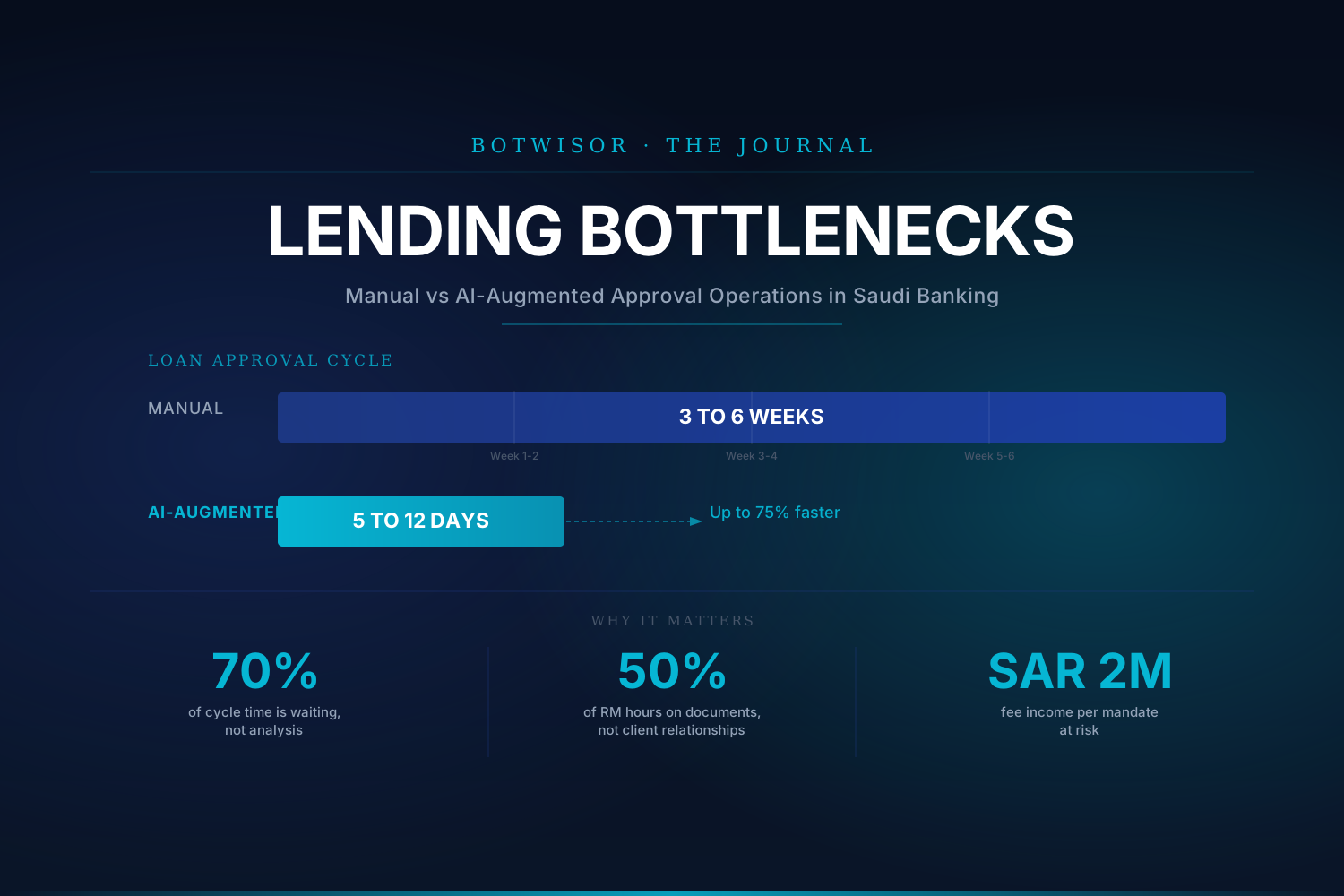
Saudi commercial banks competing for corporate mandates face a structural disadvantage their relationship managers cannot outwork: loan approval cycles that still run three to six weeks on manual document pipelines. AI-augmented lending operations compress that cycle to five to twelve business days, without sacrificing credit quality or the SAMA documentation standards that govern every file.
What does a manual corporate lending pipeline look like today?
The process begins when a relationship manager emails a prospective borrower a document checklist: audited financial statements, board resolutions, collateral certificates, trade licenses, and three years of bank statements. The client returns PDFs over the next four to seven business days, often as scanned images the credit analyst cannot search.
Once documents arrive, the review forks. The credit team models the financials in spreadsheets. Legal reviews collateral and corporate structure. Compliance runs sanctions screening and politically exposed person checks. Each team works from its own copy of the same files, and version control is managed in practice by whoever remembers to resend the latest PDF.
The relationship manager becomes a document traffic controller: chasing missing certificates, resending items that arrived in the wrong format, and answering the same questions from three different teams simultaneously. An experienced RM at a Saudi commercial bank typically spends between 40% and 60% of deal time on document coordination rather than client work.
After the reviews converge, an analyst drafts the credit memo: a two-to-three-day task that involves transcribing financial statement figures into the bank's standard template, synthesizing three separate team opinions into one recommendation, and preparing the committee presentation package.
The credit committee itself meets on a fixed schedule, often weekly. If a deal misses the submission cutoff by a day, it waits seven more days. The typical end-to-end cycle from document request to approval decision runs three to six weeks for a SAR 5M to SAR 50M commercial facility.
Where is the real bottleneck?
Analysts and managers inside the process often attribute the delay to clients who submit incomplete documents or to complex deal structures. Both factors are real. Neither is the primary constraint.
The structural bottleneck is the proportion of cycle time spent gathering and transcribing data versus actually analyzing it. In most manual pipelines, between 70% and 80% of elapsed time is waiting: waiting for documents, waiting for the other team's input, waiting for the committee slot. The actual hours of analytical work represent a fraction of the calendar days consumed.
That ratio matters because it defines what is fixable. The client submission delay can be shortened with a better intake process. The siloed review can be tightened with coordinated workflows. The committee schedule can shift from fixed to on-demand. None of these require changing credit standards. All of them are process and information-flow problems.
Manual vs AI-augmented lending operations
| Stage | Manual today | AI-augmented |
|---|---|---|
| Document collection | 4-7 business days via email and PDF | Structured digital intake; same-day completeness check |
| Financial spreading | 2-3 analyst days to transcribe statements | Hours; AI extracts and maps key ratios automatically |
| Parallel review coordination | Siloed; version drift is common | Shared workspace; one version of record throughout |
| Credit memo drafting | 1-2 analyst days | AI-generated first draft; analyst reviews and edits |
| Committee preparation | 2-4 hours of formatting work | Auto-generated summary package from memo |
| Total cycle (SAR 5M-50M facility) | 3-6 weeks | 5-12 business days |
| SAMA audit trail | Reconstructed manually after approval | Built and time-stamped throughout the process |
What does the delay actually cost?
The most direct cost is mandate loss. When a corporate treasury team requests indicative terms from three banks and one responds with a preliminary credit view in three business days while the others are still chasing documents, that bank wins the relationship. Fee income on a single revolving credit line or syndicated facility can run SAR 500K to SAR 2M. Multiply that by the number of competitive situations your team enters annually.
The second cost is staff utilization. Relationship managers with years of Saudi market knowledge spend their hours resending PDFs and explaining submission requirements. That is not what the bank hired them to do, and it is not what clients pay relationship premiums for.
The third cost is error risk. Manual transcription of financial statements into credit models introduces errors that analytical review does not always catch. A miskeyed revenue figure in year two of a three-year trend analysis changes the covenant headroom calculation. At volume, these errors surface in portfolio reviews, not in individual deal files.
The fourth cost is audit exposure. SAMA examiners reviewing credit files expect complete, time-stamped documentation of every decision point. When that trail is scattered across email threads, shared drives, and handwritten committee minutes, reconstruction is expensive and incomplete documentation becomes a compliance finding.
Vision 2030 and the competitive pressure on Saudi banks
The Financial Sector Development Program, one of Vision 2030's twelve realization programs, sets explicit targets for the Saudi banking sector: raising the private-sector credit-to-GDP ratio, deepening capital markets, and increasing financial institutions' contribution to GDP. Meeting those targets at scale requires processing more credit decisions without staffing up linearly.
At the same time, Saudi fintech entrants and regional banks with stronger digital infrastructure are competing for the same corporate clients. A lending cycle that was competitive in 2018 is a liability in 2026. The gap is not in credit judgment. It is in operational velocity.
What AI-augmented lending operations look like
In an AI-augmented workflow, document intake is structured from the start. Clients upload to a secure portal; the system checks completeness instantly and requests only the specific missing items. Documents arrive processed and searchable, not as scanned images in email attachments.
Financial spreading shifts from a multi-day analyst task to a review task. AI extracts income statement, balance sheet, and cash flow data, maps it to the bank's model format, and flags material variances for analyst attention. The analyst validates, adjusts, and interprets. The transcription task disappears.
Reviews happen in a shared workspace where credit, compliance, and legal see the same document version simultaneously. Issues surface during the process, not at the committee gate when resolving them requires restarting the queue.
The credit memo is drafted by AI from the extracted data and parallel review outputs. The analyst's role shifts to editorial judgment: does this recommendation accurately reflect the risk picture? The formatting hours disappear.
Throughout the workflow, every action is logged with timestamps, ownership, and rationale. The SAMA audit file is complete before the deal closes, not assembled after the fact.
The diagnostic question worth asking
Before benchmarking technology or writing an RFP, a more useful starting point is one operational question: in a typical SAR 10M credit approval at your bank, what percentage of the calendar days elapsed represent actual analysis versus waiting for documents, handoffs, or committee slots?
If the answer is less than 25% analysis time, the constraint is process and information flow, not analytical capacity or credit complexity. That is a workflow problem with a workflow solution. The specific configuration depends on your systems, your document mix, and your regulatory obligations. But the business case for change is already visible in the current cycle time. We help Saudi banks scope the first AI-augmented lending workflow against their existing systems and within SAMA constraints.