
The Journal
Lease Renewal Lag: What It Costs Saudi Commercial Landlords
Saudi commercial landlords lose over SAR 300K per year to lease renewal lag, not from vacancies, from process delays. This breakdown maps where the cost builds and what changes when renewal management runs on automation.
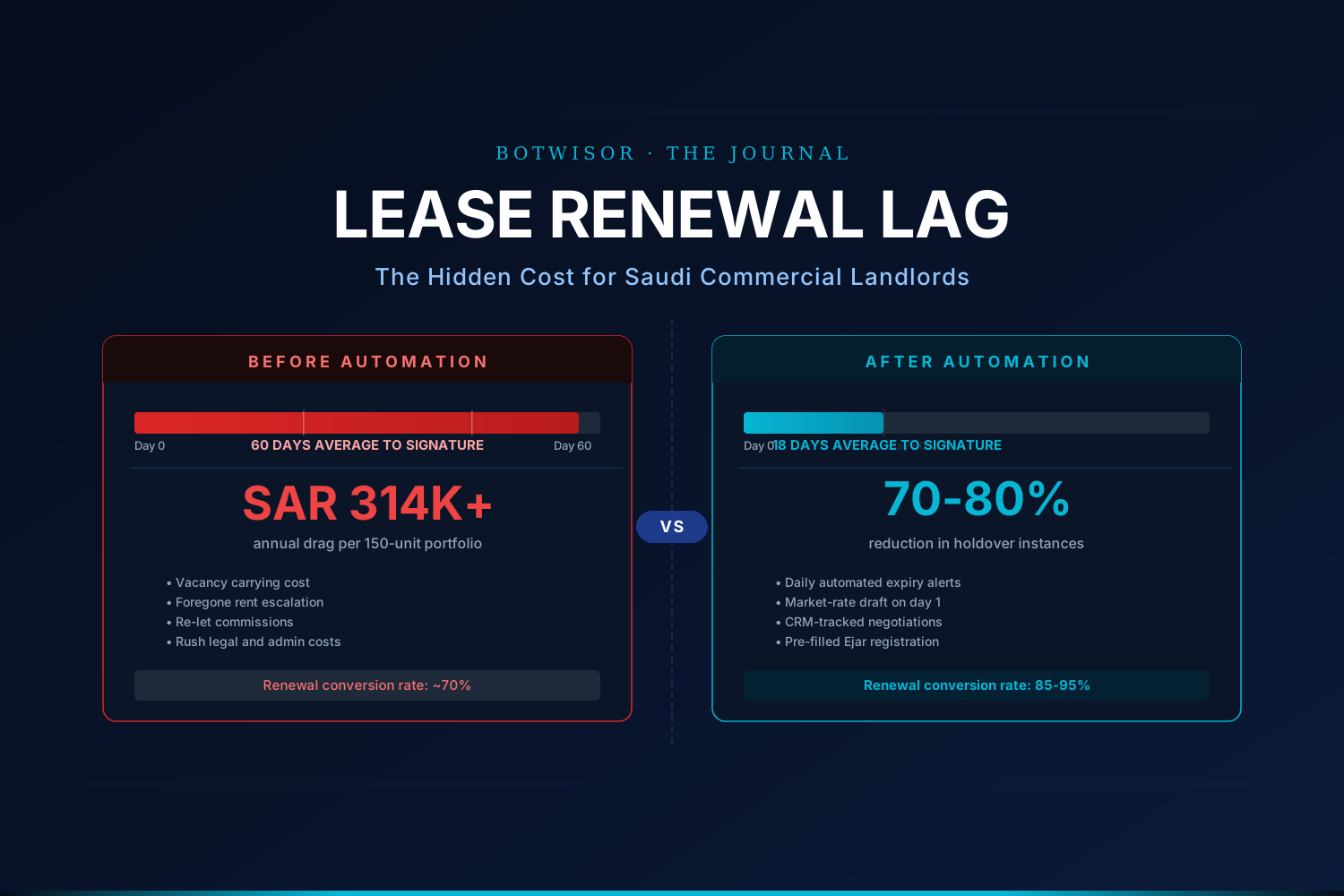
Saudi commercial landlords managing retail strips, office floors, or mixed-use towers face a cost that rarely appears on any dashboard: lease renewal lag. When expiry tracking, tenant outreach, negotiation, and Ejar registration depend on spreadsheets and WhatsApp threads, renewal windows slip. A 150-unit commercial portfolio in Riyadh can lose over SAR 300,000 per year to that process gap alone.
What Is Lease Renewal Lag?
A commercial lease in Saudi Arabia typically runs one to three years. Most agreements require the tenant to notify intent to renew 60 to 90 days before expiry. When neither party manages that window actively, a cascade begins: missed notice dates, late outreach, informal negotiations that drag past the expiry date, and holdover periods where the tenant stays on prior-year contract terms.
Lease renewal lag is the measurable interval between when a renewal action should have started and when a signed, registered new lease is in place. It is distinct from vacancy, but it creates the conditions for vacancy: tenants who are not re-engaged on time increasingly consider competing buildings, and landlords who arrive late to the table lose the negotiating position to push through market-rate escalations.
Most Saudi commercial landlords track vacancy rates carefully. Few track renewal lag directly, because it does not appear on the income statement as a single line item. It hides in holdover rents that should be higher, in commission paid to re-let units that should have been retained, and in legal costs from rushed contracts.
Five Points Where Manual Renewal Processes Fail
Commercial portfolios of 50 or more units commonly manage leases in accounting software or spreadsheets. Neither system pushes renewal alerts. The process is as reliable as whoever checks the calendar that week.
- Missed notice windows. No automated trigger fires when a 90-day window opens. A busy quarter passes and the opportunity closes.
- Slow tenant outreach. Once someone notices, a WhatsApp message or email goes out. The tenant responds in a few days. An informal back-and-forth begins.
- Negotiation without data. The leasing team works from the prior contract rather than current market comparables. Rent escalations that could be defended are not pursued.
- Contract drafting latency. Legal prepares a revised lease. Revisions go back and forth. Signatures take a week.
- Ejar registration delay. The registered contract requires correct identity documents, property details, and a portal upload. A single error restarts the cycle.
Each stage adds days. Across twenty renewals per quarter, the accumulation becomes significant.
What Renewal Lag Actually Costs: A Riyadh Portfolio Model
Consider a commercial landlord with 150 leased units in central Riyadh: a mix of retail, ground-floor food and beverage, and mid-floor office space.
Model assumptions:
- Average annual rent per unit: SAR 150,000
- Total rent roll: SAR 22.5 million per year
- Annual lease expirations: 40 (27% portfolio turnover)
- Leases falling into renewal lag: 10 (25% of expiring leases)
- 3 units: tenant leaves during the lag; unit vacant 75 days before a replacement tenant is found
- 7 units: renewed late, tenant retains prior-year rate for the full next year (missing a 9% market-rate increase)
| Cost Category | How It Arises | Annual SAR Impact |
|---|---|---|
| Vacancy carrying cost (3 units, 75 days) | 3 x 75 x (SAR 150K / 365) | SAR 92,500 |
| Re-let commission on 3 replacement leases | 3 x SAR 150K x 6% | SAR 27,000 |
| Foregone rent escalation (7 units, full year) | 7 x SAR 150K x 9% | SAR 94,500 |
| Fit-out incentives to attract replacement tenants | 2 of 3 replacement leases | SAR 60,000 |
| Rush legal and admin costs | 10 files x SAR 4,000 | SAR 40,000 |
| Total annual drag | SAR 314,000 |
SAR 314,000 per year on a 150-unit portfolio with a SAR 22.5 million rent roll. That is 1.4 percent of gross income, lost not to the market, not to tenant default, but to a process that ran late.
For a 500-unit mixed-use development in Jeddah or a commercial strip across multiple Dammam buildings, scale proportionally. The percentage holds; the absolute SAR figures grow.
The Compounding Problem: Below-Market Positions That Accumulate
A single year of renewal lag is expensive. The multi-year effect is worse.
A landlord who repeatedly misses renewal windows accumulates a portfolio where 20 to 30 percent of units are locked into below-market rates, because each late renewal ended in a below-market settlement. The tenant who stayed on old terms has no incentive to accept a correction the following year. The building's rent roll begins to diverge from current market levels, which reduces its valuation and weakens the landlord's negotiating position with any institutional buyer or financier who requests a rent-to-market analysis.
This is the structural cost that manual portfolio management builds up silently over years, invisible until a valuation, a refinancing, or a portfolio sale surfaces it.
What Changes With AI-Assisted Renewal Management
The shift is not about replacing the leasing team. It is about removing the dependence on human memory for a process that is entirely date-driven.
When renewal management runs on an automated system connected to lease records, tenant contacts, and Ejar data, the process changes materially:
- Every lease with a 90-day expiry horizon is flagged automatically, every day, without anyone checking a spreadsheet.
- Tenant outreach fires on schedule: a formal notification goes out the day the window opens.
- Draft renewal terms are prepared using current market comparables and the tenant's payment history, not the prior year's contract pulled from a filing cabinet.
- Every negotiation exchange is logged in a CRM with a timestamp. Status is visible to the landlord and the finance team in real time.
- Ejar registration documents are pre-populated. The human step is authorizing the upload, not filling the form.
Operators who have automated their renewal pipelines typically report: days-to-signature dropping from 45 to 60 days down to under 20; holdover instances falling by 70 to 80 percent; renewal conversion rate (retaining the same tenant) rising by 15 to 25 percent; below-market settlements nearly eliminated because the landlord arrives at the table with data, on time, every time.
Before vs. After: How the Same Renewal Looks
| Stage | Manual Process | AI-Assisted Process |
|---|---|---|
| Window alert | Spreadsheet check (weekly if consistent) | Automated daily flag, day 90 before expiry |
| Tenant outreach | Ad hoc call or email when noticed | Scheduled formal notification, day 90 |
| Terms preparation | Prior contract, renegotiated informally | Market-comparable draft, ready on day 1 |
| Negotiation record | WhatsApp thread, email chain | CRM stage with timestamp and audit trail |
| Contract finalization | Legal redraft cycle, several days | Template with tracked exceptions, hours |
| Ejar registration | Manual upload, error-prone | Pre-filled package, single authorization |
| Finance update | Manual rent-schedule adjustment | Triggered automatically on signature event |
The before-and-after gap is not about the quality of the landlord's judgment. It is about whether the right information reaches the right person at the right moment, automatically, every time.
The Vision 2030 Context: Scale Changes the Math
Saudi Arabia's commercial real estate pipeline is expanding at a pace that makes manual renewal management a structural vulnerability for serious operators, not just an inconvenience.
The National Housing Company (NHC) is delivering large-scale mixed-use communities across Riyadh, Jeddah, and Al-Qassim. ROSHN's developments carry significant commercial gross leasable area. NEOM's commercial and hospitality assets are coming online. Red Sea Global's resort and retail zones will require active tenancy management for years.
A portfolio operator managing 150 units today may be managing 500 in four years. A process that strains at 150 will not survive at 500.
PDPL compliance adds a separate obligation. Tenant data processed through a renewal pipeline (national IDs, financial details, signed contracts, Ejar records) falls under Saudi Arabia's Personal Data Protection Law. A properly designed automated system enforces data-retention limits, access controls, and audit trails that a shared drive and a group chat cannot provide.
The Gap Is Predictable and Closeable
Lease renewal lag follows predictable patterns: specific months of the year (fiscal year-end, the Ramadan run-up), specific property types (retail more than long-term office), and specific portfolio size thresholds where manual tracking begins to fail (50 units is a common inflection point). Predictable patterns are automatable patterns.
The data already exists in every commercial portfolio: lease dates in the accounting system, tenant contacts in the phone, market comparables from JLL or CBRE Saudi Arabia research, and Ejar records in a filing folder. The gap is not in the data. It is in the connections between it, and in the absence of a daily trigger asking: which renewal window opens today?
Commercial landlords who close that gap first, in KSA's expanding market, lock in tenants at current market rates, reduce replacement cycles, and build the operational foundation to manage portfolios three times their current size without proportional headcount growth.
If your commercial portfolio has 50 or more units under management, a renewal gap assessment typically surfaces SAR 200,000 to SAR 800,000 in recoverable annual income within the first review. → Book a free automation audit and we will map the renewal lag specific to your portfolio.