
The Journal
Late Reports, Wrong Calls: The Multi-Branch Saudi Retail Ops Gap
Saudi retail chains operating across multiple branches lose margin every week to a 48-to-72-hour reporting gap. Here is what it costs and what changes when it disappears.
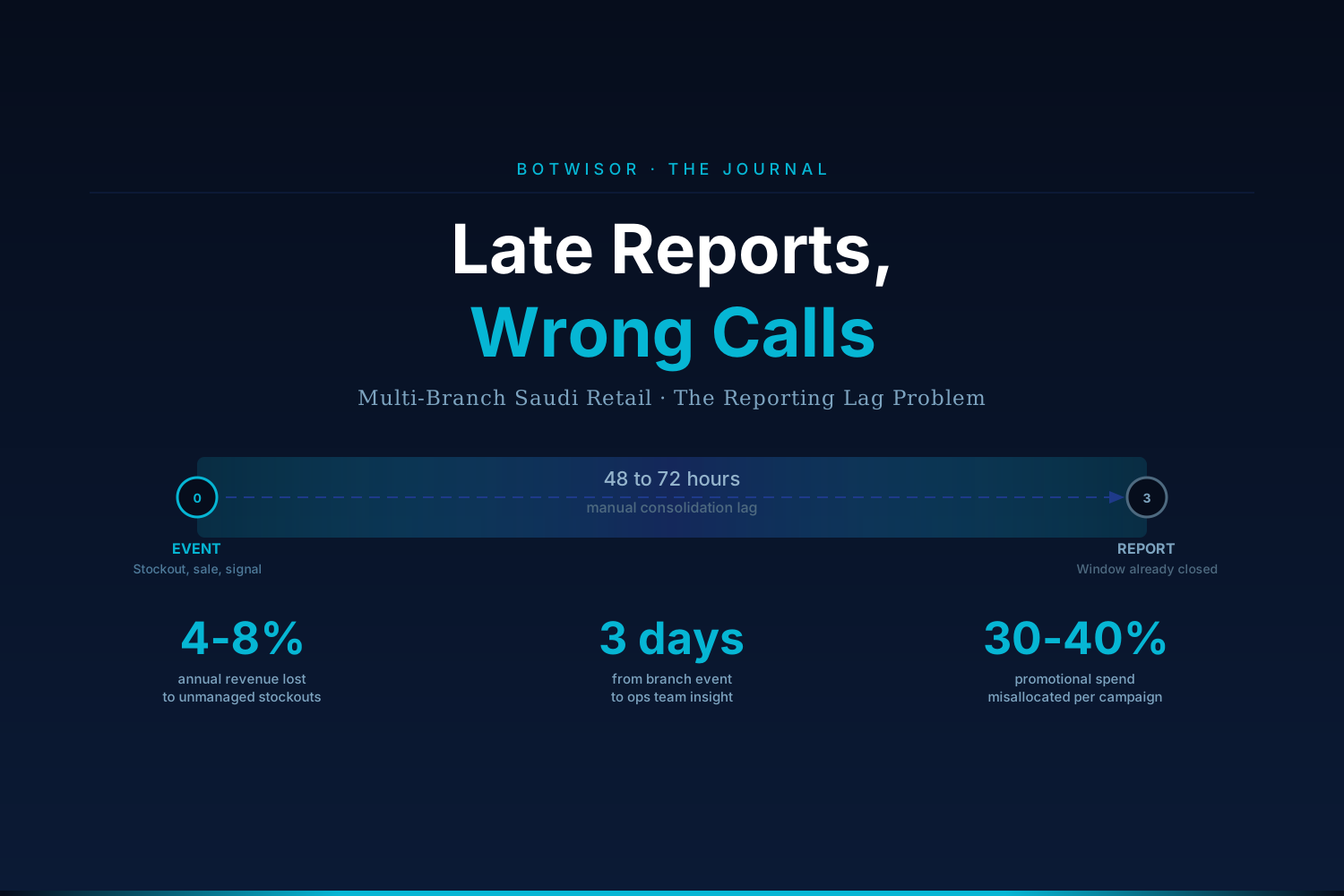
Saudi retail chains operating across multiple branches lose margin every week to a problem most have stopped treating as one. Branch performance data arrives 48 to 72 hours after the events that generated it. By then, the restocking, promotion, and markdown decisions built on that data are responding to a situation that has already changed.
How the Reporting Cycle Works in a Typical KSA Retail Operation
The process runs in layers that most multi-branch retailers recognize immediately. Store managers pull end-of-day sales reports from the POS system and send them to area managers. Area managers consolidate branch files into a shared spreadsheet. The operations director receives the combined view, reviews it, and circulates it to department heads. In most Saudi multi-branch retail operations, this sequence takes two to three full business days.
The delay is not caused by slow systems. Most KSA retailers use enterprise POS platforms, cloud inventory tools, and ERP modules that generate transaction-level data in real time. The bottleneck is the human consolidation layer: the manual extraction, aggregation, reconciliation, and distribution of that data across organizational levels.
A chain with 12 branches across Riyadh, Jeddah, and Dammam might have each branch manager spending 30 to 45 minutes every evening producing a daily report. Area managers spend another 60 to 90 minutes consolidating their territories. By the time the combined view reaches someone with authority to act, the business reality it describes is already history.
The Three Decisions That Go Wrong in the 72-Hour Window
The reporting lag is costly not because the data is wrong, but because it arrives after the moment for action has passed.
Restocking. A high-margin SKU sells out at a Riyadh branch on a Thursday afternoon. The stockout registers in POS data immediately. But without automated visibility, the operations team learns about it Monday morning. The branch runs empty shelves over the entire weekend. For a Saudi retailer with average basket values of SAR 350 to SAR 600 and consistent Friday and Saturday foot traffic, dozens of transactions on that SKU are lost before anyone notices. The sales are gone; the customers who left empty-handed are not automatically recovered.
Promotion management. A five-day promotional campaign launches across six branches. By day two, two branches are producing strong lift while three are returning marginal results and one is unnecessarily discounting a high-velocity SKU. The area manager learns this on day four when the consolidated performance report arrives. One day is not enough time to reallocate promotional budget, extend the offer where it is working, or pull it where it is draining margin.
Markdown timing. Slow-moving inventory at two Jeddah branches is consuming shelf space and tying up working capital. Without real-time visibility across the portfolio, the merchandising team does not know which branches are holding excess units until the weekly inventory reconciliation surfaces it. By then, the optimal markdown window has narrowed. Goods that could have cleared at a 15 percent discount require a 30 percent markdown a week later because the overstock was invisible until the report arrived.
Each scenario is ordinary. None requires unusual circumstances. They repeat across most Saudi multi-branch retail operations, every week, because the reporting cycle is not fast enough to serve the decision cycle.
Manual Reporting vs. Real-Time Operations Visibility
| Dimension | Manual Consolidation | Real-Time Visibility |
|---|---|---|
| Time from transaction to ops insight | 48 to 72 hours | Under 1 hour |
| Stockout detection | Next scheduled report | Automatic threshold alert |
| Promotion adjustment window | Post-campaign | Mid-campaign |
| Cross-branch inventory comparison | Weekly | Live |
| Markdown trigger | Delayed by reporting cycle | Immediate on signal |
| Decisions driven by | Past state | Current state |
The comparison is not between a sophisticated operation and a primitive one. It is between a team acting on what happened three days ago and a team acting on what is happening now.
What This Gap Costs a Mid-Size Saudi Retail Chain
For a Saudi retail chain generating SAR 60M to SAR 100M annually across 10 to 15 branches, the financial impact of the reporting lag shows up across three categories.
Stockout revenue loss. Industry data suggests that 4 to 8 percent of potential retail revenue is lost annually to stockouts in stores with unmanaged replenishment cycles. For a chain at SAR 80M in annual revenue, that range represents SAR 3.2M to SAR 6.4M in missed sales. Not all of this is attributable to reporting lag, but a significant portion involves stockouts that persisted longer than necessary because the signal arrived late.
Promotional budget waste. When promotional spend cannot be redirected mid-campaign, a portion lands on branches or SKUs where it produces no return. In campaigns spending SAR 150K to SAR 300K, a 30 to 40 percent inefficiency rate from inability to adjust mid-flight represents SAR 45K to SAR 120K in spend that generated no measurable lift.
Markdown erosion. Slow-moving inventory managed reactively tends to require deeper discounts before it clears. The difference between a timely 15 percent markdown and a delayed 30 percent markdown on inventory valued at SAR 500K represents SAR 75K in margin that was avoidable.
These figures do not represent catastrophic failure. They represent normal operations in an organization that has accepted a 72-hour data lag as a structural feature.
The ERP Misconception
Retailers who raise this problem internally often hear the same response: "We have an ERP. The data is there." This is technically correct and operationally inadequate. The ERP captures the data. It does not consolidate it, surface exceptions, or present actionable signals to the right person at the moment they need to act.
The gap between data existing in a system and insight being available to an operations manager in real time is not an ERP limitation. It is an integration and orchestration challenge. Connecting POS, inventory, and ERP data into a live operational view, applying business logic to flag exceptions, and routing signals to the right people requires a layer above the systems of record, not a replacement of them.
Saudi retail operators who have closed this gap are not running different ERP software. They are running an intelligence layer that makes their existing systems operationally useful in near real time.
The Vision 2030 Context: Saudi Retail Is Expanding Faster Than Its Ops Infrastructure
Saudi Arabia's retail landscape is growing rapidly. Vision 2030 investments in entertainment, hospitality, and urban development are generating new foot traffic patterns across Riyadh Season venues, the Red Sea Project's hospitality corridors, and expanding mall ecosystems. Saudi retail chains planning to grow from 12 branches to 25 branches over the next three years are expanding into a more competitive, more data-intensive operating environment.
A reporting process that barely functions at 12 branches becomes a genuine operational crisis at 25. The manual consolidation burden grows proportionally with branch count. The delay in reaching a coherent portfolio view lengthens. The decisions made on outdated data affect a larger share of revenue.
PDPL compliance also introduces new data governance requirements for how customer transaction data is collected, stored, and processed. Retail operations formalizing their data infrastructure to meet PDPL requirements have an opportunity to simultaneously eliminate the manual consolidation layer that creates reporting lag.
What Changes When Reporting Lag Goes Away
When a Saudi multi-branch retailer moves to real-time operational visibility, the first visible change is behavioral. Area managers stop waiting for Monday's report and start responding to Thursday's signals. Merchandising decisions are made against current inventory positions, not last week's count. Promotion performance is visible branch by branch within hours of launch.
The structural change is less visible. When the operations team can act on today's data today, the organization builds different habits. Problems surface faster because the system surfaces them continuously rather than in periodic batches. Opportunities are captured because the data reveals them while they remain actionable.
This is not an argument against experienced retail judgment. It is an argument for giving experienced retail operators current information. Their judgment improves when it operates on a current view of the portfolio rather than a historical one.
The Margin Is Not Gone. It Is Delayed.
The margin Saudi retail chains lose to reporting lag is not permanently unavailable. It sits in this week's stockout events, in the promotion currently running below efficiency, in the markdown decision that will be made too late again next month.
The organizations gaining ground in KSA's competitive retail environment are not those with larger advertising budgets. They are the ones whose operations teams see what is happening across their portfolio today, and act before the window closes.
→ Book a free automation audit to see exactly where your reporting lag is costing you margin across branches.