
The Journal
The Investor Progress Report Saudi Developers Build by Hand
Saudi developers building investor reports manually lose three working days per project cycle to report assembly. The delay pushes drawdowns and erodes confidence across the capital stack.
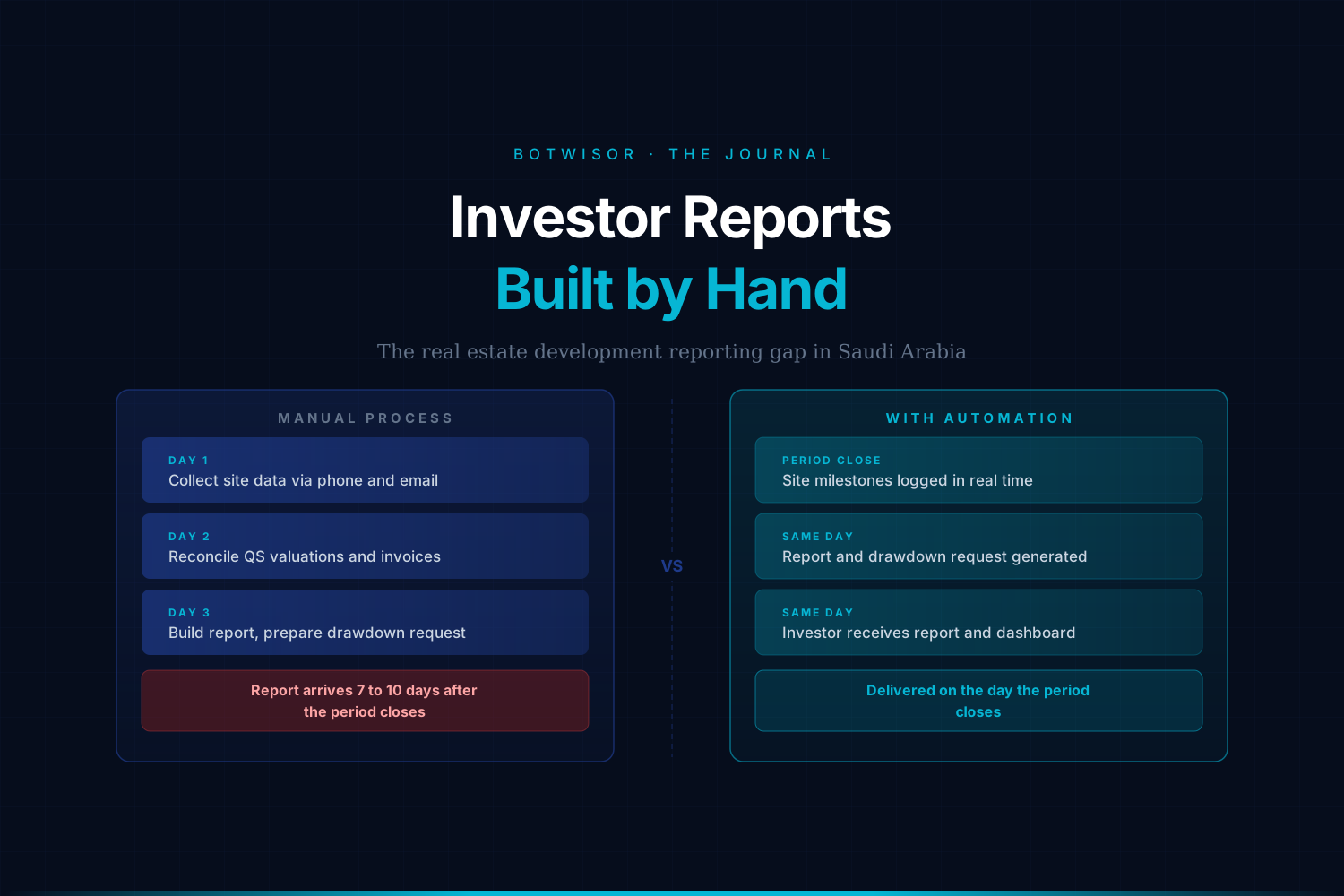
Saudi real estate developers managing multiple projects and private investors lose considerable finance-team bandwidth each month assembling progress reports by hand. The reports arrive late, carry data mismatches, and slow drawdown requests. The cost shows up not as a line item but as carry, friction, and investor questions that could have been answered automatically.
How Saudi Developers Currently Report to Investors
When a Saudi developer raises capital from private investors, the relationship typically includes a reporting obligation. Whether the structure is Musharaka, direct equity participation, or a bank-administered construction facility, the financing party expects documented evidence that the project is progressing, that funds are being applied as stated, and that milestone targets are being met.
For most developers, fulfilling that obligation begins with a round of manual data collection. The finance executive contacts the site engineer or project manager for a completion percentage per phase or floor. The quantity surveyor (QS) provides a valuation of work done. Procurement shares a status on outstanding purchase orders and pending supplier payments. Accounts payable exports the payment certificates issued to subcontractors.
Once collected, those inputs are consolidated into a Word or Excel report, cross-referenced against the draw schedule agreed with the bank or private investor, and formatted for distribution. For a developer managing three concurrent projects, this exercise is never fully finished. The moment one round of reports is out, the next reporting period has already begun.
Where the Manual Process Slows the Project
The reporting delay is not just an internal inconvenience. It creates downstream effects that compound across the project lifecycle.
Stale data at the point of delivery. By the time a monthly progress report reaches investors, the data inside it typically reflects conditions from five to eight days earlier. Site progress captured on the 25th of the month and reported on the 3rd of the following month is already history by the time investors read it. For fast-moving projects, this lag means investors are forming questions and making decisions against a picture that the developer themselves has already moved past.
Reconciliation errors between progress and drawdown. A frequent problem in manually assembled reports is the divergence between what the QS has certified as work completed and what has actually been drawn from the construction finance facility. This divergence usually results from timing differences in data collection rather than actual accounting errors, but investors cannot distinguish one from the other without an explanation. Those explanations require additional exchanges and slow the cycle further.
Multiple investor formats, multiple reassembly cycles. Developers who have multiple investors, a common structure among Saudi developers who syndicate equity across family offices or raise both bank debt and private equity, often maintain different report formats for each financing party. A construction lender may want a drawdown certificate structured against loan covenants; an equity partner may want a narrative progress summary with photos. Each format requires a separate production pass, multiplying the time investment accordingly.
Drawdown requests built after the report, not alongside it. For developers using construction finance from Saudi commercial banks, the drawdown request is a formal document that must accompany the progress evidence. In a manual process, the drawdown request is typically assembled as a separate step after the report is complete, adding one to two additional days before the request is submitted. Each day of delay on a SAR 50 million facility adds carrying cost that accumulates quietly over a twelve-month construction period.
Manual vs. Automated: The Reporting Gap
| Reporting Element | Manual Process | Automated Process |
|---|---|---|
| Site progress data | Collected via phone or email, 2 to 3 days per cycle | Logged by site team at milestone completion, available same day |
| QS valuation reconciliation | Manual cross-check of certificates and completion claims | Auto-reconciled against payment certificate data |
| Financial vs. physical progress | Compared manually; divergence requires written explanation | Single source of truth; divergence flagged automatically |
| Report production | 2 to 3 working days per project after data collection | Generated same day as period close |
| Drawdown request | Assembled separately; 1 to 2 additional days | Auto-populated from milestone and certificate data |
| Investor visibility between reports | None; formal report only | Real-time dashboard access on request |
| Error rate | Periodic data mismatches; QS percentage versus cash-drawn divergence common | Low; single data source, audit trail maintained |
When Report Delays Become Drawdown Delays
Saudi commercial banks and Islamic finance institutions providing construction facilities typically require formal progress evidence before releasing a drawdown. The SAMA-regulated framework for construction finance includes requirements for certified milestone evidence, and for off-plan projects RERA escrow reporting adds another layer of structured documentation that must be submitted accurately and on time.
A developer who takes seven to ten days to produce a progress report and then a separate drawdown request has incurred a processing delay before the bank has even begun its own review. On a SAR 60 million facility priced at the SAIBOR reference rate, a ten-day unnecessary delay in each monthly drawdown cycle costs approximately SAR 45,000 in additional interest carry across the project's twelve-month construction period. That is not a large number relative to total project cost, but it is entirely avoidable.
More significantly, a developer who consistently delivers delayed, internally inconsistent reports to their financing partners develops a reputational quality that follows them into the next project's capital raising. Saudi family offices and institutional investors who have been asked to accept explanations for data mismatches in one project are harder to bring back for the next development, particularly as Vision 2030's pace of activity creates more competition for quality investor relationships.
What Vision 2030 Investors Expect
The investment environment surrounding Vision 2030 has raised the standard for developer reporting. Giga-projects including NEOM, Diriyah Gate, and Red Sea Global have established operational norms, including structured milestone tracking, digital project dashboards, and regular investor briefings, that are beginning to define expectations in the broader market.
Saudi family offices and private equity vehicles that participate in residential and commercial development projects alongside these programs are increasingly familiar with professional-grade reporting. A developer who provides a manually assembled spreadsheet two weeks after the period closes is operating at a visible distance from that standard.
International investors entering the Saudi market through the Investment Law reforms bring similar expectations. They are accustomed to cloud-based dashboards, real-time milestone visibility, and structured drawdown documentation. Developers who cannot provide this level of reporting transparency are not automatically disqualified from raising capital, but they are competing at a disadvantage that compounds across successive projects and successive capital raises.
The reporting standard that was acceptable for a single development five years ago is no longer the benchmark. Investors who are being asked to commit SAR 200 million or more to a developer's project pipeline have options, and the quality of reporting they receive is part of how they evaluate the quality of the management team behind the project.
What Changes When Reporting Is Connected
When site progress data, QS certifications, and financial disbursements feed into a connected platform rather than separate spreadsheets, the production of the investor progress report shifts from a multi-day assembly task to a review-and-release activity.
Site teams log milestone completions as they occur. The platform reconciles those completions against the agreed-upon build schedule and the current draw schedule. When the reporting period closes, the system generates a structured summary: physical progress by phase, financial disbursements by category, variance against plan, and outstanding items. The developer's finance manager reviews, adds any narrative context, and releases to investors, typically within the same working day the period closes.
The drawdown request is generated in parallel, pre-populated with the milestone evidence and certification data that the bank requires. Submission happens alongside the investor report rather than after it.
Investors who want to check progress between formal reporting periods access a dashboard rather than sending a question to the developer's operations team. The developer's team spends time on project decisions rather than report production.
For a developer managing five projects and twenty-five investors, the compounded time saving is significant. Finance team capacity released from report assembly can be redirected to financial planning, covenant management, and the preparation for the next capital raise.
The Cost That Remains Invisible Until It Is Not
The reporting lag rarely appears as a discrete cost on a developer's project accounts. It sits inside labor cost, borrowing cost, and the less-quantifiable cost of investor relationships that do not move forward.
It surfaces as an unmeasured drag on project economics when the carry cost of drawdown delays is calculated, when a finance team of three is spending six working days each month on report production across an active portfolio, and when an investor who received inconsistent data in project one declines to participate in project two.
None of those costs are inherent to the development business. They are the cost of a reporting process that was designed for a single project and never updated when the portfolio grew.
If your investor reporting process is running on manual assembly, a structured review of your current workflow will surface exactly where the time goes and what it costs. Book a free automation audit and we will map your reporting cycle from period close to investor delivery in one conversation.