
The Journal
The Installment Default Rate Saudi Developers Track Too Late to Recover
Saudi off-plan developers detect buyer defaults when the next installment misses, not before. By then, the recovery window has often closed. Early detection changes the outcome; late detection locks in the loss.
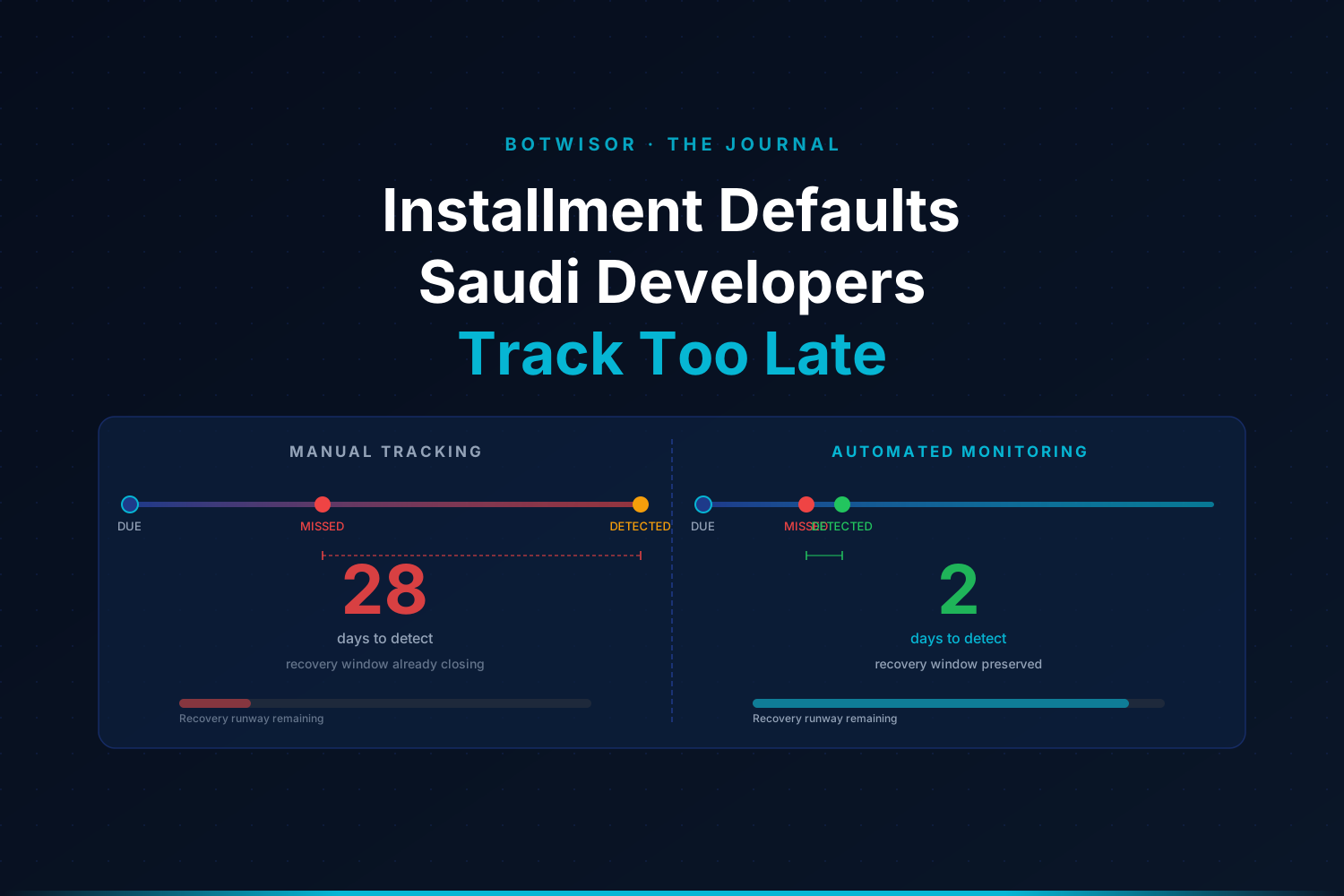
Saudi off-plan developers typically detect buyer defaults only when the next scheduled installment fails to clear. By that point, the window to restructure a payment plan, relist the unit, or find a replacement buyer has often closed. Early detection changes the outcome; late detection locks in the loss.
What Is an Off-Plan Installment Default in Saudi Real Estate?
Under RERA's Wafi platform, all off-plan sales in Saudi Arabia require a registered payment schedule tied to construction milestones. A buyer signs a sale-and-purchase agreement with a plan that typically runs 24 to 48 months. Each tranche represents 10 to 20% of the unit price, payable when a defined construction milestone is certified.
A default occurs when a scheduled payment is not made by its due date. The developer's contract usually specifies a cure period of 30 to 60 days before rescission rights activate. Within that cure period, several paths remain available: a negotiated restructuring, a transfer of the reservation to a new buyer, or a cure by the original buyer.
What determines which of those paths remains viable is how quickly the developer learns that the payment was not made.
How Long Does It Take Saudi Developers to Detect a Missed Payment?
The most common answer, in Saudi development operations today, is two to four weeks.
Here is what that process looks like in practice. A payment due date passes. No automated alert fires. The finance team, handling installment schedules across dozens or hundreds of active units, reviews bank statements as part of a standard monthly reconciliation. The sales manager learns of the shortfall in the next weekly update call. A follow-up is placed. Another week passes before a formal default notice is issued.
By the time the developer's response machinery is in motion, 28 to 45 days have typically elapsed since the payment was due. In a cure period of 30 to 60 days, the detection process itself has consumed most of the practical recovery window.
In a portfolio of 300 active off-plan units across two or three simultaneous projects, a developer's finance team is tracking hundreds of installment due dates per quarter. Month-end bank reconciliation is not designed to flag individual payment misses in real time; it is designed to balance accounts. The detection gap is an architectural feature of manual installment management, not a resource problem that more staff can solve.
What Developers Lose When Detection Is Late
The loss occurs on two fronts simultaneously.
Restructuring outcomes deteriorate with time. A buyer who has missed a payment and is three days past due is in a materially different situation from one who is 35 days past due and has received multiple follow-up calls. The earlier conversation is a practical problem-solving discussion. The later one is a legal notice situation. In the early stage, the buyer typically has options: a short deferral, a partial payment, a restructured schedule. At day 35, options are narrower, stress is higher, and the probability of a successful restructuring is lower. Developers who detect defaults on day 2 are having a different conversation, with a different likely outcome, than those who detect them on day 28.
Resale timelines extend with project completion. When a unit must be recovered and relisted, the resale timeline depends on project stage. An off-plan unit recovered at 30% completion in a project with strong forward sales momentum is an easier resell than the same unit recovered at 75% completion, when the developer has shifted marketing focus toward handover. The Wafi rescission and re-registration process takes time regardless. A unit that returns to the developer's portfolio later in the construction cycle competes in a narrower resale window. Every week of detection lag is a week in which that resale window closes.
Manual Installment Tracking vs. Automated Monitoring
| Metric | Manual Tracking | Automated Monitoring |
|---|---|---|
| Default detection lag | 14 to 30 days post-due | 24 to 48 hours |
| Recovery conversation window | Typically inside cure period already | 2 to 3 weeks before cure period starts |
| Successful restructuring rate | Lower (buyer stress compounded) | Materially higher in practice |
| Resale time on recovered units | 45 to 90 days | 15 to 30 days in active markets |
| Finance reporting on defaults | Monthly or ad hoc | Continuous |
| Documentation trail for RERA | Scattered across email and WhatsApp | Timestamped, audit-ready |
The SAR Cost of Late Detection
A mid-size Saudi residential developer selling 300 active off-plan units might see 3 to 8% of payment tranches in arrears at any given point, depending on economic conditions and the buyer profile of the project. At SAR 800K average unit price and 15% per-tranche payment, each unit tranche represents approximately SAR 120K. Nine to 24 units in some state of payment delay is a normal portfolio position for a developer of this size.
If detection lag extends the recovery window by 30 days per incident, and each additional 30 days of delay costs SAR 8K to SAR 20K in carrying cost, legal correspondence, and re-marketing expense, the aggregate annual cost across 15 incidents is SAR 120K to SAR 300K. That figure does not include markdown risk on recovered units. In a slower submarket or a project where unit differentiation is limited, a recovered unit relisted at a later project stage may sell at 5 to 10% below the original contract price.
Neither number appears on a budget line. Both reduce project margin at close, after the project finance team has already submitted its investor reports.
Why Saudi Developers Accept This Pattern
The pattern persists for structural reasons rather than negligence.
Saudi real estate developers invest heavily in construction management and sales operations. Finance reporting is designed for investors and lenders, not for operational early warning. Once a sale is Wafi-registered and a payment schedule is set, the transaction exits active oversight. The CRM closes the lead. The finance system records the schedule. No process monitors the gap between.
Vision 2030 has expanded the scale at which this gap operates. The private sector housing push, ROSHN's affordable housing program, and the rapid growth in off-plan supply across Riyadh, Jeddah, and the Eastern Region have all increased the number of active installment schedules per developer. A developer running three or four simultaneous projects has a payment book that no monthly spreadsheet reconciliation can monitor in real time. The detection gap does not shrink with portfolio growth; it widens.
Sales teams are measured on new sales velocity, not on the health of prior-period commitments. Finance teams are measured on reporting accuracy, not on early-warning coverage. The organizational structure does not reward the function that automated monitoring would perform.
What Automated Installment Monitoring Changes
Automated monitoring connects the payment schedule register to bank clearing feeds. When an expected payment does not confirm by end of the defined settlement window, an alert fires to the sales or retention team within 24 to 48 hours of the missed due date.
This changes the character of the recovery function. Instead of a reactive legal exercise initiated four weeks after the fact, it becomes a proactive retention conversation initiated while the buyer still has options and the developer still has flexibility. Restructuring rates improve. Fewer units return to the pool. Those that do return faster, from an earlier project stage where relisting is more straightforward.
The automation does not change the developer's underlying credit risk. Market conditions, buyer income profiles, and mortgage availability all affect default rates in ways no internal system controls. What changes is the organization's ability to respond when options still exist, rather than after they have expired.
RERA Documentation and the Compliance Dividend
RERA has been expanding oversight of the off-plan market since 2017, with Wafi registration requirements and escrow account mandates that protect buyers. These protections create a reciprocal obligation: developers enforcing buyer default provisions must do so within defined procedural windows, with documented notice timelines.
An automated default detection and notification system generates the documentation trail that RERA proceedings require. Every alert, every follow-up, and every formal notice is timestamped and recorded in a single system. Manual processes, run through WhatsApp conversations and email threads, do not produce this trail with the consistency that a formal dispute or RERA audit requires.
The compliance benefit is secondary to the financial one. But for a developer managing multiple projects simultaneously, it is not trivial.
A free automation audit from BotWisor covers your off-plan installment management process, identifies the detection gap across your active payment book, and quantifies what that lag is costing your portfolio in SAR. The review typically takes under an hour.