The Journal
The Cost of Generic Promotions in Saudi Retail
Saudi retailers on batch promotion cycles give away margin to buyers who needed no discount and train loyal customers to wait for offers. What that pattern costs operators at SAR 50M-200M in revenue.
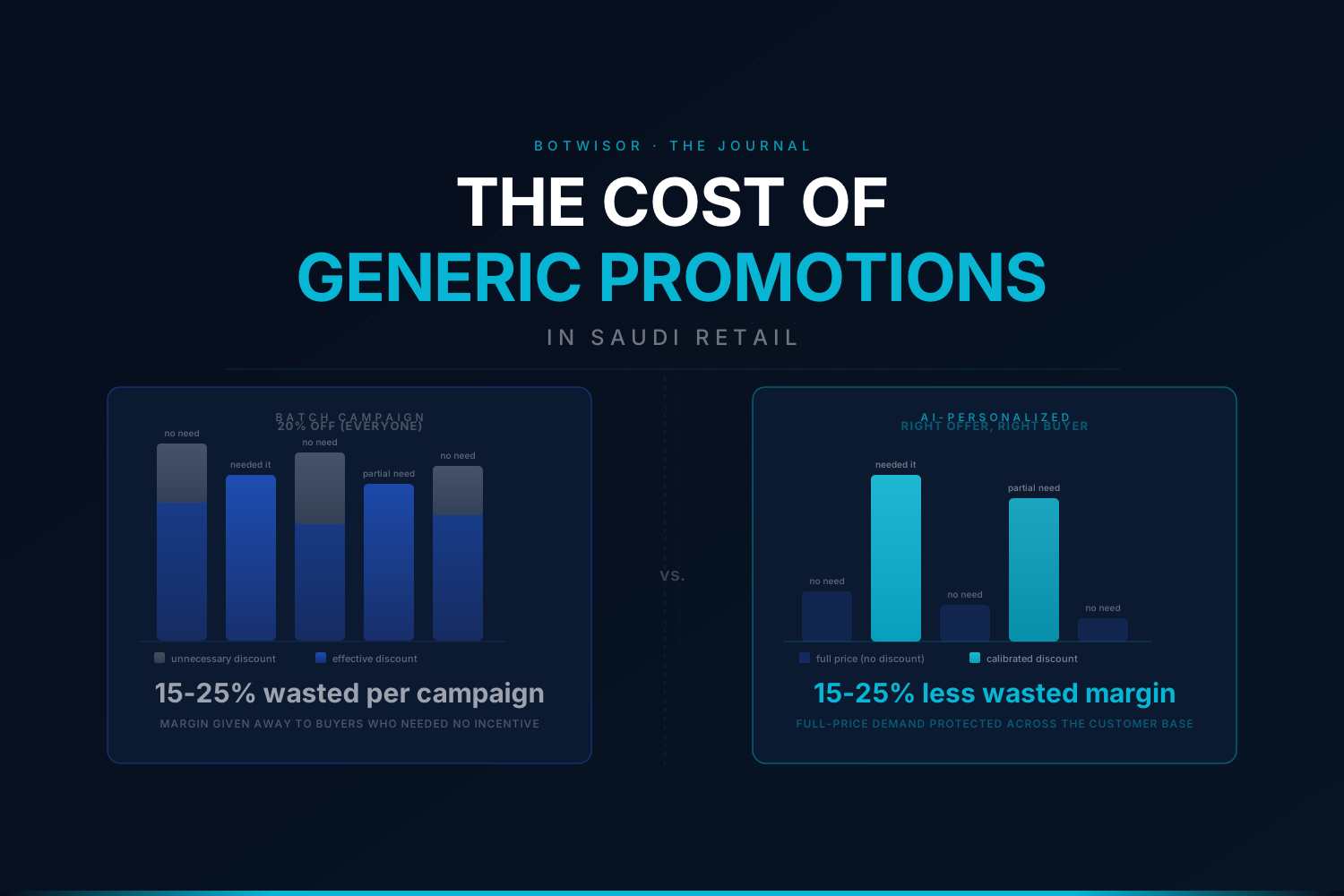
Saudi retailers running generic promotions give away margin on two fronts: discounts to customers who would have purchased at full price, and promotional noise that conditions loyal buyers to delay purchases and wait for the next offer. For operators running SAR 50M to SAR 200M in annual revenue, the combined cost of unnecessary discounting and eroded full-price velocity is rarely accounted for as a single number.
How Saudi Retailers Run Promotions Today
The standard promotional model at mid-size Saudi retailers follows straightforward logic: build a customer database, map the promotional calendar to Ramadan, Eid al-Fitr, Eid al-Adha, National Day, and White Friday, then blast the full database or broad segments with a percentage discount.
The model is not wrong in principle. These are the moments when Saudi consumers are actively purchasing, and being present with an offer during those windows is clearly better than being absent. The problem is not the calendar; it is the granularity.
A head of marketing managing 200,000 contacts across WhatsApp, SMS, and email cannot realistically build offer-level personalization without infrastructure designed for it. The practical output is a single offer, sent to the broadest viable segment, at the margin the business can absorb. The campaign generates sales. The cost it generates rarely shows up on the same dashboard.
Where the Cost Accumulates
The Margin Given Away to Buyers Who Did Not Need a Discount
The clearest cost in a batch promotion is the discount issued to customers who would have purchased regardless. In every customer database of meaningful size, a segment of buyers is already primed to purchase at the next occasion: recent first-time buyers, customers who browsed specific categories recently, and subscribers whose behaviour signals high purchase intent.
A 20% discount given to a customer who had a 90% likelihood of purchasing anyway is not a promotion. It is a margin concession that returned nothing incremental.
Research from comparable retail markets suggests that between 15 and 25 percent of customers reached by a batch campaign would have purchased at full price within the same promotional window. For a Saudi retailer with SAR 80M in annual revenue, a promotional calendar that moves SAR 20M through discount events at an average of 20% off contains roughly SAR 600K to SAR 1M in margin given to buyers who needed no incentive. That figure is structural, not occasional; it recurs every promotional cycle.
Discount Conditioning and the Erosion of Full-Price Demand
The second cost is longer-term and harder to isolate on a single report. Customers who receive consistent promotional discounts learn, over time, to defer purchases until an offer arrives. The behaviour is rational from the customer's perspective; it is a growing problem from the retailer's.
The effect is most visible in categories with high repeat purchase frequency: cosmetics, household goods, apparel basics, and groceries. A customer who buys body care products three times per year initially purchases at full price. By the second or third year of receiving monthly promotional campaigns, that same customer has migrated to a purchase pattern of buying primarily during promotional windows, spending the same volume but at 20% less per unit.
The full-price demand erosion that results from this pattern does not appear as a discrete cost. It shows up as a slow decline in full-price sell-through rates and a gradual widening of the promotional budget required to maintain the same revenue. Saudi fashion and cosmetics retailers with long promotional histories are often already managing this dynamic without having named it as a cause.
The Missed Conversion Upside
Generic promotions also miss an asymmetric opportunity. Different customers in the same database are lapsed for different reasons: one has not received an offer relevant to the category they browse; one has received the wrong offer depth; one is already in-market for a specific product and needs a targeted push rather than a sitewide discount.
A blanket 15% off sitewide may reactivate one lapsed segment and leave the rest unmoved. An offer calibrated to the reason for lapsing, the category the customer last engaged with, and the offer depth required to close the conversion has a measurably higher return per SAR spent on promotion.
Comparable retail deployments in the GCC and broader MENA region consistently report 20 to 30 percent higher redemption rates for behaviour-triggered personalized offers against batch equivalents. In Saudi retail, where WhatsApp has the highest open rates of any communication channel and message fatigue is a real constraint, offer precision is also an attention economy problem.
Before vs. After: What Personalized Promotions Change
| Dimension | Batch Campaign | AI-Personalized Campaign |
|---|---|---|
| Customer targeting | Full database or broad segment | Individual, based on purchase and browse history |
| Offer type | Fixed percentage sitewide or by category | SKU-specific, inventory-aware |
| Timing | Calendar-driven | Behaviour-triggered |
| Discount depth | Uniform across segment | Calibrated to conversion likelihood |
| Margin cost | Full discount on all recipients | Discount only where purchase probability is below threshold |
| Discount conditioning risk | High; grows with campaign frequency | Low; full-price purchases are reinforced |
| Full-price sell-through | Declining over time | Protected |
The table maps the structural differences. The operational implication is that a Saudi retailer moving from batch to personalized promotions does not necessarily run fewer campaigns; it runs campaigns where the discount is only deployed where it generates incremental revenue.
What Makes This Particularly Expensive in Saudi Retail
The Saudi promotional calendar concentrates a disproportionate share of annual sales into a small number of windows. Ramadan alone can account for 20 to 35 percent of full-year revenue in categories like food retail, electronics, and home goods. National Day and White Friday move significant volume in a matter of days.
The concentration means the cost of batch promotions is not spread evenly across twelve months. It is front-loaded into the moments when the business is most exposed: peak windows where margin giveaway is largest and discount conditioning risk is highest.
A Saudi retailer who blasts their full database at 25% off across a Ramadan promotional window is making an implicit decision about every customer in that database simultaneously. Some needed a 5% nudge. Some needed a category-specific offer. Some would have bought at full price on day one of the campaign. The 25% uniform discount serves the least-efficient subset of that need while the rest absorb unnecessary margin cost.
Vision 2030 and Growing Competitive Pressure
Saudi retail is entering a period of channel expansion and competitive intensification as the National Retail Development Program drives new entrants, format diversification, and growing price transparency through comparison tools. Retailers operating on undifferentiated promotional strategies face pressure from both sides: cost-of-goods inflation compressing gross margins, and consumer optionality increasing the likelihood that a generic offer is benchmarked against a competitor's targeted one.
The retailers building personalized promotion capability now are not doing so primarily because it is operationally tidy. They are doing so because the alternative is promotional spend that becomes less efficient with every campaign cycle.
The Question to Ask Your Marketing Team
There is a straightforward way to size this cost in your own business. Ask: in our last three promotional campaigns, what percentage of redemptions came from customers who had purchased at full price in the 30 days before the offer went out?
If your team does not have that number, the measurement infrastructure required to answer it is also the infrastructure that would allow targeted promotions. The data almost every Saudi retailer already holds, including point-of-sale history, CRM records, and browse data for digital channels, is sufficient to identify the structural cost of batch promotions and begin building more precise targeting. The gap is not in data collection; it is in connecting that data to promotional decisions at the individual customer level.
A Useful Starting Point
The right starting point is not a full system overhaul. It is a promotional database audit: segment your last three campaigns by customer purchase probability at the time the offer was sent, and map the correlation between discount depth and incremental conversion. The result will identify the categories and customer segments where promotional spend is generating the least return.
If your promotional calendar drives SAR 15M to SAR 60M in campaign revenue annually, a 10% improvement in promotional efficiency represents SAR 1.5M to SAR 6M in margin protected or recovered. That calculation is worth running before the next campaign goes out.
→ Book a free automation audit to identify where your promotional spend is generating unnecessary discount and what a targeted approach would realistically recover for your business.