
The Journal
Why Saudi Banks Lose More to Fraud Than They Realize
Rule-based fraud detection misses the transactions it was never designed to catch. For Saudi banks, that gap has grown significantly as payment rails accelerated and fraud methods evolved.
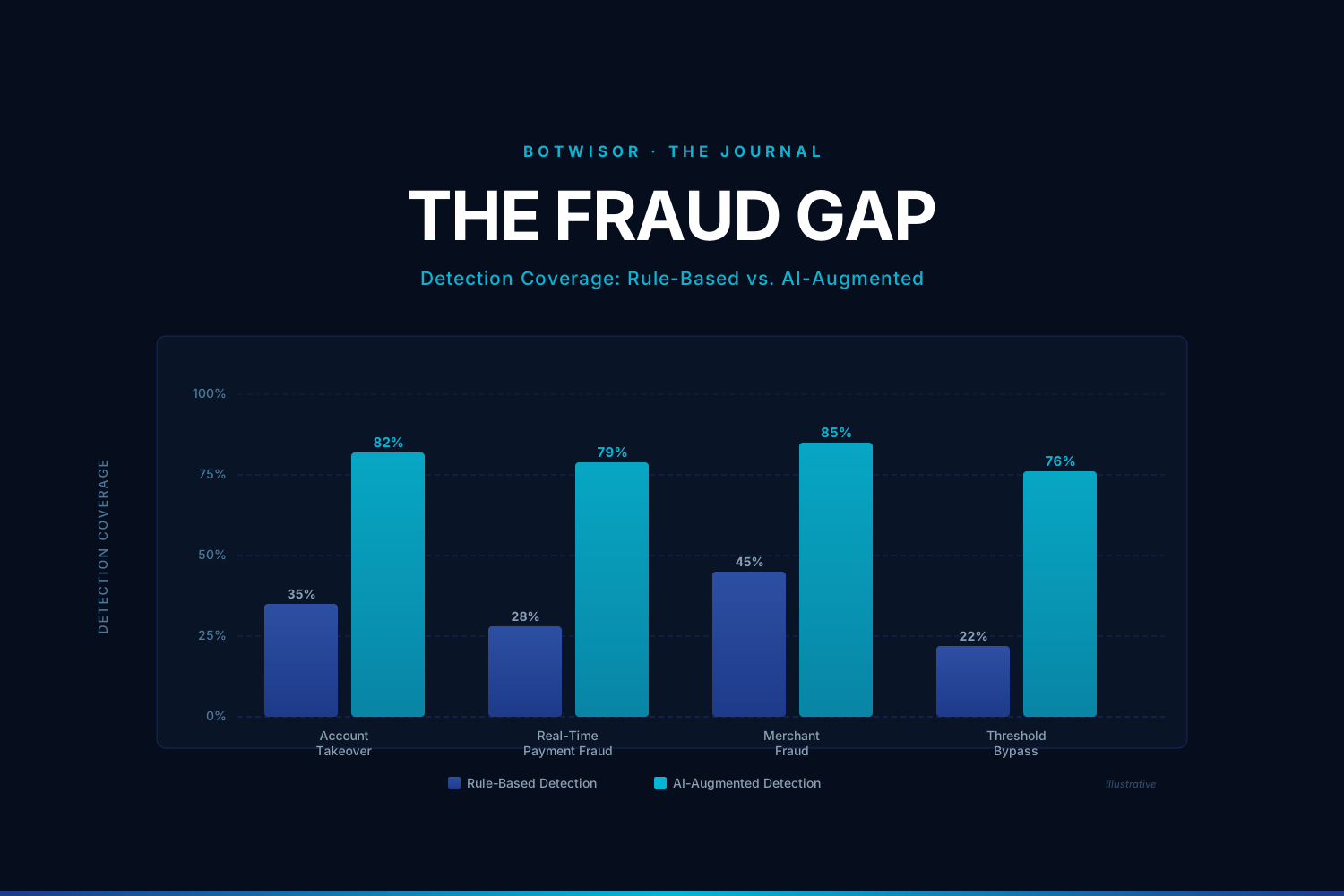
Rule-based fraud detection systems -- the kind most Saudi banks still rely on -- flag a fraction of what they are designed to catch. The rest completes as clean transactions until a customer dispute, a regulator inquiry, or an internal audit surfaces it. The direct SAR loss is only part of the story.
What Rule-Based Fraud Detection Actually Does (and Doesn't)
A rules engine operates on fixed criteria: if a transaction exceeds a defined threshold, if login attempts originate from two countries within an hour, if beneficiary additions cluster at unusual times -- raise a flag. These criteria were suited to the fraud patterns that existed when they were written. They were not designed for behavioral account takeover, for the velocity of SARIE and Fawri+ payment settlements, or for the multi-step, context-switching patterns that sophisticated fraud now follows.
The deeper problem is the revision cycle. Most banks update their rule sets quarterly at best. Fraud actors revise their methods within days of finding a bypass. The gap between those two timelines is where losses accumulate, silently, across thousands of transactions.
There is also the false positive burden. Industry estimates for rule-based card and payment fraud systems place the false positive rate -- legitimate transactions incorrectly flagged as suspicious -- at 5 to 15 percent of all alerts. Each one requires investigator time to clear. Each one that results in a blocked transaction creates a customer service event. At a bank processing tens of thousands of transactions daily, that translates into hundreds of analyst hours each month spent confirming that transactions were, in fact, legitimate.
The True Cost of a Single Fraud Event
Most fraud loss figures reported internally count only the direct write-off. The real cost is considerably higher.
When a fraudulent transaction completes undetected:
- An investigator spends two to four hours reconstructing what happened, gathering logs across payment, core banking, and CRM systems, then writing a case summary.
- If the transaction meets SAMA's mandatory reporting thresholds, a compliance filing is required -- adding legal and compliance involvement to what was already an operational cost.
- Customer service handles the dispute. At this stage, the customer is already distressed, and retention probability drops sharply.
- If the customer escalates to SAMA's Consumer Protection Department, the bank bears additional exposure in resolution time and required remediation.
None of these costs appear in the "fraud loss" line. They compound the headline number considerably. For a bank processing hundreds of thousands of transactions each month, investigation backlog is not incidental -- it is a material operational line item that rarely features in risk presentations.
Where Saudi Banks Face the Most Exposure
Three fraud categories have grown fastest in the KSA market over the past three years:
-
Account takeover via social engineering. Attackers obtain one-time passwords through phone calls, SMS, or WhatsApp messages, then drain accounts within minutes. Because each individual step -- login, OTP entry, beneficiary addition, transfer -- looks normal in isolation, rule-based systems rarely stop these in real time.
-
Real-time payment abuse. SARIE processes transfers within seconds. Fawri+ handles immediate domestic transfers across all major banks. At that speed, any detection mechanism that triggers a review after the transaction settles offers no practical protection. The funds are irrecoverable.
-
Merchant and acquiring fraud. As e-commerce growth accelerated and banks expanded merchant onboarding at pace, manual verification created gaps. Fraudulent merchant accounts processed chargebacks that were difficult to recover once those accounts were closed.
What these three categories share: they are behavioral, contextual, and dynamic -- precisely the conditions where threshold-based rules produce the most misses.
Rule-Based Systems vs. AI-Augmented Detection
| Dimension | Rule-Based Detection | AI-Augmented Detection |
|---|---|---|
| How it recognizes fraud | Fixed thresholds, static rule sets | Patterns across transaction sequences and behavioral history |
| Adaptation speed | Quarterly rule updates at best | Continuous model retraining from new data |
| False positive rate | 5–15% of flagged transactions (industry range) | Substantially lower once customer behavior is modeled |
| Real-time coverage | Partial; some transaction types excluded | Transaction-level scoring at millisecond latency |
| Investigation queue | Manual triage of every alert | Risk-ranked; highest-confidence cases surfaced first |
| SAMA audit readiness | Manual report assembly from disparate systems | Machine-readable audit trail generated per transaction |
The SAMA reporting dimension deserves particular attention. Under SAMA's Cybersecurity Framework and its mandatory fraud prevention controls, banks are expected to maintain complete audit trails. Assembling these manually from emails, CRM notes, and core banking exports is the current workflow at most mid-tier Saudi banks. It adds significant cost to every compliance cycle and introduces gaps that are difficult to defend during a supervisory review.
What Changes When Detection Runs in Real Time
AI-augmented fraud detection does not remove investigators from the process. It fundamentally changes what they investigate.
A behavioral sequence that would pass unnoticed through a rules engine -- device change, new beneficiary addition, large outward transfer, all within four minutes -- registers as a high-risk pattern in a model trained on that bank's own transaction history. The investigator receives a pre-scored, pre-contextualized alert rather than a raw flag requiring them to reconstruct the picture from scratch.
The operational results are measurable: shorter mean time to case containment, a smaller open-case backlog, and the ability to notify customers in real time rather than after damage has already occurred. In a relationship-banking market like Saudi Arabia, contacting a customer proactively during a suspicious event makes the difference between a customer who stays loyal and one who files a complaint with SAMA.
The false positive reduction matters equally. High-value customers -- those using digital wallets for large corporate transfers or Ramadan-period retail spending -- are among the most likely to abandon a bank that repeatedly blocks legitimate transactions without clear explanation. Fewer false flags preserve the relationship.
SAMA Expectations and the Vision 2030 Dimension
SAMA's regulatory framework expects fraud detection capabilities that are proportionate to a bank's transaction volume and digital channel exposure. As Saudi Arabia's Vision 2030 program drives accelerating adoption of cashless and real-time payments -- with digital transaction volumes growing substantially year over year -- the benchmark for "proportionate" shifts upward.
Institutions that demonstrate to SAMA that their fraud detection layer is model-driven, actively managed, and producing auditable outputs are in a materially different compliance posture than those relying on static rule sets designed for a previous era of banking. Financial Sector Development Program commitments reinforce this expectation: the 2030 competitive landscape is not compatible with detection infrastructure that is structurally behind the fraud methods it is meant to stop.
What Banks That Have Made the Shift Report
The consistent pattern across institutions that have upgraded fraud detection is that improvement compounds across the organization. Fewer false positives give investigators more time for complex cases. Faster case closure reduces the open-case backlog. Better behavioral modeling at the fraud detection layer often surfaces anomalies that were also affecting lending decisions and KYC accuracy.
The cost of operating manual, rule-based fraud detection at scale in a real-time payment environment is not stable. It grows as transaction volume grows, as channel diversity increases, and as the gap between rule revision cycles and evolving fraud methods widens. At a certain scale, that operational cost becomes larger than the investment required to address the underlying problem.
The Risk of Staying Where You Are
The question Saudi bank risk officers are increasingly confronting is not whether to upgrade but how much longer they can afford not to.
Fraudsters have already priced the detection gap into their operational models. The cost of inaction is not the cost of one incident. It is the compounding cost of operating a detection layer that falls further behind with every quarter the rule set goes unrevised.
A free automation audit from BotWisor maps your current fraud detection coverage against your actual transaction exposure, identifies where your rule set is generating the most misses, and shows where the highest-leverage improvements are.