
The Journal
Four Weeks for a Credit Memo: The Saudi Corporate Banking Default
Saudi corporate banks accept 3-to-5-week credit memo cycles as standard reality. The cost accumulates in lost deals, frustrated clients, and analysts buried in work that automation can handle.
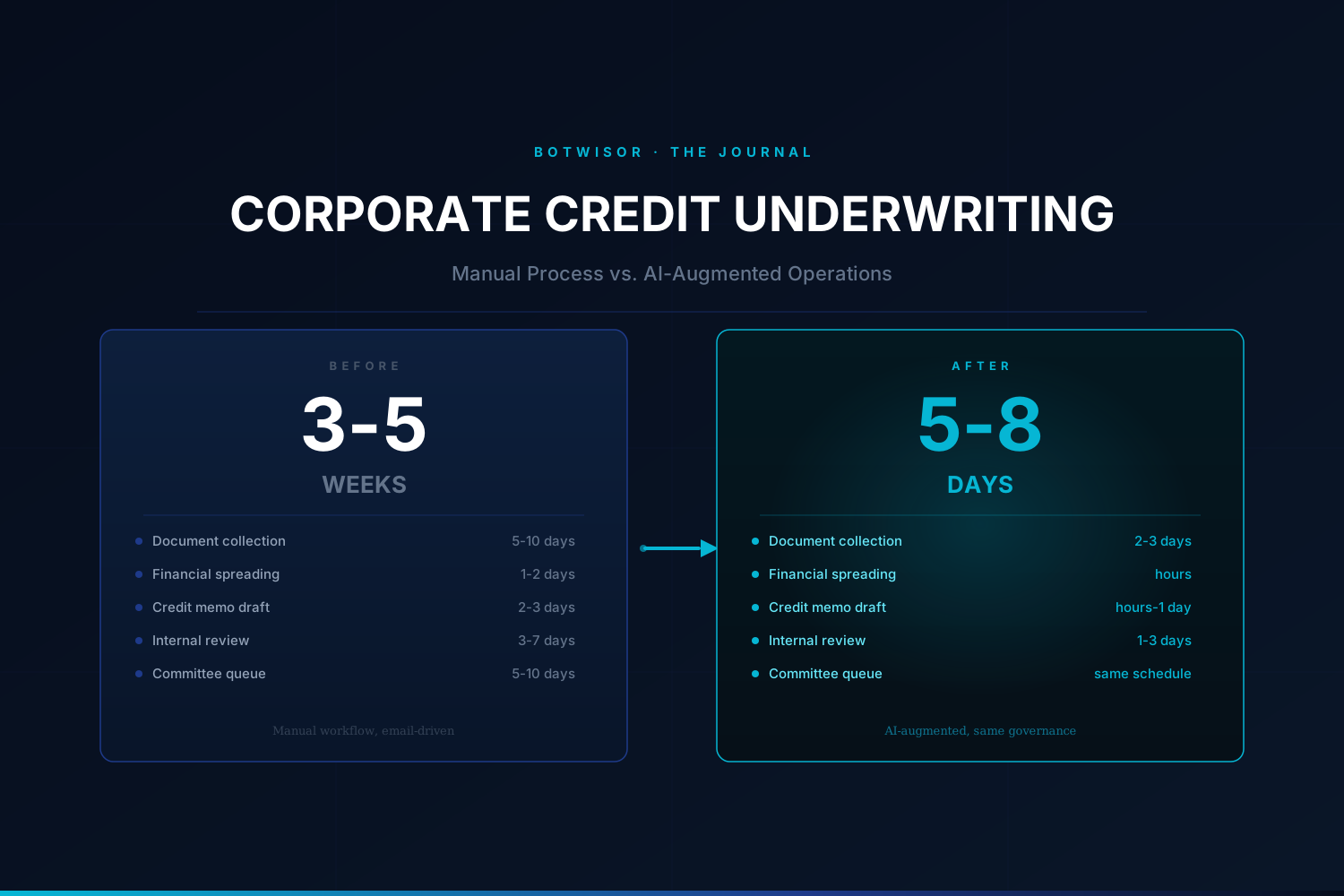
For most Saudi corporate banks, a credit memo for a mid-market facility takes three to five weeks from document request to committee decision. Four weeks is the rough midpoint, and it is treated as an operational given, not a solvable problem. The cost it creates, in lost deals, client attrition, and misallocated analyst capacity, accumulates every quarter and rarely appears in any review.
What Goes Into a Corporate Credit Memo?
A credit memo for a SAR 15M to SAR 50M corporate facility is not a short document. The relationship manager must gather audited financial statements for the past two or three years, tax certificates, a current commercial registration record, a business overview, and group structure charts. For construction and contracting clients, the file also includes project references, contract backlog schedules, and bonding capacity statements.
Once the documents arrive, a credit analyst spreads those financials into a standardized template, calculates key ratios, benchmarks them against sector peers, and writes a narrative risk assessment. The draft then moves to the unit head, then to a risk review function, and finally into a committee scheduling queue.
Every handoff introduces a waiting period. Committees meet on fixed schedules, weekly or fortnightly in most Saudi banks. If a file misses the cut-off for one session, it waits for the next. In a well-run operation, the full cycle takes three to four weeks. In most operations, it takes longer.
Why Has This Timeline Become the Accepted Normal?
Credit departments at Saudi banks generally offer three explanations for the timeline. Document collection is partly outside the bank's control because corporate clients are slow to submit. Financial analysis requires human judgment that cannot be safely rushed. Committee scheduling is a governance requirement, not a variable.
Each explanation contains some truth. None of them accounts for how long the manual portions of the work actually take.
The real reason the timeline persists is structural. Credit workflows were designed before document automation existed. Those workflows became embedded in policy frameworks, staff training materials, and system configurations. No single team owns the delay end-to-end, so no single team is accountable for reducing it. The backlog stays invisible at the leadership level because it is tracked in "file in progress" status, not in days lost per deal.
What the Delay Actually Costs
The costs do not appear in a single line item. They distribute across three categories.
Deals that close elsewhere. A corporate client evaluating a SAR 25M working-capital facility has a decision window. If a competing bank returns with indicative terms in five business days and a binding credit decision in ten, the client makes a judgment about which institution is operationally competent. Saudi banks competing for corporate relationships with larger domestic players and regional banks are facing this comparison more frequently as the corporate lending market grows under Vision 2030's private-sector diversification mandate. Time-to-credit is becoming a selection criterion.
Analyst capacity consumed by administration. A credit analyst at a mid-size Saudi bank routinely spends a large share of their week on work that requires data entry, formatting, and document chasing rather than risk judgment. The actual analysis, assessing a client's repayment capacity, sector position, and the appropriateness of a proposed covenant structure, gets compressed into a smaller fraction of the cycle. This is not how skilled analyst capacity is meant to be deployed. It also drives attrition among capable staff who joined credit teams to do analytical work, not document administration.
Relationship erosion that does not appear in CRM notes. Corporate treasurers and CFOs remember how their last credit transaction was handled. A process that took five weeks and required multiple follow-up calls to chase missing documents leaves a clear impression. That impression shapes where the next financing mandate goes. The attrition is quiet: the relationship is never officially ended, the client simply brings fewer transactions, and no one tracks the cause.
Before and After: Manual vs. AI-Augmented Credit Underwriting
The table below reflects outcomes for a Saudi corporate bank applying automation to the credit memo process. These are realistic operating estimates, not optimistic projections.
| Stage | Manual Process Today | With AI Augmentation |
|---|---|---|
| Document collection | 5-10 business days, email and phone follow-up | Automated client portal, structured checklist: 2-3 days |
| Financial spreading | 1-2 days per analyst per file | Structured extraction in hours; analyst validates |
| Credit memo first draft | 2-3 days to produce a reviewable draft | Draft generated from spread data; analyst adds judgment |
| Internal review cycles | 3-7 days across unit head and risk function | Pre-formatted file, standard structure: 1-3 days |
| Committee queue | 5-10 business days depending on schedule | Same governance structure; cleaner files move faster |
| Total time-to-decision | 3-5 weeks | 5-8 business days |
The governance elements remain unchanged. Credit authority, committee structure, and risk sign-off thresholds do not move. What changes is the time consumed by work that does not require credit judgment.
What About Regulatory Defensibility?
A persistent concern in credit departments is that manual processes are more defensible under SAMA examination: a human reviewed every line, the logic is traceable, the file was assembled by a qualified analyst. This concern is legitimate but it reflects a misunderstanding of what automation actually changes.
AI-assisted financial spreading does not make credit decisions. It extracts figures from source documents, calculates ratios, and flags anomalies for analyst review. The analyst validates the spread and approves the output. The committee applies the same credit authority it has always applied. What changes is the speed and accuracy of the data preparation phase.
A SAMA examiner reviewing a credit file is focused on the soundness of the credit analysis and the quality of the approval decision. Whether an analyst entered the figures manually or validated an automated extraction is not the substance of what the examination assesses. The defensibility concern, examined carefully, becomes an argument for thoughtful implementation rather than an argument against any change.
The Vision 2030 Context
Saudi Arabia's corporate lending market is expanding. The giga-project ecosystem, the private-sector diversification targets across Vision 2030 programs, and the National Industrial Development and Logistics Program are generating new corporate borrowers with more complex financing requirements. The volume of credit memos the sector must process will grow.
Banks that can return credit decisions in eight business days rather than four weeks are positioned to capture a disproportionate share of the corporate relationships forming around this activity. Banks that cannot will continue to compete on relationship and pricing alone, with an unaddressed operational constraint working against them.
The Financial Sector Development Program (FSDP), SAMA's roadmap for the banking sector's evolution, includes explicit targets around digital banking and operational efficiency. The direction of expectation is clear even where the specific timeline for credit underwriting modernization is not yet mandated.
What the Same Process Looks Like After Automation
A relationship manager at a Saudi bank running an AI-augmented underwriting process uses the client conversation differently. Instead of explaining why the file is still in preparation or following up on missing documents, the RM is discussing the client's business: expansion plans, the appropriate facility structure, covenant preferences. The document submission is handled through a structured portal with clear requirements. The analytical spread arrives in hours, not days.
A credit analyst in the same setup reviews and enriches a structured draft rather than constructing one from raw inputs. The ratio calculations are pre-populated. Anomalies are flagged for judgment. The analyst's contribution is the risk assessment: whether a flagged item is material, whether the proposed pricing reflects the actual exposure, whether the covenant package fits the client's operating cycle.
The result is not a faster version of the same process. It is a different allocation of skilled attention: less time on format compliance and data entry, more time on the analysis that actually differentiates a credit team's output.
If your credit team is spending more time on document work than on risk analysis, the ratio has drifted from where it should be.
Book a free automation audit to see where the time is going and what a realistic path to AI-augmented underwriting looks like for your operation.