
The Journal
Saudi Commercial Landlords Are Renewing FM Contracts They Have Never Scored
Saudi commercial landlords renew FM contracts on relationship, not data. SLA penalties go unclaimed and renewal negotiations favor underperforming vendors over the asset owner.
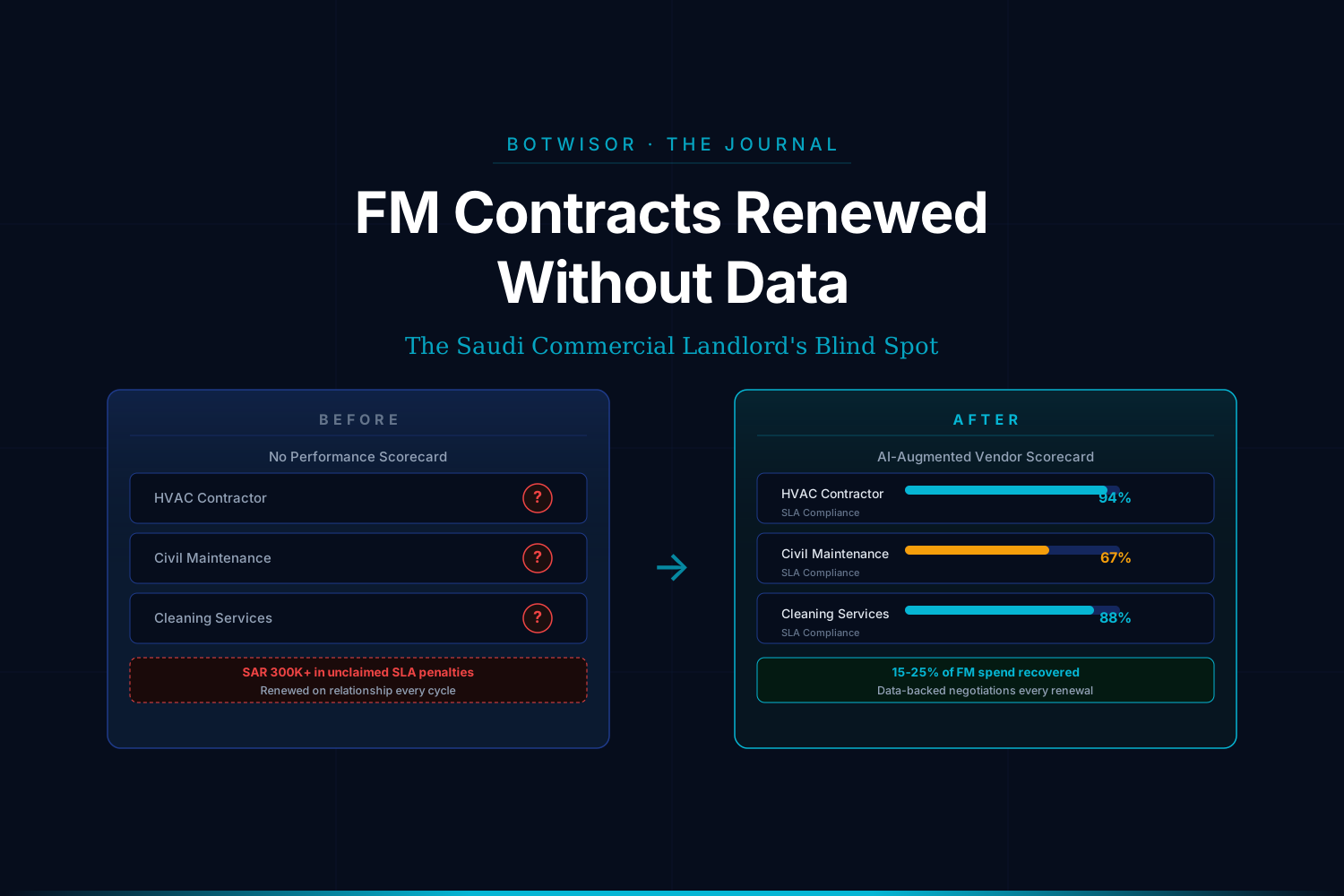
Saudi Commercial Landlords Are Renewing FM Contracts They Have Never Scored
Most Saudi commercial landlords renew facility management contracts based on contract expiry dates and relationship inertia, not performance data. Without a vendor scorecard, SLA breaches go undetected, penalties are never levied, and renewal negotiations start from weakness. Operators who close this gap typically recover 15 to 25 percent of FM spend within the first year.
What Is Facility Management Vendor Scoring?
Facility management in Saudi commercial real estate covers a wide mandate: HVAC, electrical, civil maintenance, cleaning, security, lifts, and fire suppression systems, often split across specialist contractors or consolidated under a single integrated FM provider. The total FM spend for a mid-size Riyadh office tower or regional mall typically runs SAR 4M to SAR 10M per year. For larger assets in Al Khobar or Jeddah with high occupancy density, the number climbs further.
A vendor scorecard is a continuous record of contractor performance against the KPIs written into the FM contract: call response times, resolution rates, recurring fault rates, inspection pass rates, tenant complaint volumes, and invoice accuracy. It is not a form filled out once a year before renewal. It is operational data captured throughout the contract term and aggregated into a format the asset manager can use in a negotiation.
In markets where this practice is standard, asset managers enter renewal discussions holding documented evidence spanning the full contract term. In Saudi commercial real estate, most operators still open that meeting with a paper contract and a subjective impression.
How Saudi Commercial Property Teams Track FM Vendors Today
The operational pattern is consistent across most Saudi commercial property owners.
An FM contract is signed for one, two, or three years with SLA schedules attached. Maintenance requests arrive through WhatsApp groups, the building reception desk, or a disconnected helpdesk system. Some requests are logged in the property management platform; others are handled through verbal instruction and never recorded.
At renewal time, a property manager retrieves the original agreement, checks the invoice history, and schedules a meeting with the vendor. The conversation turns on three implicit questions: Did the vendor cause a visible crisis? Has the cost risen beyond the market rate? Is there a better alternative available right now?
Whether the vendor met its contracted response times 60 percent of the time or 95 percent of the time over the past two years is not formally known by either party sitting at that table. Penalty clauses exist in nearly every Saudi FM contract, typically 2 to 5 percent of the monthly invoice per unresolved call past the SLA window, but they are rarely invoked because no system has logged the breach in real time.
The result is not negligence. It is the predictable outcome of managing FM vendor relationships without a performance-tracking infrastructure.
Where the Cost Accumulates
When an FM vendor is never formally scored, financial leakage builds in three places.
Unrecovered SLA penalties. A Riyadh commercial property with an annual FM contract value of SAR 6M likely accumulates SAR 120K to SAR 300K in legitimate penalty exposure each year, based on typical SLA breach rates documented in the sector. Without timestamped breach logs, the property team has no documented basis for a deduction. The vendor invoices at full value and is paid in full.
Renewal premiums paid to underperformers. Vendors know that landlords without performance data rarely switch at renewal. An FM contractor who has quietly breached response SLAs 30 percent of the time for two years still presents a price increase at renewal and often receives it, because the landlord cannot produce a counter-argument backed by evidence. The negotiation is symmetric in a way that should not be: the vendor knows its own operational data; the landlord does not.
Tenant escalation cost. Unresolved FM failures reach tenants before they reach the asset manager. In a Grade A Riyadh office building or a regional retail mall, persistent HVAC issues, slow lift response, or recurring common-area cleaning failures generate formal complaints, lease renegotiation leverage, and, in sustained cases, early exits. Each tenant exit in a quality commercial asset costs the landlord SAR 200K to SAR 800K in rent-free periods, fit-out contributions, and void periods before replacement.
These three cost categories compound over the term of a multi-year FM contract. Across a portfolio of five to ten assets, the aggregate exposure is material.
Before vs. After: FM Contract Management
| Dimension | Manual FM Tracking | AI-Augmented FM Tracking |
|---|---|---|
| SLA data source | Informal logs, memory | Automated from ticket system |
| Breach detection | Reactive, after tenant escalation | Real-time, at SLA threshold |
| Penalty invoicing | Rarely raised | Triggered on breach confirmation |
| Renewal preparation | One to two weeks of manual assembly | Scorecard generated in minutes |
| Vendor negotiation posture | Subjective impression | 24-month quantified record |
| Tenant complaint linkage | Disconnected from FM data | Mapped to vendor and SLA window |
| FM spend forecast accuracy | Low | High, based on breach trend data |
The shift does not require replacing the FM vendor or the property management software. It requires instrumenting the vendor relationship so the landlord holds the operational data.
What the After Looks Like
A commercial property operation with AI-augmented FM tracking works differently at every stage of the vendor lifecycle.
During contract operation: every maintenance request is logged, timestamped, and assigned a resolution target drawn from the SLA schedule. The system monitors open calls against the SLA clock. When a call ages past the contracted response window, it is flagged automatically. The property team receives a weekly compliance summary for each vendor: response rate, resolution rate, repeat-call rate, and tenant complaint index. Problems surface at the incident level, not after they have compounded into a crisis.
At quarter-end: an automated statement of SLA breaches is generated, cross-referenced against the penalty clause in the contract, and sent to the vendor for acknowledgment. Most vendors settle the penalty deduction without formal dispute, because the breach record is timestamped, verifiable, and aligns with the job-log system they operate from. The conversation shifts from confrontational to administrative.
At renewal: the asset manager opens the meeting with a 24-month vendor scorecard covering every KPI in the contract. The discussion moves from "we are generally satisfied with your service" to "your response rate on electrical calls was 73 percent in Q3 and Q4 against a contracted 95 percent. What is your mitigation plan, and what credit are you offering as part of this renewal?" That shift in posture changes the renewal outcome. It also changes which vendors bid the next cycle, once the market understands that this landlord tracks performance.
Why Vision 2030-Era Portfolios Cannot Keep Running on Informal Tracking
The commercial real estate market in Saudi Arabia is in structural expansion. NEOM, Diriyah, Qiddiya, and the Red Sea Project will require facility management at a scale and specification that relationship-based informal tracking cannot support. Institutional investors and REITs entering Saudi commercial real estate already expect FM performance reporting as part of standard asset due diligence. A landlord who cannot produce a vendor scorecard is signaling operational immaturity to buyers and investors who are reading that signal.
REGA's regulatory scope over commercial property management is also expanding. Operators who build data infrastructure now, while it is optional, will be better positioned for the compliance and reporting environment ahead.
The operators scaling into Vision 2030-adjacent commercial portfolios need FM management systems that can hold vendors accountable across dozens of assets and thousands of service calls per month. Informal tracking does not scale. A scorecard system does.
The Starting Point Is Simpler Than Most Operators Expect
Most Saudi commercial property teams do not need to replace their FM vendor, their property management software, or their operations staff. The data already exists: in helpdesk tickets, WhatsApp threads, inspection reports, and vendor invoices. The gap is a structured layer that captures this data as it flows, measures it against contract SLAs in real time, and produces a scorecard the asset manager can act on.
That infrastructure does not take a year to build. The first vendor scorecard can run within weeks of connecting the existing data sources. The recovery from unrecovered SLA penalties in the first contract cycle typically more than covers the implementation cost.
The question is not whether the data is available. It is whether the landlord is currently in a position to use it.
Book a free automation audit to see which FM data your operation already captures and where the first scorecard opportunity sits.