
The Journal
The Early-Payment Discount Saudi Retailers Never Claim
Most Saudi retail chains leave early-payment discounts uncollected because manual invoice queues outlast the discount window. This is a measurable, recurring margin drain, not a one-time accounting error.
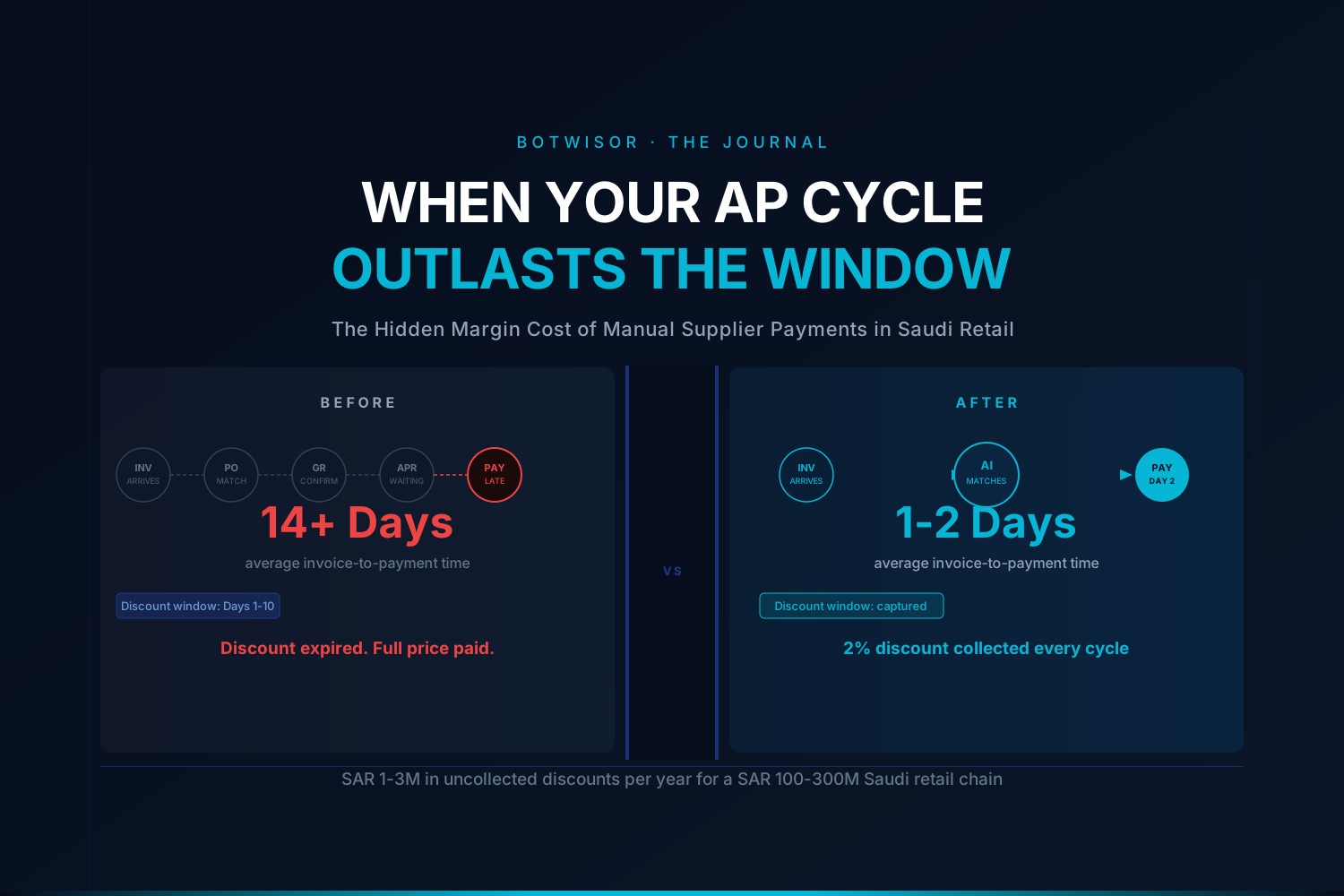
Most Saudi retail chains have negotiated early-payment discount terms with their suppliers but collect them rarely, if at all. When invoice approval runs through manual queues, payment windows close before finance can act. The result is a recurring, predictable margin drain that rarely surfaces as a line item on anyone's P&L, and almost never gets fixed because no one is measuring it.
What Early-Payment Discounts Are, and Why They Vanish
Early-payment discounts, sometimes called prompt-payment terms, are offers from suppliers: pay early and pay less. A common structure is "2/10 net 30," meaning pay within 10 days of the invoice date and deduct 2% from the total; otherwise the full amount is due within 30 days.
For a Saudi retail chain paying SAR 80 million annually in supplier invoices, a 2% discount on half of those invoices is SAR 800,000 per year. That is not a rounding error. It is a budget line that most finance teams have never measured, because no reporting system tracks what was never collected.
The terms exist. Saudi procurement teams have already done the work of negotiating them. The problem is not the contract. The problem is that the operational process cannot deliver payment in time to use the terms.
How the Manual Queue Kills the Discount Window
An invoice arrives, usually by email, occasionally by paper, and enters a processing queue. Someone needs to match it against an open purchase order, confirm a goods receipt from the warehouse, route it through an approval chain, and release it to the payment run. Each handoff has a human in the middle.
The procurement officer is in a meeting. The warehouse supervisor enters the goods receipt two days after delivery. The finance director approves on the Monday after returning from a site visit to a new branch in Jeddah. A reference number mismatch sends the invoice back for correction and it sits in someone's inbox for three more days.
In a well-run manual process, invoice-to-payment approval takes eight to fourteen days. In a typical multi-branch Saudi retail operation, it takes longer when approvers are traveling, when paper documentation arrives from branches, or when a system exception waits for a human to notice it.
The early-payment discount window is ten days.
When the invoice clears on day twelve or day seventeen, the window has expired. Finance pays the full amount. The transaction is recorded as settled. No flag appears because nothing has technically gone wrong. The P&L shows what was paid; it says nothing about what could have been deducted.
Counting What Saudi Retail Chains Are Missing
The arithmetic is straightforward, even when the data is not tracked.
| Annual Supplier Spend | Discount-Eligible Share | Average Discount Rate | Uncollected per Year |
|---|---|---|---|
| SAR 80M | 40% | 1.5% | SAR 480K |
| SAR 100M | 50% | 2% | SAR 1M |
| SAR 200M | 50% | 2% | SAR 2M |
| SAR 300M | 55% | 2% | SAR 3.3M |
These figures repeat every quarter, every year, as long as the manual queue persists. They do not appear on a variance report because the budget never included early-payment discount capture as a target line item. There is nothing to report against when the metric was never defined.
For a Saudi retail finance team managing pressure from rising logistics costs, increasing commercial rents in Riyadh and Jeddah, and the margin compression that comes with competitive consumer pricing, SAR 1 to 3 million in annual uncollected discounts is not an abstraction. It is the cash equivalent of opening an additional store on favorable terms, or funding a meaningful portion of a digital commerce platform build.
The negotiating work has already been done. The discount is already agreed. The only remaining task is paying on time, and the manual process cannot execute it consistently.
Before and After: What the AP Cycle Looks Like
The difference between manual and automated AP is not headcount. It is where time disappears in the process.
Before: Manual Accounts Payable
Invoices arrive across email, supplier portals, and paper. An AP clerk pulls the corresponding purchase order from the ERP and the goods receipt note from the warehouse system manually. Three-way matching is a human task. Exceptions, which can be a reference number mismatch, a quantity variance, or a missing goods receipt, go back to buyers or warehouse teams via email and wait for a response. Approval routing follows an email chain or an ERP workflow that still requires manual triggers. Payment runs are batched weekly or biweekly. Discount-eligible invoices sit in the same queue as everything else; no system knows or cares that one invoice has a 10-day window while another has 30.
After: AI-Augmented Accounts Payable
The system reads incoming invoices electronically, structured or unstructured. Three-way matching runs automatically for standard invoices. Exceptions are flagged, categorized, and routed to the relevant person within hours rather than days. Discount-eligible invoices are identified immediately on receipt and escalated in the approval queue with a time stamp showing when the window closes. Payment runs execute on a daily cadence for time-sensitive items. Finance manages exceptions. Standard invoices clear in one to two days.
The practical outcome: the 10-day discount window becomes reachable for most invoices. Discounts that were structurally uncollectable under the manual process become routine captures under the automated one.
The Supplier Relationship Dimension
Saudi retail procurement does not operate on contract terms alone. Supplier allocation decisions, particularly for high-demand SKUs during Ramadan, Eid al-Adha, National Day, and back-to-school promotional periods, are influenced by commercial relationship quality.
A retail chain that consistently pays on time or early occupies a different tier than one that pays in the final days of the 30-day window. When stock is constrained, whether because of a supply disruption, a port delay, or a Ramadan surge that caught a supplier under-stocked, allocation decisions reflect relationship history.
This is a second-order cost of slow AP that almost never appears in a finance report: the product line that could not be stocked at a key promotional window because a supplier quietly allocated inventory to a customer with a better payment record. It is harder to quantify than a missed discount percentage, but it is real and it compounds.
Systematic early payment, made consistent through automation, shifts a retail chain into a different tier of supplier relationship over time. It is a commercial advantage that does not require renegotiating contracts. It requires executing reliably on the ones that already exist.
The Reporting Blind Spot
The structural reason most Saudi retail finance teams do not act on this is not intent. It is measurement. What you do not collect is never recorded. The P&L shows payments made. Variance reports compare actuals to budget. But no budget line captures early-payment discount opportunity, so there is nothing to variance against.
Manual AP is designed to confirm that invoices were paid correctly. It is not designed to track the delta between what was paid and what could have been paid with a faster process. The metric does not exist until someone builds a system to create it, and building it manually means reconciling data across an ERP, a procurement platform, a warehouse management system, and the email chains where approvals spent their time.
When AP processing is automated, that data flows through a single pipeline. The system records every discount-eligible invoice, every window that closed before payment cleared, and the cumulative value of uncollected deductions. Finance sees for the first time what the manual process was costing each month. The number is often a surprise.
Vision 2030 is driving retail expansion across Saudi Arabia, from new mall developments in secondary cities to e-commerce infrastructure investment that is bringing new supplier categories and new invoice volumes into the picture. More supplier relationships, more invoices, and more discount windows mean more leverage from capturing early-pay terms. The cost of missing them scales with the business.
If you want to understand how much early-payment discount your chain is leaving uncollected and what it would take to recover it, a BotWisor automation audit maps the current AP cycle, sizes the discount opportunity, and identifies where the time is going. No cost, no obligation.